




Probing adsorption and aggregation of insulin at a poly(acrylic acid) brush
文献信息
发布日期
2010-02-09
DOI
10.1039/B925134K
影响因子
3.676
作者
Florian Evers, Christian Reichhart, Roland Steitz, Metin Tolan, Claus Czeslik
查看原文
摘要
A planar poly(acrylic acid) (PAA) brush provides an unusual substrate for the unspecific immobilization of proteins on material surfaces. At neutral pH-values, proteins adsorb at a PAA brush when the ionic strength of the protein solution is low. In contrast, raising the ionic strength to a few 100 mM transforms a PAA brush into a rather protein-resistant surface coating. Moreover, a PAA brush represents a mild environment for adsorbed proteins which preserves their secondary structure and biological activity. In this study, we focus on the biocompatibility of a PAA brush with an insulin solution. Insulin can form amyloid fibrils, which may also be triggered by interfaces. Using neutron reflectometry and attenuated total reflection-Fourier transform infrared (ATR-FTIR) spectroscopy, the effects of pD value, ionic strength, and glycerol concentration on the density profile and the secondary structure of adsorbed insulin molecules at a PAA brush have been studied. At pD 7, insulin adsorbs at a PAA brush despite its negative net charge. As has been found for other proteins in earlier studies, increasing the ionic strength of the insulin solution to 500 mM decreases the amount of adsorbed insulin drastically. In contrast, at pD 2, addition of salt to the insulin solution induces a thick insulin adsorbate at a PAA brush suggesting both protein–brush and protein–protein interactions, i.e., insulin adsorption and aggregation to be effective. However, in the presence of 2 M glycerol, insulin adsorption is largely suppressed. Furthermore, no major alterations of the secondary structure of adsorbed insulin can be detected by ATR-FTIR spectroscopy under all conditions studied. Hence, the performed experiments demonstrate that a PAA brush does not promote the formation of insulin amyloid structures, which represents a fundamentally new aspect of the biocompatibility of this material surface coating.
相关文献
Synthesis of bis(bora)calix[4]arenes bearing perfluoroaryl substituents
Carl Redshaw, Mark R. J. Elsegood
2005-09-07
Communication
DOI: 10.1039/B509556E
First EXAFS studies on aurophilic interactions in solution
Héctor de la Riva, Aranzazu Pintado-Alba, Mark Nieuwenhuyzen, Christopher Hardacre, M. Cristina Lagunas
2005-09-08
Communication
DOI: 10.1039/B508863A
Direct asymmetric aldol-Tishchenko reaction of aliphatic ketones catalyzed by syn-aminoalcohol–Yb(iii) complexes
Jacek Mlynarski, Joanna Jankowska, Bartosz Rakiel
2005-08-30
Communication
DOI: 10.1039/B509505K
Plasma-promoted dielectric heating in the microwave synthesis of spinels
David J. Brooks, Richard E. Douthwaite, Lisa J. Gillie
2005-09-05
Communication
DOI: 10.1039/B506569K
One-dimensional coordination polymers containing penta-supertetrahedral sulfide clusters linked by dipyridyl ligands
Jingli Xie, Xianhui Bu, Nanfeng Zheng, Pingyun Feng
2005-09-13
Communication
DOI: 10.1039/B508470A
Highly effective phosphate electrochemical sensor based on tetrathiafulvalene
Wei Xu, Deqing Zhang, Daoben Zhu
2005-08-19
Communication
DOI: 10.1039/B509133K
Rhodium-catalyzed tandem cyclization–cycloaddition reactions of enynebenzaldehydes: construction of polycyclic ring systems
Seunghoon Shin, Arun Kumar Gupta, Chul Yun Rhim, Chang Ho Oh
2005-07-29
Communication
DOI: 10.1039/B506003F
Efficient nickel catalyst for coupling of acetonitrile with aldehydes
Lei Fan, Oleg. V. Ozerov
2005-08-08
Communication
DOI: 10.1039/B505778G
您可能还喜欢
化合物问答
如何处理含有8-氯咪唑并[1,2-A]吡嗪(CAS号:69214-33-1)的废料?
处理含有8-氯咪唑并[1,2-A]吡嗪的废料时,应首先将其收集并进行化学回收或降解。如果无法回收,需采用安全的化学处理方法,如中和、氧化还原或沉淀。处理过程中需...
69214-33-18-chloroimidazo[1,2-...
化合物问答
Calhex 231 hydrochloride(CAS号:2387505-78-2)适用哪些法规指南?
Calhex 231 hydrochloride 需要遵循《全球化学品统一分类和标签制度》(GHS)的分类和标签要求,以及欧盟的《化学品注册、评估、授权和限制条...
2387505-78-24-Chloro-N-[(1S,2S)-...
化合物问答
11-Beta,17-alpha,21-三羟基-5-beta-孕烯-3,20-二酮(CAS号:1482-50-4)的物理化学性质是什么?
11-Beta,17-alpha,21-三羟基-5-beta-孕烯-3,20-二酮是一种无色结晶性粉末,分子量为372.45 g/mol。该化合物在水中的溶解度...
1482-50-45β-Dihydrocortisol
化合物问答
处理5-异丙基-1,3,4-恶二唑-2-羧酸(CAS号:944907-13-5)时应注意哪些实验室安全事项?
处理5-异丙基-1,3,4-恶二唑-2-羧酸时应注意以下安全事项:穿戴适当的个人防护装备,包括实验室外套、手套和护目镜;操作应在通风橱中进行,以减少吸入或接触有...
944907-13-55-Isopropyl-1,3,4-ox...
化合物问答
benzyl 3-bromopropanoate(CAS号:90841-55-7)安全吗?
Benzyl 3-bromopropanoate属于有毒物质,吸入、摄入或皮肤接触均可能对人体造成伤害。操作时应佩戴防护眼镜、口罩和手套,避免吸入蒸汽和直接接触...
90841-55-7Benzyl 3-bromopropan...
化合物问答
什么是(R)-N-苄氧羰基-3,4-二氢-1H-异喹啉羧酸(CAS号:151004-88-5)?
(R)-N-苄氧羰基-3,4-二氢-1H-异喹啉羧酸是一种含有苄氧羰基和异喹啉环结构的化合物,分子式为C17H15NO3。它是一种有机化合物,具有一定的生物活性...
151004-88-5(1R)-2-[(Benzyloxy)c...
化合物问答
在合成中是否有1-苄基吡啶嗡-3-羧酸盐(CAS号:15990-43-9)的替代品?
可以考虑使用1-苄基吡啶-3-羧酸盐作为1-苄基吡啶嗡-3-羧酸盐的替代品。此外,还可以探索其他类似物,如1-苄基吡啶-3-氨基甲酸酯等。具体的替代品选择需根据...
15990-43-91-Benzyl-3-pyridiniu...
化合物问答
(2,6-二甲基吡啶-3-基)甲醇(CAS号:582303-10-4)安全吗?
(2,6-二甲基吡啶-3-基)甲醇在使用时需注意安全,应避免吸入其蒸汽,接触皮肤和眼睛。操作应在通风良好的环境中进行,佩戴适当的个人防护装备。
582303-10-4(2,6-Dimethyl-3-pyri...
化合物问答
5-溴-2-乙烯基吡啶(CAS号:226883-52-9)的物理化学性质是什么?
5-溴-2-乙烯基吡啶是一种有机化合物,外观为白色固体,具有良好的结晶性。分子量约为190.03 g/mol。它的溶解性在水中较差,但在有机溶剂如二氯甲烷、甲醇...
226883-52-95-Bromo-2-vinylpyrid...
化合物问答
2-羟基-3-硝基-5-甲基吡啶(CAS号:7464-14-4)应用于哪些行业?
2-羟基-3-硝基-5-甲基吡啶主要应用于医药、聚合物和半导体行业。在医药领域,它可以用作合成其他药物的中间体。在聚合物领域,它可以作为功能性单体参与聚合反应,...
7464-14-45-Methyl-3-nitro-2(1...
来源期刊
Physical Chemistry Chemical Physics

CiteScore:
5.5
自引率:
10.3%
年发文量:
3036
Physical Chemistry Chemical Physics (PCCP) is an international journal co-owned by 19 physical chemistry and physics societies from around the world. This journal publishes original, cutting-edge research in physical chemistry, chemical physics and biophysical chemistry. To be suitable for publication in PCCP, articles must include significant innovation and/or insight into physical chemistry; this is the most important criterion that reviewers and Editors will judge against when evaluating submissions. The journal has a broad scope and welcomes contributions spanning experiment, theory, computation and data science. Topical coverage includes spectroscopy, dynamics, kinetics, statistical mechanics, thermodynamics, electrochemistry, catalysis, surface science, quantum mechanics, quantum computing and machine learning. Interdisciplinary research areas such as polymers and soft matter, materials, nanoscience, energy, surfaces/interfaces, and biophysical chemistry are welcomed if they demonstrate significant innovation and/or insight into physical chemistry. Joined experimental/theoretical studies are particularly appreciated when complementary and based on up-to-date approaches.
推荐化合物
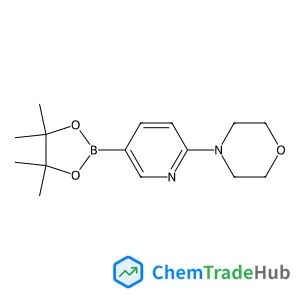
4-(5-(4,4,5,5-tetramethyl-1,3,2-dioxaborolan-2-yl)pyridin-2-yl)morpholine
CAS号:
485799-04-0
分子式:
C15H23BN2O3
推荐供应商





免责声明
本页面提供的学术期刊信息仅供参考和研究使用。我们与任何期刊出版商均无关联,也不处理投稿事宜。如有投稿相关咨询,请直接联系相关期刊出版商。
如发现页面信息有误,请发送邮件至 support@chemtradehub.com 联系我们。我们将及时核实并处理您的问题。