


Bioorganic Chemistry
基本信息
期刊简写:
BIOORG CHEM
影响因子:
4.5
ISSN:
0045-2068
研究领域:
CHEMICAL
h-index:
50
自引率:
6.7%
年发文量:
614
SCI收录来源:
Science Citation Index Expanded
期刊官网:
https://www.sciencedirect.com/journal/bioorganic-chemistry
期刊介绍:
Bioorganic Chemistry publishes research that addresses biological questions at the molecular level, using organic chemistry and principles of physical organic chemistry. The scope of the journal covers a range of topics at the organic chemistry-biology interface, including: enzyme catalysis, biotransformation and enzyme inhibition; nucleic acids chemistry; medicinal chemistry; natural product chemistry, natural product synthesis and natural product biosynthesis; antimicrobial agents; lipid and peptide chemistry; biophysical chemistry; biological probes; bio-orthogonal chemistry and biomimetic chemistry. For manuscripts dealing with synthetic bioactive compounds, the Journal requires that the molecular target of the compounds described must be known, and must be demonstrated experimentally in the manuscript. For studies involving natural products, if the molecular target is unknown, some data beyond simple cell-based toxicity studies to provide insight into the mechanism of action is required. Studies supported by molecular docking are welcome, but must be supported by experimental data. The Journal does not consider manuscripts that are purely theoretical or computational in nature. The Journal publishes regular articles, short communications and reviews. Reviews are normally invited by Editors or Editorial Board members. Authors of unsolicited reviews should first contact an Editor or Editorial Board member to determine whether the proposed article is within the scope of the Journal. Benefits to authors We also provide many author benefits, such as a liberal copyright policy, special discounts on Elsevier publications and much more. Please click here for more information on our author services. Please see our Guide for Authors for information on article submission. If you require any further information or help, please visit our Support Center
CiteScore
CiteScore
9.7
SJR
0.745
SNIP
1.137
| 学科 | 排名 | 百分位 |
|---|---|---|
ChemistryOrganic Chemistry |
17 / 211 | 92% |
期刊统计
Bimonthly
期/年
Time to first decision: 8days
Review time: 66days
Submission to acceptance: 81days
Acceptance to publication: 5days
审稿周期
$4100
论文处理费
投稿信息
投稿网址:
https://www.editorialmanager.com/BIOORG相关文献
Theoretical study of rhodium- and cobalt-catalyzed decarboxylative transformations of isoxazolones: origin of product selectivity
Wei Rong, Tian Zhang, Ting Li, Juan Li
2021-01-26
Research Article
DOI: 10.1039/D0QO01498B
An electrochemical perspective on the roles of ligands in the merger of transition-metal catalysis and electrochemistry
Jun-Song Zhong, Yi Yu, Zhaojiang Shi, Ke-Yin Ye
2020-12-28
Review Article
DOI: 10.1039/D0QO01227K
Dioxygenase-catalysed oxidation of monosubstituted thiophenes: sulfoxidation versus dihydrodiol formation
Derek R. Boyd, Narain D. Sharma, Nimal Gunaratne, Simon A. Haughey, Martina A. Kennedy, John F. Malone, Christopher C. R. Allen, Howard Dalton
2003-02-24
Paper
DOI: 10.1039/B300867N
Experimental and quantum-mechanical investigation of the vinylsilane-iminium ion cyclization
Lisbet Kværnø, Per-Ola Norrby, David Tanner
2003-02-24
Paper
DOI: 10.1039/B212333A
Facile access to benzofuran-fused tetrahydropyridines via catalytic asymmetric [4 + 2] cycloaddition of aurone-derived 1-azadienes with 3-vinylindoles
Guang-Jian Mei
2021-01-05
Research Article
DOI: 10.1039/D0QO01236J
Using combinatorial methods to arrive at a quantitative structure–stability relationship for a new class of one-armed cationic peptide receptors targeting the C-terminus of the amyloid β-peptide
Carsten Schmuck, Martin Heil
2003-01-27
Paper
DOI: 10.1039/B211425A
The use of enantiomerically pure ketene dithioacetal bis(sulfoxides) in highly diastereoselective intramolecular nitrone cycloadditions. Application in the total synthesis of the β-amino acid (−)-cispentacin and the first asymmetric synthesis of cis-(3R,4R)-4-amino-pyrrolidine-3-carboxylic acid
Varinder K. Aggarwal, Stephen Roseblade, Rikki Alexander
2003-01-30
Paper
DOI: 10.1039/B212719A
Site-specific solvation determined by intermolecular nuclear Overhauser effect—measurements and molecular dynamics
Manuel Angulo, Christoph Hawat, Hans-Jörg Hofmann, Stefan Berger
2003-02-13
Paper
DOI: 10.1039/B211134A
您可能还喜欢
化合物问答
4-[4-三氟甲基苯基]恶唑(CAS号:1126636-40-5)通常如何合成?
4-[4-三氟甲基苯基]恶唑通常通过将4-三氟甲基苯酚与异硫氰酸苯酯在有机溶剂中进行酯化反应合成。该反应可在无水条件下,使用适当的催化剂,如四丁基氢氧化铵,以提...
1126636-40-54-(4-(Trifluoromethy...
59729-32-71-[3-(Dimethylamino)...
化合物问答
RockPhos Pd G3(CAS号:2009020-38-4)通常如何合成?
RockPhos Pd G3 通常通过钯催化偶联反应合成,使用配体 (2'-Amino-2-biphenylyl)(methanesulfonato-kappa...
2009020-38-4(2'-Amino-2-biphenyl...
化合物问答
1-哌啶甲酰胺(CAS号:2158-03-4)的市场或研究趋势如何?
1-哌啶甲酰胺作为有机合成中的重要中间体,其市场需求主要受医药、农药、染料等行业推动。近年来,随着新药开发和绿色化学的发展,该化合物的研究趋势集中在开发更高效、...
2158-03-41-Piperidinecarboxam...
化合物问答
2-(二苯基膦基)乙胺(CAS号:4848-43-5)适用哪些法规指南?
2-(二苯基膦基)乙胺适用于多种法规指南,包括但不限于《全球化学品统一分类和标签制度》(GHS),欧盟《化学品注册、评估、授权和限制》法规(REACH),以及美...
4848-43-52-(Diphenylphosphino...
化合物问答
如何储存间苯二甲酸二烯丙酯(CAS号:1087-21-4)?
间苯二甲酸二烯丙酯应储存在阴凉、干燥、通风良好的地方,远离火源和热源。储存容器应密封,避免光照和高温。储存温度应控制在25℃以下,相对湿度应低于80%。避免与其...
1087-21-4Diallyl isophthalate
化合物问答
什么是间甲苯异硫代异氰酸酯(CAS号:621-30-7)?
间甲苯异硫代异氰酸酯是一种有机化合物,分子式为C7H7NO2S,具有刺激性气味。它是一种重要的有机合成中间体,在合成其他化合物时广泛应用。
621-30-71-Isothiocyanato-3-m...
化合物问答
在合成中是否有N-Boc-D-苯丙氨醇(CAS号:106454-69-7)的替代品?
在合成中,可以考虑使用N-Cbz-D-苯丙氨醇或N-Fmoc-D-苯丙氨醇作为替代品。这些化合物同样具有保护氨基的功能,且在合成过程中表现出良好的反应性能。
106454-69-72-Methyl-2-propanyl ...
化合物问答
3-羟甲基-2-氧异丙基吡啶(CAS号:954240-50-7)的主要用途是什么?
3-羟甲基-2-氧异丙基吡啶主要用于有机合成领域,可以作为合成其他药物、农药或精细化学品的中间体。此外,它还可能在实验室研究中作为特定反应的前体或溶剂。
954240-50-7(2-Isopropoxy-3-pyri...
化合物问答
6-氨基-9-甲基嘌呤(CAS号:700-00-5)应用于哪些行业?
6-氨基-9-甲基嘌呤目前主要应用于医药行业,作为某些药物的中间体。此外,它还可能用于聚合物、传感器和半导体的某些领域,作为功能性单体或掺杂剂。
700-00-59-Methyl-9H-purin-6-...
推荐化合物
![(S,S)-2-{1-Carboxy-2-[3-(3,5-dichloro-benzyl)-3H-imidazol-4-YL]-ethylamino}-4-methyl-pentanoic acid structure](https://cnstatic.chemtradehub.com/structs/305/305335-31-3-1724.webp "(S,S)-2-{1-Carboxy-2-[3-(3,5-dichloro-benzyl)-3H-imidazol-4-YL]-ethylamino}-4-methyl-pentanoic acid structure")
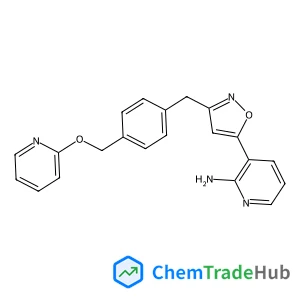
3-(3-(4-((Pyridin-2-yloxy)methyl)benzyl)isoxazol-5-yl)pyridin-2-amine
CAS号:
936339-60-5
分子式:
C21H18N4O2
![Sodium 4-{2-[(E)-2-{(3E)-3-{(2E)-2-[3,3-dimethyl-1-(4-sulfonatobutyl)-1,3-dihydro-2H-indol-2-ylidene]ethylidene}-2-[(4-isothiocyanatophenyl)sulfanyl]-1-cyclohexen-1-yl}vinyl]-3,3-dimethyl-3H-indolium-
1-yl}-1-butanesulfonate structure](https://cnstatic.chemtradehub.com/structs/152/152111-91-6-e5df.webp "Sodium 4-{2-[(E)-2-{(3E)-3-{(2E)-2-[3,3-dimethyl-1-(4-sulfonatobutyl)-1,3-dihydro-2H-indol-2-ylidene]ethylidene}-2-[(4-isothiocyanatophenyl)sulfanyl]-1-cyclohexen-1-yl}vinyl]-3,3-dimethyl-3H-indolium-
1-yl}-1-butanesulfonate structure")
![(4-{[(2-Methyl-2-propanyl)oxy]methyl}phenyl)boronic acid structure](https://cnstatic.chemtradehub.com/structs/102/1024017-53-5-41c0.webp "(4-{[(2-Methyl-2-propanyl)oxy]methyl}phenyl)boronic acid structure")
推荐供应商





免责声明
本页面提供的学术期刊信息仅供参考和研究使用。我们与任何期刊出版商均无关联,也不处理投稿事宜。如有投稿相关咨询,请直接联系相关期刊出版商。
如发现页面信息有误,请发送邮件至 support@chemtradehub.com 联系我们。我们将及时核实并处理您的问题。