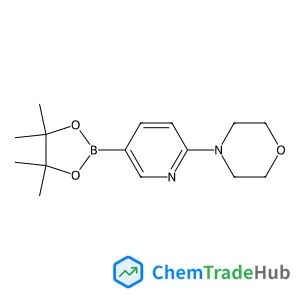
4-(5-(4,4,5,5-tetramethyl-1,3,2-dioxaborolan-2-yl)pyridin-2-yl)morpholine
CAS号:
485799-04-0
分子式:
C15H23BN2O3
Jorge N. Beltramini, Chun-Xiang Lin, Zhi-Ping Xu, G. Q. (Max) Lu, A. Tanksale
To convert glycerol, a by-product of biodiesel, into value-added fine chemicals is of great industrial and economic importance and represents a great challenge. This paper reports the influence of various metal elements (M = Ni, Zn, Cu, Co, etc.) incorporated into MgAl layered double hydroxide (LDH) materials used as catalysts for the liquid phase oxidation of glycerol to fine chemicals. The catalytic behaviour was also studied and discussed in terms of structure and texture of the synthesized materials that were determined using PXRD, FE-SEM, TEM, TG-DTA, FTIR, XPS and nitrogen adsorption–desorption isotherms. The results revealed that CuAlMg LDH materials are active in converting glycerol to glyceric acid (GLYAC) and formic acid, while yielding oxalic and hydroxyehthanoic acid. The selectivity to glyceric acid remarkably increased over Cu-containing catalysts, compared with those over similar materials with the addition of Ni, Zn, Co metal elements. The increase of Cu content not only affects the catalyst activity but also the selectivity. Moreover, an improvement of activity and selectivity was found on calcined CuAlMg samples. The calcined catalysts, with a Cu : Al : Mg molar ratio of 20 : 100 : 200, exhibited superior performances with a 97.3% conversion of glycerol and a 70% glyceric acid selectivity. It was concluded that the nature of the metal added to the LDH structure, such as Cu as active sites, in combination with the chemical state and microenvironment in calcined and uncalcined materials significantly affects the catalytic performance of the synthesized catalysts in the liquid phase oxidation of glycerol in terms of product activity and distribution.
Russian Journal of Coordination Chemistry
Russian Journal of Organic Chemistry

Acta Materialia
Organic Process Research & Development

Journal of Natural Medicines
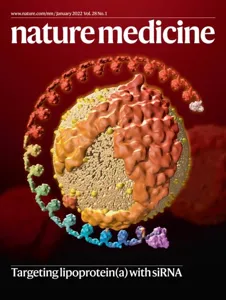
Nature Medicine

Chemical Communications
Saudi Pharmaceutical Journal
Current Opinion in Solid State & Materials Science
Russian Journal of Bioorganic Chemistry
François Stoffelbach, Rinaldo Poli
DOI: 10.1039/B409992C
Donald H. McCullough, III, Steven L. Regen
DOI: 10.1039/B410027C
Susannah J. Patey, Jeremy E. Turnbull
DOI: 10.1039/B411726C
Cédric Tard, Xiaoming Liu, David L. Hughes, Christopher J. Pickett
DOI: 10.1039/B411559G
Varinder K. Aggarwal, Mike Butters, Paul W. Davies
DOI: 10.1039/B300719G
Moonhyun Oh, Charlotte L. Stern, Chad A. Mirkin
DOI: 10.1039/B408084J
Max J. Cryle, Julia M. U. Stuthe, Paul R. Ortiz de Montellano, James J. De Voss
DOI: 10.1039/B315911F
Leilani L. Welbes, Robert C. Scarrow, A. S. Borovik
DOI: 10.1039/B408553A
Bas G. G. Lohmeijer, Daan Wouters, Zhihui Yin, Ulrich S. Schubert
DOI: 10.1039/B411777H
Le-Ping Liu, Min Shi
DOI: 10.1039/B412823K
处理含有8-氯咪唑并[1,2-A]吡嗪的废料时,应首先将其收集并进行化学回收或降解。如果无法回收,需采用安全的化学处理方法,如中和、氧化还原或沉淀。处理过程中需...
Calhex 231 hydrochloride 需要遵循《全球化学品统一分类和标签制度》(GHS)的分类和标签要求,以及欧盟的《化学品注册、评估、授权和限制条...
11-Beta,17-alpha,21-三羟基-5-beta-孕烯-3,20-二酮是一种无色结晶性粉末,分子量为372.45 g/mol。该化合物在水中的溶解度...
处理5-异丙基-1,3,4-恶二唑-2-羧酸时应注意以下安全事项:穿戴适当的个人防护装备,包括实验室外套、手套和护目镜;操作应在通风橱中进行,以减少吸入或接触有...
Benzyl 3-bromopropanoate属于有毒物质,吸入、摄入或皮肤接触均可能对人体造成伤害。操作时应佩戴防护眼镜、口罩和手套,避免吸入蒸汽和直接接触...
(R)-N-苄氧羰基-3,4-二氢-1H-异喹啉羧酸是一种含有苄氧羰基和异喹啉环结构的化合物,分子式为C17H15NO3。它是一种有机化合物,具有一定的生物活性...
可以考虑使用1-苄基吡啶-3-羧酸盐作为1-苄基吡啶嗡-3-羧酸盐的替代品。此外,还可以探索其他类似物,如1-苄基吡啶-3-氨基甲酸酯等。具体的替代品选择需根据...
(2,6-二甲基吡啶-3-基)甲醇在使用时需注意安全,应避免吸入其蒸汽,接触皮肤和眼睛。操作应在通风良好的环境中进行,佩戴适当的个人防护装备。
5-溴-2-乙烯基吡啶是一种有机化合物,外观为白色固体,具有良好的结晶性。分子量约为190.03 g/mol。它的溶解性在水中较差,但在有机溶剂如二氯甲烷、甲醇...
2-羟基-3-硝基-5-甲基吡啶主要应用于医药、聚合物和半导体行业。在医药领域,它可以用作合成其他药物的中间体。在聚合物领域,它可以作为功能性单体参与聚合反应,...

Catalysis Science & Technology is committed to publishing research reporting high-quality, cutting-edge developments across the catalysis community at large. The journal places equal focus on publications from the heterogeneous, homogeneous, thermo-, electro-, photo-, organo- and biocatalysis communities. Works published in the journal feature a balanced mix of fundamental, technology-oriented, experimental, computational, digital and data-driven original research, thus appealing to catalysis practitioners in both academic and industrial environments. Original research articles published in the journal must demonstrate new catalytic discoveries and/or methodological advances that represent a significant advance on previously published work, from the molecular to the process scales. We welcome rigorous research in a wide range of timely or emerging applications related to the environment, health, energy and materials. Catalysis Science & Technology publishes Communications, Articles, Reviews and Perspectives. More details regarding manuscript types may be found in the Information for Authors section.