



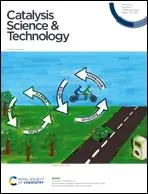
Catalysis Science & Technology
基本信息
期刊简写:
CATAL SCI TECHNOL
影响因子:
4.4
ISSN:
2044-4753
研究领域:
CHEMICAL
h-index:
86
自引率:
4.5%
年发文量:
600
SCI收录来源:
Science Citation Index Expanded
期刊官网:
http://pubs.rsc.org/en/Journals/JournalIssues/CY
期刊介绍:
Catalysis Science & Technology is committed to publishing research reporting high-quality, cutting-edge developments across the catalysis community at large. The journal places equal focus on publications from the heterogeneous, homogeneous, thermo-, electro-, photo-, organo- and biocatalysis communities. Works published in the journal feature a balanced mix of fundamental, technology-oriented, experimental, computational, digital and data-driven original research, thus appealing to catalysis practitioners in both academic and industrial environments. Original research articles published in the journal must demonstrate new catalytic discoveries and/or methodological advances that represent a significant advance on previously published work, from the molecular to the process scales. We welcome rigorous research in a wide range of timely or emerging applications related to the environment, health, energy and materials. Catalysis Science & Technology publishes Communications, Articles, Reviews and Perspectives. More details regarding manuscript types may be found in the Information for Authors section.
CiteScore
CiteScore
5.91
SJR
1.734
SNIP
1.214
| 学科 | 排名 | 百分位 |
|---|---|---|
Chemical EngineeringCatalysis |
9 / 54 | 84% |
期刊统计
期/年
Time to first decision (peer reviewed only): 31 days
审稿周期
£2,750
论文处理费
投稿信息
投稿网址:
http://mc.manuscriptcentral.com/cy收录体裁:
Communications
Full papers
Perspectives
Minireviews
Comments
Full papers
Perspectives
Minireviews
Comments
相关文献
Construction of core–shell MOF@COF hybrids with a Z-scheme heterojunction for efficient visible light photocatalysis
Jun Pang, Weijie Chen, Jintao Hu, Jie Cheng, Mingqiang Tang, Zewei Liu, Rong Tan
2023-10-02
Paper
DOI: 10.1039/D3CY00869J
ANbO3 (A = Na, K) and (A′ = Ca, Sr) composite oxides for oxidative coupling of methane and oxidative dehydrogenation of ethane: perovskite vs. layered perovskite
Junwei Xu, Xusheng Zhong, Rumeng Ouyang, Xiuzhong Fang, Xianglan Xu, Xiang Wang
2023-09-25
Paper
DOI: 10.1039/D3CY01055D
Highly selective hydroxylation of gaseous alkanes at the terminal position by wild-type CYP153A33
Yusaku Kodama, Shinya Ariyasu, Masayuki Karasawa, Yuichiro Aiba
2023-09-13
Paper
DOI: 10.1039/D3CY00752A
Kinetics and optimization studies of modified VPO/γ-Al2O3 catalyst prepared in situ for cross-aldol condensation
Xinpeng Guo
2023-09-22
Paper
DOI: 10.1039/D3CY00844D
Essential role of CO coverage in CO2 hydrogenation over Pt(111)
Yongjie Xi, Jia Wang, Jinlei Li
2023-09-25
Paper
DOI: 10.1039/D3CY01134H
Unravelling the chain growth mechanism in Cr/NNN-catalysed ethylene oligomerization
Jiale Peng, Mengyu Zhu, Long Chen, Zhen Liu
2023-08-07
Paper
DOI: 10.1039/D3CY00954H
Selective oxidation of substituted phenols with Co–N–C catalysts fabricated via low temperature heat treatment
Bairui Guo, Zhongtian Du, Xiaoyu Shen, Mengjing Han, Yanbin Zhao, Jingjie Luo
2023-08-09
Communication
DOI: 10.1039/D3CY00834G
Confinement effects over Ni-based catalysts for methane dry reforming
Chongchong Chen, Jiaojiao Wei, Yao Lu, Melis Seher Duyar, Yuanyuan Huang, Ling Lin, Runping Ye
2023-09-18
Minireview
DOI: 10.1039/D3CY00845B
From biomass to C4 chemicals: selective transformation of bio-based furans to succinic anhydride in the presence of oxygen
Xiaoqian Gao, Xinli Tong, RuiChen Liu, Yi Zhang
2023-09-22
Communication
DOI: 10.1039/D3CY01152F
New prodigiosin derivatives – chemoenzymatic synthesis and physiological evaluation against cisplatin-resistant cancer cells
Tim Moritz Weber, Alexandra Leyens, Lena Berning, Björn Stork
2023-09-21
Paper
DOI: 10.1039/D3CY00913K
您可能还喜欢
化合物问答
4-[4-三氟甲基苯基]恶唑(CAS号:1126636-40-5)通常如何合成?
4-[4-三氟甲基苯基]恶唑通常通过将4-三氟甲基苯酚与异硫氰酸苯酯在有机溶剂中进行酯化反应合成。该反应可在无水条件下,使用适当的催化剂,如四丁基氢氧化铵,以提...
1126636-40-54-(4-(Trifluoromethy...
59729-32-71-[3-(Dimethylamino)...
化合物问答
RockPhos Pd G3(CAS号:2009020-38-4)通常如何合成?
RockPhos Pd G3 通常通过钯催化偶联反应合成,使用配体 (2'-Amino-2-biphenylyl)(methanesulfonato-kappa...
2009020-38-4(2'-Amino-2-biphenyl...
化合物问答
1-哌啶甲酰胺(CAS号:2158-03-4)的市场或研究趋势如何?
1-哌啶甲酰胺作为有机合成中的重要中间体,其市场需求主要受医药、农药、染料等行业推动。近年来,随着新药开发和绿色化学的发展,该化合物的研究趋势集中在开发更高效、...
2158-03-41-Piperidinecarboxam...
化合物问答
2-(二苯基膦基)乙胺(CAS号:4848-43-5)适用哪些法规指南?
2-(二苯基膦基)乙胺适用于多种法规指南,包括但不限于《全球化学品统一分类和标签制度》(GHS),欧盟《化学品注册、评估、授权和限制》法规(REACH),以及美...
4848-43-52-(Diphenylphosphino...
化合物问答
如何储存间苯二甲酸二烯丙酯(CAS号:1087-21-4)?
间苯二甲酸二烯丙酯应储存在阴凉、干燥、通风良好的地方,远离火源和热源。储存容器应密封,避免光照和高温。储存温度应控制在25℃以下,相对湿度应低于80%。避免与其...
1087-21-4Diallyl isophthalate
化合物问答
什么是间甲苯异硫代异氰酸酯(CAS号:621-30-7)?
间甲苯异硫代异氰酸酯是一种有机化合物,分子式为C7H7NO2S,具有刺激性气味。它是一种重要的有机合成中间体,在合成其他化合物时广泛应用。
621-30-71-Isothiocyanato-3-m...
化合物问答
在合成中是否有N-Boc-D-苯丙氨醇(CAS号:106454-69-7)的替代品?
在合成中,可以考虑使用N-Cbz-D-苯丙氨醇或N-Fmoc-D-苯丙氨醇作为替代品。这些化合物同样具有保护氨基的功能,且在合成过程中表现出良好的反应性能。
106454-69-72-Methyl-2-propanyl ...
化合物问答
3-羟甲基-2-氧异丙基吡啶(CAS号:954240-50-7)的主要用途是什么?
3-羟甲基-2-氧异丙基吡啶主要用于有机合成领域,可以作为合成其他药物、农药或精细化学品的中间体。此外,它还可能在实验室研究中作为特定反应的前体或溶剂。
954240-50-7(2-Isopropoxy-3-pyri...
化合物问答
6-氨基-9-甲基嘌呤(CAS号:700-00-5)应用于哪些行业?
6-氨基-9-甲基嘌呤目前主要应用于医药行业,作为某些药物的中间体。此外,它还可能用于聚合物、传感器和半导体的某些领域,作为功能性单体或掺杂剂。
700-00-59-Methyl-9H-purin-6-...
推荐化合物
![4-Chloro-1-[(4-methylphenyl)sulfonyl]-1H-pyrrolo[2,3-b]pyridine structure](https://cnstatic.chemtradehub.com/structs/348/348640-05-1-7db8.webp "4-Chloro-1-[(4-methylphenyl)sulfonyl]-1H-pyrrolo[2,3-b]pyridine structure")
![(4-{[(2-Methyl-2-propanyl)oxy]methyl}phenyl)boronic acid structure](https://cnstatic.chemtradehub.com/structs/102/1024017-53-5-41c0.webp "(4-{[(2-Methyl-2-propanyl)oxy]methyl}phenyl)boronic acid structure")
![1,4-Dioxaspiro[4.5]dec-7-en-8-ylboronic acid structure](https://cnstatic.chemtradehub.com/structs/850/850567-90-7-6fff.webp "1,4-Dioxaspiro[4.5]dec-7-en-8-ylboronic acid structure")
推荐供应商




免责声明
本页面提供的学术期刊信息仅供参考和研究使用。我们与任何期刊出版商均无关联,也不处理投稿事宜。如有投稿相关咨询,请直接联系相关期刊出版商。
如发现页面信息有误,请发送邮件至 support@chemtradehub.com 联系我们。我们将及时核实并处理您的问题。