





Highly water repellent aerogels based on cellulose stearoyl esters
文献信息
发布日期
2011-05-03
DOI
10.1039/C0PY00309C
影响因子
5.582
作者
Mari Granström, Marjo Kettunen née Pääkkö, Hua Jin, Erkki Kolehmainen, Ilkka Kilpeläinen, Olli Ikkala
查看原文
摘要
Herein we combine in a novel way the physical effect of porous structure of a cellulosic aerogel with the chemical effect of long alkyl tails by a well known homogeneous green esterification method, to achieve purely bio-based and highly water repellent cellulosic materials. As an alternative for a traditional fluoro derivatized hydrophobization, here long fatty acid tails are utilized to lower the surface energy. To minimize the process emission, ionic liquid (IL) 1-allyl-3-methylimidazolium chloride is used for the esterification, due to its non-volatility and recyclability. We have shown here that low degree of substitution (DS) of the fatty acid cellulose material enables the spontaneous formation of aerogels. Additionally, the very low content of the long stearoyl tails combined with the porous aerogel structure resulted in significant increase in hydrophobicity from an aqueous contact angle of 0° up to 124°. We foresee that this approach can allow sustainable and completely bio-based coatings and insulators paving the way for a new green application potential for cellulose based materials.
相关文献
Large Rashba splitting, carrier mobility, and valley polarization in a 1T-SnS2/MoTe2 heterostructure
Sukai Teng, Jia Li, Xiujuan Mao, Fuli He, Ze Liu, Jiaxi Wang, Yafan Wang
2021-07-07
Paper
DOI: 10.1039/D1CP02039K
Theoretical study of the dissociative photodetachment dynamics of the hydrated superoxide anion cluster
Yu Hashimoto, Kohei Saito, Toshiyuki Takayanagi, Hiroto Tachikawa
2021-07-27
Paper
DOI: 10.1039/D1CP02379A
Ground and excited electronic structure analysis of XM4 (X = N, P and M = Li, Na) and their anions
2021-06-30
Paper
DOI: 10.1039/D1CP02273C
Enhanced photocatalytic activity, transport properties and electronic structure of Mn doped GdFeO3 synthesized using the sol–gel process
Ritwik Maity, Alo Dutta, Saswata Halder, Santiranjan Shannigrahi, Kalyan Mandal, T. P. Sinha
2021-07-22
Paper
DOI: 10.1039/D1CP00621E
Local structure and NO adsorption/desorption property of Pd2+ cations at different paired Al sites in CHA zeolite
Shunsaku Yasumura, Taihei Ueda, Hajime Ide, Katsumasa Otsubo, Chong Liu, Nao Tsunoji, Zen Maeno
2021-08-12
Paper
DOI: 10.1039/D1CP02668B
Designing nanoscale capacitors based on twin-graphene
Jyotirmoy Deb, Harkishan Dua, Utpal Sarkar
2021-07-12
Paper
DOI: 10.1039/D1CP02680A
Polymer network formation mechanism of multifunctional poly(ethylene glycol)s in ionic liquid electrolyte with a lithium salt
Asumi Ishikawa, Namie Ikeda, Shuichi Maeda, Kenta Fujii
2021-07-27
Paper
DOI: 10.1039/D1CP02710G
Photochemistry and UV/vis spectroscopy of hydrated vanadium cations, V+(H2O)n, n = 1–41, a model system for photochemical hydrogen evolution
Jakob Heller, Tobias F. Pascher, Dominik Muß, Christian van der Linde, Martin K. Beyer, Milan Ončák
2021-08-06
Paper
DOI: 10.1039/D1CP02382A
The growth of a large GdPO4 crystal guided by theoretical simulation and the study of its phonon properties
Xinghong Gong, Yujin Chen, Jianhua Huang, Yanfu Lin, Zundu Luo, Shuiquan Deng, Yidong Huang
2021-09-16
Paper
DOI: 10.1039/D1CP02977K
Low-frequency vibrational spectroscopy: a new tool for revealing crystalline magnetic structures in iron phosphate crystals
Zihui Song, Xudong Liu, Anish Ochani, Suling Shen, Qiqi Li, Yiwen Sun, Michael T. Ruggiero
2021-09-27
Communication
DOI: 10.1039/D1CP03424C
您可能还喜欢
化合物问答
2-(甲基磺酰基)嘧啶-5-胺(CAS号:56621-92-2)适用哪些法规指南?
该化合物适用的法规指南包括GHS(全球化学品统一分类和标签制度)分类为特定目标器官毒性-单次接触类别3;根据欧盟REACH法规,该化合物需要进行注册和评估;在美...
56621-92-22-(Methylsulfonyl)py...
化合物问答
在合成中是否有4-(4-氯苯基)-1H-咪唑(CAS号:35512-29-9)的替代品?
在合成中,可以考虑使用一些类似的化合物作为4-(4-氯苯基)-1H-咪唑的替代品,如4-(4-溴苯基)-1H-咪唑或4-(4-甲氧基苯基)-1H-咪唑。这些化合...
35512-29-94-(4-Chlorophenyl)-1...
化合物问答
什么是N~2~-甲基丙氨酸酰胺(CAS号:32012-16-1)?
N~2~-甲基丙氨酸酰胺是一种有机化合物,其化学名为2-(Methylamino)propanamide。它是一种酰胺类化合物,分子式为C4H10N2O,相对分...
32012-16-12-(Methylamino)propa...
化合物问答
如何处理含有N-苄基-3-氨基氧杂环丁烷草酸盐(CAS号:1956341-96-0)的废料?
处理含有N-苄基-3-氨基氧杂环丁烷草酸盐(CAS号:1956341-96-0)的废料时,应首先确保遵循相关法规要求,如GHS和REACH等。通常,废液应先进行...
1956341-96-0N-Benzyloxetan-3-ami...
化合物问答
4-bromo-2-chloro-6-methylbenzoic acid(CAS号:877149-07-0)的物理化学性质是什么?
4-溴-2-氯-6-甲基苯甲酸是一种固体化合物,具有较高的熔点和较低的沸点。它的分子量为261.03 g/mol。该化合物在水中几乎不溶,在有机溶剂中溶解度适中...
877149-07-04-Bromo-2-chloro-6-m...
化合物问答
2-[(2,5-二氯-4-嘧啶)氨基]-N-甲基苯甲酰胺(CAS号:761440-08-8)通常如何合成?
该化合物通常通过缩合反应合成,典型的方法是将2,5-二氯嘧啶与N-甲基苯甲酰胺在碱性条件下进行偶联反应。常用的碱包括NaH、LDA等强碱。该合成路线具有较高的选...
761440-08-82-[(2,5-dichloropyri...
4752-10-71,4-Dichlorophthalaz...
化合物问答
在合成中是否有3,5-二溴-4-甲基苯胺(CAS号:13194-73-5)的替代品?
3,5-二溴-4-甲基苯胺在某些合成路线中可能没有直接替代品。然而,在某些应用场景下,可以考虑使用其他类似结构的化合物如3,5-二溴-4-硝基苯胺或3,5-二碘...
13194-73-53,5-Dibromo-4-methyl...
化合物问答
2-氯喹啉-4-羧酸甲酯(CAS号:62482-26-2)的主要用途是什么?
2-氯喹啉-4-羧酸甲酯主要用于有机合成和药物合成领域,作为中间体或原料。它在合成某些药物和染料时具有重要作用。此外,该化合物还可能用于某些特定的化学研究中。
62482-26-2Methyl 2-chloro-4-qu...
化合物问答
i>]吡啶(CAS号:474708-88-8)安全吗?
6-溴-8-氯咪唑[1,2-a]吡啶在操作过程中需要谨慎以确保安全。该化合物具有一定的毒性,吸入其蒸气或粉尘可能导致呼吸道刺激。处理时应佩戴适当的防护装备,如手...
474708-88-86-Bromo-8-chloroimid...
来源期刊
Polymer Chemistry

CiteScore:
8.6
自引率:
7.3%
年发文量:
457
Polymer Chemistry welcomes submissions in all areas of polymer science that have a strong focus on macromolecular chemistry. Manuscripts may cover a broad range of fields, yet no direct application focus is required.
推荐化合物
![(1R,3S,5R)-2-{[(2-Methyl-2-propanyl)oxy]carbonyl}-2-azabicyclo[3.1.0]hexane-3-carboxylic acid structure](https://cnstatic.chemtradehub.com/structs/197/197142-34-0-6a44.webp "(1R,3S,5R)-2-{[(2-Methyl-2-propanyl)oxy]carbonyl}-2-azabicyclo[3.1.0]hexane-3-carboxylic acid structure")
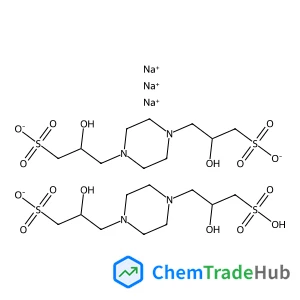
3,3'-(Piperazine-1,4-diyl)bis(2-hydroxypropane-1-sulfonic acid) Sodium Salt
CAS号:
108321-08-0
分子式:
C20H41N4Na3O16S4
推荐供应商



免责声明
本页面提供的学术期刊信息仅供参考和研究使用。我们与任何期刊出版商均无关联,也不处理投稿事宜。如有投稿相关咨询,请直接联系相关期刊出版商。
如发现页面信息有误,请发送邮件至 support@chemtradehub.com 联系我们。我们将及时核实并处理您的问题。