





![trans,trans-4-n-Propyl-4-[4-(trifluoromethoxy)phenyl]bicyclohexyl structure](https://cnstatic.chemtradehub.com/structs/133/133937-72-1-25ef.webp "trans,trans-4-n-Propyl-4-[4-(trifluoromethoxy)phenyl]bicyclohexyl structure")
pH-responsive polymer–antigen vaccine bioconjugates
文献信息
发布日期
2011-05-18
DOI
10.1039/C1PY00060H
影响因子
5.582
作者
Emily F. Crownover, Anthony J. Convertine, Patrick S. Stayton
查看原文
摘要
Protein-based vaccines play an important role in controlling infectious disease but their full clinical impact has been limited by their inability to generate a coordinated cellular CD4+ and CD8+ immune response. Vaccines that better deliver antigens to the cytosolic MHC1 display system could in principle provide a better coordinated response. Here, controlled radical polymerization was employed to prepare a diblock copolymer containing an endosomal releasing segment based on poly(propylacrylic acid) (poly(PAA)) and a hydrophilic segment containing thiol-reactive disulfide moieties for antigen conjugation. Propylacrylic acid (PAA) was polymerized in the presence of a trithiocarbonate based RAFT chain transfer agent (CTA). The resultant poly(PAA) was then employed as a macroCTA in the copolymerization of pyridyl disulfide methacrylamide (PDSMA) (thiol-reactive monomer) and N,N-dimethylacrylamide (DMA) as a hydrophilic comonomer. Copolymer compositions and molecular weights were determined via1H NMR spectroscopy and size exclusion chromatography. Native polyacrylamide gel electrophoresis (PAGE) showed a complete disappearance of the bands corresponding to free thiolated ovalbumin after conjugation to the polymer at pyridyl disulfide to thiol ratios as low as 2.5. The ability of the poly[(PAA)-b-(DMA)co(PDSMA)]–ovalbumin conjugates to activate CTLs was evaluated in vivo, tumor protection using the EG7 tumor protection model. Tumors were visible in the PBS and free ovalbumin immunized mice by day 7 but were not visible in the polyPAA–ovalbumin conjugate immunized mice until day 18. The mice immunized with the polyPAA–ovalbumin conjugate had a survival rate at day 21 of 100% versus 20% for PBS and 40% for ovalbumin immunized mice.
相关文献
Computational investigations of selected enzymes from two iron and α-ketoglutarate-dependent families
Madison B. Berger, Alice R. Walker, Erik Antonio Vázquez-Montelongo, G. Andrés Cisneros
2021-09-24
Perspective
DOI: 10.1039/D1CP03800A
An evaluation of solvent effects and ethanol oxidation
Yuhan Mei, N. Aaron Deskins
2021-07-19
Paper
DOI: 10.1039/D1CP00630D
Molecular dynamics study on the inhibition mechanisms of ReACp53 peptide for p53–R175H mutant aggregation
Jiangtao Lei, Mengqiang Cai, Yun Shen, Dongdong Lin, Xiaohua Deng
2021-09-22
Paper
DOI: 10.1039/D1CP03094A
New ethionamide boosters and EthR2: structural and energetic analysis
J. F. Vianna, K. S. Bezerra, A. H. Lima Costa, E. D. Barbosa, J. X. Lima Neto, J. I. N. Oliveira, V. N. Freire, U. L. Fulco
2021-09-27
Paper
DOI: 10.1039/D1CP02853G
A graphene–Mo2C heterostructure for a highly responsive broadband photodetector
Xiaozhi Bao, Tian Sun, Yan Liu, Chuan Xu, Weiliang Ma, Junpo Guo, Yun Zheng, Shivananju Bannur Nanjunda, Huating Liu, Zongyu Huang, Shenghuang Lin, Guichuan Xing, Wencai Ren, Qiaoliang Bao, Huaiyu Shao
2021-09-15
Paper
DOI: 10.1039/D1CP03536C
Revisiting the glass transition temperature of water–glycerol mixtures in the bulk and confined in mesoporous silica
Ivette Angarita, Ma. Florencia Mazzobre
2021-07-10
Paper
DOI: 10.1039/D1CP02153B
Oscillatory dynamics during the methanol electrooxidation reaction on Pt(111)
Kaline Nascimento da Silva
2021-08-02
Paper
DOI: 10.1039/D1CP02490F
Tuning Dzyaloshinskii–Moriya interaction via an electric field at the Co/h-BN interface
C. L. Ma, J. Hu
2021-09-21
Communication
DOI: 10.1039/D1CP02554F
Mechanical properties and thermal conductivity of newly introduced graphene-like borophanes: a reactive molecular dynamics study
2021-08-02
Paper
DOI: 10.1039/D1CP01831K
B-Doped 2D-InSe as a bifunctional catalyst for CO2/CH4 separation under the regulation of an external electric field
Chenxu Zhao, Menghui Xi, Jinrong Huo, Chaozheng He
2021-09-30
Paper
DOI: 10.1039/D1CP03943A
您可能还喜欢
化合物问答
2-(甲基磺酰基)嘧啶-5-胺(CAS号:56621-92-2)适用哪些法规指南?
该化合物适用的法规指南包括GHS(全球化学品统一分类和标签制度)分类为特定目标器官毒性-单次接触类别3;根据欧盟REACH法规,该化合物需要进行注册和评估;在美...
56621-92-22-(Methylsulfonyl)py...
化合物问答
在合成中是否有4-(4-氯苯基)-1H-咪唑(CAS号:35512-29-9)的替代品?
在合成中,可以考虑使用一些类似的化合物作为4-(4-氯苯基)-1H-咪唑的替代品,如4-(4-溴苯基)-1H-咪唑或4-(4-甲氧基苯基)-1H-咪唑。这些化合...
35512-29-94-(4-Chlorophenyl)-1...
化合物问答
什么是N~2~-甲基丙氨酸酰胺(CAS号:32012-16-1)?
N~2~-甲基丙氨酸酰胺是一种有机化合物,其化学名为2-(Methylamino)propanamide。它是一种酰胺类化合物,分子式为C4H10N2O,相对分...
32012-16-12-(Methylamino)propa...
化合物问答
如何处理含有N-苄基-3-氨基氧杂环丁烷草酸盐(CAS号:1956341-96-0)的废料?
处理含有N-苄基-3-氨基氧杂环丁烷草酸盐(CAS号:1956341-96-0)的废料时,应首先确保遵循相关法规要求,如GHS和REACH等。通常,废液应先进行...
1956341-96-0N-Benzyloxetan-3-ami...
化合物问答
4-bromo-2-chloro-6-methylbenzoic acid(CAS号:877149-07-0)的物理化学性质是什么?
4-溴-2-氯-6-甲基苯甲酸是一种固体化合物,具有较高的熔点和较低的沸点。它的分子量为261.03 g/mol。该化合物在水中几乎不溶,在有机溶剂中溶解度适中...
877149-07-04-Bromo-2-chloro-6-m...
化合物问答
2-[(2,5-二氯-4-嘧啶)氨基]-N-甲基苯甲酰胺(CAS号:761440-08-8)通常如何合成?
该化合物通常通过缩合反应合成,典型的方法是将2,5-二氯嘧啶与N-甲基苯甲酰胺在碱性条件下进行偶联反应。常用的碱包括NaH、LDA等强碱。该合成路线具有较高的选...
761440-08-82-[(2,5-dichloropyri...
4752-10-71,4-Dichlorophthalaz...
化合物问答
在合成中是否有3,5-二溴-4-甲基苯胺(CAS号:13194-73-5)的替代品?
3,5-二溴-4-甲基苯胺在某些合成路线中可能没有直接替代品。然而,在某些应用场景下,可以考虑使用其他类似结构的化合物如3,5-二溴-4-硝基苯胺或3,5-二碘...
13194-73-53,5-Dibromo-4-methyl...
化合物问答
2-氯喹啉-4-羧酸甲酯(CAS号:62482-26-2)的主要用途是什么?
2-氯喹啉-4-羧酸甲酯主要用于有机合成和药物合成领域,作为中间体或原料。它在合成某些药物和染料时具有重要作用。此外,该化合物还可能用于某些特定的化学研究中。
62482-26-2Methyl 2-chloro-4-qu...
化合物问答
i>]吡啶(CAS号:474708-88-8)安全吗?
6-溴-8-氯咪唑[1,2-a]吡啶在操作过程中需要谨慎以确保安全。该化合物具有一定的毒性,吸入其蒸气或粉尘可能导致呼吸道刺激。处理时应佩戴适当的防护装备,如手...
474708-88-86-Bromo-8-chloroimid...
来源期刊
Polymer Chemistry

CiteScore:
8.6
自引率:
7.3%
年发文量:
457
Polymer Chemistry welcomes submissions in all areas of polymer science that have a strong focus on macromolecular chemistry. Manuscripts may cover a broad range of fields, yet no direct application focus is required.
推荐化合物
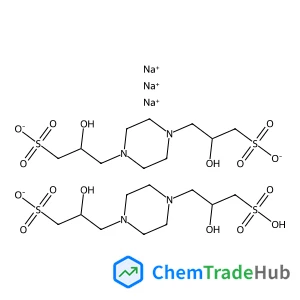
3,3'-(Piperazine-1,4-diyl)bis(2-hydroxypropane-1-sulfonic acid) Sodium Salt
CAS号:
108321-08-0
分子式:
C20H41N4Na3O16S4
![5-(2-Phenylpyrazolo[1,5-a]pyridin-3-yl)-2H-pyrazolo[3,4-c]pyridazin-3-amine structure](https://cnstatic.chemtradehub.com/structs/865/865362-74-9-0091.webp "5-(2-Phenylpyrazolo[1,5-a]pyridin-3-yl)-2H-pyrazolo[3,4-c]pyridazin-3-amine structure")
推荐供应商






免责声明
本页面提供的学术期刊信息仅供参考和研究使用。我们与任何期刊出版商均无关联,也不处理投稿事宜。如有投稿相关咨询,请直接联系相关期刊出版商。
如发现页面信息有误,请发送邮件至 support@chemtradehub.com 联系我们。我们将及时核实并处理您的问题。