







Bis(phosphinimino)methanide borohydride complexes of the rare-earth elements as initiators for the polymerization of methyl methacrylate: combined experimental and computational investigations
文献信息
发布日期
2011-05-24
DOI
10.1039/C1PY00133G
影响因子
5.582
作者
Sophie M. Guillaume, Pierre Brignou, Nicolas Susperregui, Laurent Maron, Magdalena Kuzdrowska, Peter W. Roesky
查看原文
摘要
Rare earth borohydride complexes are known as efficient initiators for the polymerization of both apolar and polar monomers. Significant contribution of the phosphiniminomethanide ligand on the reactivity of group 3 derivatives was previously established in the polymerization of ε-caprolactone. Investigations of the capability of bis(phosphinimino)methanide rare earth metal bisborohydrides, [{CH(PPh2NSiMe3)2}La(BH4)2(THF)] (1) and [{CH(PPh2NSiMe3)2}Ln(BH4)2] (Ln = Y (2), Lu (3)) to polymerize methyl methacrylate (MMA) both experimentally and computationally, are reported here. All three metallic compounds allowed the preparation of PMMA at room temperature. However, the overall performances of 1–3 remain quite poor based on experimental observations. DFT investigations on the insertion of the first two MMA molecules revealed that the incoming of the first MMA molecule was the most important step regardless of the nature of the metal center. The nucleophilic attack of MMA leads to the formation of a first adduct B followed by the unprecedented trapping of the liberated BH3 group by the nitrogen of the phosphiniminomethanide ligand to afford the active enolate species C. The unique significant role played by the phosphiniminomethanide ligand has thus been clearly unveiled and evidenced computationally. This whole first insertion of the MMA process is both kinetically and thermodynamically favorable. Trapping of the BH3 by the ancillary ligand appeared to make the second MMA insertion more energetically favorable than the first one, especially for lanthanum. The ketoenolate thus formed, Prod., is thermodynamically and kinetically favorable. In the case of yttrium, steric considerations, in addition to energetically comparable first and second MMA insertions, support the experimentally observed difficulty to polymerize MMA. DFT calculations closely corroborate experimental findings.
相关文献
A theoretical approach to evaluate and understand the electrical properties of the electrode materials of batteries
Hatef Yousefi-Mashhour, Mohammad Mahdi Kalantarian
2021-07-06
Paper
DOI: 10.1039/D1CP01796A
Improved carbon dioxide absorption in double-charged ionic liquids
Jocasta Avila, Luiz Fernando Lepre, Kateryna Goloviznina, Lorenzo Guazzelli, Christian Silvio Pomelli, Cinzia Chiappe, Agilio Pádua, Margarida Costa Gomes
2021-09-08
Paper
DOI: 10.1039/D1CP02080C
Structure and thermodynamics of empty clathrate hydrates below the freezing point of water
Fernando J. A. L. Cruz, José P. B. Mota
2021-07-13
Paper
DOI: 10.1039/D1CP00893E
Excited states of modified oxygen-deficient centers and Si quantum dots in Gd-implanted silica glasses: emission dynamics and lifetime distributions
A. F. Zatsepin, Yu. A. Kuznetsova, E. S. Trofimova, V. A. Pustovarov
2021-09-24
Paper
DOI: 10.1039/D1CP03826E
Phase analysis of tungsten and phonon behavior of beryllium layers in W/Be periodic multilayers
Niranjan Kumar, Roman S. Pleshkov, Aleksey V. Nezhdanov, Vladimir N. Polkovnikov, Nikolay I. Chkhalo, Aleksandr I. Mashin
2021-09-21
Paper
DOI: 10.1039/D1CP02815D
Probing the solute-drag effect and its role in stabilizing the orthorhombic phase in bulk La-doped HfO2 by X-ray and gamma ray spectroscopy
2021-07-03
Paper
DOI: 10.1039/D1CP00096A
Mixed-diphosphine-protected chiral undecagold clusters Au11(S,S-DIOP)4(rac-/R-/S-BINAP): effect of the handedness of BINAP on their chiroptical responses
Yasuhiko Sato, Hiroshi Yao
2021-07-26
Paper
DOI: 10.1039/D1CP02106K
Chiral recognition via a stereodynamic vanadium probe using the electronic circular dichroism effect in differential Raman scattering
Davide Carraro, Giulia Licini, Petr Bouř, Cristiano Zonta
2021-09-21
Paper
DOI: 10.1039/D1CP03020E
New complexes of liquid crystal discotic triphenylenes: induction of the double gyroid phase
O. A. Otmakhova, G. N. Bondarenko, G. A. Shandryuk, A. S. Merekalov, R. V. Talroze
2021-07-22
Paper
DOI: 10.1039/D1CP00660F
A theoretical study on the excited-state deactivation paths for the A–5FU dimer
Xue-fang Yu, Ting-he Fu, Bo Xiao, Hong-yuan Yu, Qingzhong Li
2021-06-28
Paper
DOI: 10.1039/D1CP00030F
您可能还喜欢
化合物问答
2-(甲基磺酰基)嘧啶-5-胺(CAS号:56621-92-2)适用哪些法规指南?
该化合物适用的法规指南包括GHS(全球化学品统一分类和标签制度)分类为特定目标器官毒性-单次接触类别3;根据欧盟REACH法规,该化合物需要进行注册和评估;在美...
56621-92-22-(Methylsulfonyl)py...
化合物问答
在合成中是否有4-(4-氯苯基)-1H-咪唑(CAS号:35512-29-9)的替代品?
在合成中,可以考虑使用一些类似的化合物作为4-(4-氯苯基)-1H-咪唑的替代品,如4-(4-溴苯基)-1H-咪唑或4-(4-甲氧基苯基)-1H-咪唑。这些化合...
35512-29-94-(4-Chlorophenyl)-1...
化合物问答
什么是N~2~-甲基丙氨酸酰胺(CAS号:32012-16-1)?
N~2~-甲基丙氨酸酰胺是一种有机化合物,其化学名为2-(Methylamino)propanamide。它是一种酰胺类化合物,分子式为C4H10N2O,相对分...
32012-16-12-(Methylamino)propa...
化合物问答
如何处理含有N-苄基-3-氨基氧杂环丁烷草酸盐(CAS号:1956341-96-0)的废料?
处理含有N-苄基-3-氨基氧杂环丁烷草酸盐(CAS号:1956341-96-0)的废料时,应首先确保遵循相关法规要求,如GHS和REACH等。通常,废液应先进行...
1956341-96-0N-Benzyloxetan-3-ami...
化合物问答
4-bromo-2-chloro-6-methylbenzoic acid(CAS号:877149-07-0)的物理化学性质是什么?
4-溴-2-氯-6-甲基苯甲酸是一种固体化合物,具有较高的熔点和较低的沸点。它的分子量为261.03 g/mol。该化合物在水中几乎不溶,在有机溶剂中溶解度适中...
877149-07-04-Bromo-2-chloro-6-m...
化合物问答
2-[(2,5-二氯-4-嘧啶)氨基]-N-甲基苯甲酰胺(CAS号:761440-08-8)通常如何合成?
该化合物通常通过缩合反应合成,典型的方法是将2,5-二氯嘧啶与N-甲基苯甲酰胺在碱性条件下进行偶联反应。常用的碱包括NaH、LDA等强碱。该合成路线具有较高的选...
761440-08-82-[(2,5-dichloropyri...
4752-10-71,4-Dichlorophthalaz...
化合物问答
在合成中是否有3,5-二溴-4-甲基苯胺(CAS号:13194-73-5)的替代品?
3,5-二溴-4-甲基苯胺在某些合成路线中可能没有直接替代品。然而,在某些应用场景下,可以考虑使用其他类似结构的化合物如3,5-二溴-4-硝基苯胺或3,5-二碘...
13194-73-53,5-Dibromo-4-methyl...
化合物问答
2-氯喹啉-4-羧酸甲酯(CAS号:62482-26-2)的主要用途是什么?
2-氯喹啉-4-羧酸甲酯主要用于有机合成和药物合成领域,作为中间体或原料。它在合成某些药物和染料时具有重要作用。此外,该化合物还可能用于某些特定的化学研究中。
62482-26-2Methyl 2-chloro-4-qu...
化合物问答
i>]吡啶(CAS号:474708-88-8)安全吗?
6-溴-8-氯咪唑[1,2-a]吡啶在操作过程中需要谨慎以确保安全。该化合物具有一定的毒性,吸入其蒸气或粉尘可能导致呼吸道刺激。处理时应佩戴适当的防护装备,如手...
474708-88-86-Bromo-8-chloroimid...
来源期刊
Polymer Chemistry

CiteScore:
8.6
自引率:
7.3%
年发文量:
457
Polymer Chemistry welcomes submissions in all areas of polymer science that have a strong focus on macromolecular chemistry. Manuscripts may cover a broad range of fields, yet no direct application focus is required.
推荐化合物
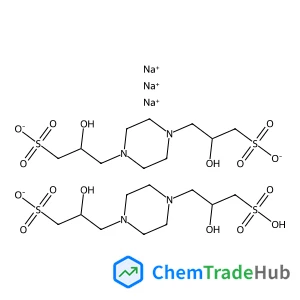
3,3'-(Piperazine-1,4-diyl)bis(2-hydroxypropane-1-sulfonic acid) Sodium Salt
CAS号:
108321-08-0
分子式:
C20H41N4Na3O16S4
![1,1'-[(E)-1,2-Ethenediyl]bis(4-bromobenzene) structure](https://cnstatic.chemtradehub.com/structs/188/18869-30-2-c907.webp "1,1'-[(E)-1,2-Ethenediyl]bis(4-bromobenzene) structure")
![5-(2-Phenylpyrazolo[1,5-a]pyridin-3-yl)-2H-pyrazolo[3,4-c]pyridazin-3-amine structure](https://cnstatic.chemtradehub.com/structs/865/865362-74-9-0091.webp "5-(2-Phenylpyrazolo[1,5-a]pyridin-3-yl)-2H-pyrazolo[3,4-c]pyridazin-3-amine structure")
推荐供应商





免责声明
本页面提供的学术期刊信息仅供参考和研究使用。我们与任何期刊出版商均无关联,也不处理投稿事宜。如有投稿相关咨询,请直接联系相关期刊出版商。
如发现页面信息有误,请发送邮件至 support@chemtradehub.com 联系我们。我们将及时核实并处理您的问题。