




pH-triggered micellar membrane for controlled release microchips
文献信息
发布日期
2011-09-16
DOI
10.1039/C1PY00300C
影响因子
5.582
作者
Xiaoqiang Yang, Basem A. Moosa, Lin Deng, Lan Zhao, Niveen M. Khashab
查看原文
摘要
A pH-responsive membrane based on polystyrene-b-poly(4-vinylpyridine) (PS-b-P4VP) block copolymer was developed on a model glass microchip as a promising controlled polymer delivery system. The PS-b-P4VP copolymer assembles into spherical and/or worm-like micelles with styrene block cores and pyridine coronas in selective solvents. The self-assembled worm-like morphology exhibited pH-responsive behaviour due to the protonation of the P4VP block at low pH and it's deprotonation at high pH and thus constituting a switchable “off/on” system. Doxorubicin (Dox) was used as cargo to test the PS-b-P4VP membrane. Luminescence experiments indicated that the membrane was able to store Dox molecules within its micellar structure at neutral pH and then release them as soon as the pH was raised to 8.0. The performance of the cast membrane was predictable and most importantly reproducible. The physiochemical and biological properties were also investigated carefully in terms of morphology, cell viability and cell uptake.
相关文献
Manganese-promoted reductive cross-coupling of disulfides with dialkyl carbonates
Chao-Peng Zhang, Tian-Zhang Wang, Yu-Feng Liang
2023-11-20
Communication
DOI: 10.1039/D3CC04862D
Decarboxylative halogenation of indoles by vanadium haloperoxidases
Lauren J. Harstad, Clare E. Wells, Lauren P. T. Ramos, Cameron A. Pascoe
2023-11-15
Communication
DOI: 10.1039/D3CC04053D
Rapid construction of Co/CoO/CoCH nanowire core/shell arrays for highly efficient hydrogen evolution reaction
Sihan Liu, Shuai Wang, Weiye Shi, Qin Zhou, Yan Zhang, Chunqing Huo, Shengjue Deng, Shiwei Lin
2023-11-10
Communication
DOI: 10.1039/D3CC04591A
CO2 switchable adhesion of ionic polydimethylsiloxane elastomers
Masatoshi Tsunoda, Shoei Shimozaki, Rina Sawada, Shoichi Kutsumizu
2023-11-14
Communication
DOI: 10.1039/D3CC04575G
The Minimum Protein Staple? – Towards ‘bio’-Baldwin's rules via inter-phosphosite linking in the MEK1 activation loop
Sébastien R. G. Galan, Ritu Raj, Lyn H. Jones
2023-12-01
Edge Article
DOI: 10.1039/D3SC04631A
A condition-tuned unorthodox approach to indole-3-carboxylic acids and anthranilic acids via carbon atom translocation
Arup Bhowmik, Koushik Naskar, Shantonu Roy, Sudip Karmakar, Writhabrata Sarkar, Imtiaj Mondal, Arindam Sana, Indubhusan Deb
2023-10-31
Communication
DOI: 10.1039/D3CC04443B
FeNbO4 nanochains with a five-electron transfer reaction toward high capacity and fast Li storage
Yingxue Cui, Zixuan Zhou, Sheng Li, Rong Kang, Yun Zhang, Wei Wei, Jiabiao Lian, Shanhai Ge, Huaming Li
2023-11-09
Communication
DOI: 10.1039/D3CC04358D
Double-stranded metallo-triangles: from anion-templated nonanuclear to cation-templated tetraicosanuclear dysprosium clusters
Yanan Liu, Xiao Sun, Peiqiong Chen, Xiaojuan Li, Fu-Ping Huang, Hou-Ting Liu, Haiquan Tian
2023-10-31
Communication
DOI: 10.1039/D3CC04449A
Beyond the formation: unveiling the atmospheric transformation of organosulfates via heterogeneous OH oxidation
Sze In Madeleine Ng
2023-10-30
Feature Article
DOI: 10.1039/D3CC03700B
您可能还喜欢
化合物问答
2-(甲基磺酰基)嘧啶-5-胺(CAS号:56621-92-2)适用哪些法规指南?
该化合物适用的法规指南包括GHS(全球化学品统一分类和标签制度)分类为特定目标器官毒性-单次接触类别3;根据欧盟REACH法规,该化合物需要进行注册和评估;在美...
56621-92-22-(Methylsulfonyl)py...
化合物问答
在合成中是否有4-(4-氯苯基)-1H-咪唑(CAS号:35512-29-9)的替代品?
在合成中,可以考虑使用一些类似的化合物作为4-(4-氯苯基)-1H-咪唑的替代品,如4-(4-溴苯基)-1H-咪唑或4-(4-甲氧基苯基)-1H-咪唑。这些化合...
35512-29-94-(4-Chlorophenyl)-1...
化合物问答
什么是N~2~-甲基丙氨酸酰胺(CAS号:32012-16-1)?
N~2~-甲基丙氨酸酰胺是一种有机化合物,其化学名为2-(Methylamino)propanamide。它是一种酰胺类化合物,分子式为C4H10N2O,相对分...
32012-16-12-(Methylamino)propa...
化合物问答
如何处理含有N-苄基-3-氨基氧杂环丁烷草酸盐(CAS号:1956341-96-0)的废料?
处理含有N-苄基-3-氨基氧杂环丁烷草酸盐(CAS号:1956341-96-0)的废料时,应首先确保遵循相关法规要求,如GHS和REACH等。通常,废液应先进行...
1956341-96-0N-Benzyloxetan-3-ami...
化合物问答
4-bromo-2-chloro-6-methylbenzoic acid(CAS号:877149-07-0)的物理化学性质是什么?
4-溴-2-氯-6-甲基苯甲酸是一种固体化合物,具有较高的熔点和较低的沸点。它的分子量为261.03 g/mol。该化合物在水中几乎不溶,在有机溶剂中溶解度适中...
877149-07-04-Bromo-2-chloro-6-m...
化合物问答
2-[(2,5-二氯-4-嘧啶)氨基]-N-甲基苯甲酰胺(CAS号:761440-08-8)通常如何合成?
该化合物通常通过缩合反应合成,典型的方法是将2,5-二氯嘧啶与N-甲基苯甲酰胺在碱性条件下进行偶联反应。常用的碱包括NaH、LDA等强碱。该合成路线具有较高的选...
761440-08-82-[(2,5-dichloropyri...
4752-10-71,4-Dichlorophthalaz...
化合物问答
在合成中是否有3,5-二溴-4-甲基苯胺(CAS号:13194-73-5)的替代品?
3,5-二溴-4-甲基苯胺在某些合成路线中可能没有直接替代品。然而,在某些应用场景下,可以考虑使用其他类似结构的化合物如3,5-二溴-4-硝基苯胺或3,5-二碘...
13194-73-53,5-Dibromo-4-methyl...
化合物问答
2-氯喹啉-4-羧酸甲酯(CAS号:62482-26-2)的主要用途是什么?
2-氯喹啉-4-羧酸甲酯主要用于有机合成和药物合成领域,作为中间体或原料。它在合成某些药物和染料时具有重要作用。此外,该化合物还可能用于某些特定的化学研究中。
62482-26-2Methyl 2-chloro-4-qu...
化合物问答
i>]吡啶(CAS号:474708-88-8)安全吗?
6-溴-8-氯咪唑[1,2-a]吡啶在操作过程中需要谨慎以确保安全。该化合物具有一定的毒性,吸入其蒸气或粉尘可能导致呼吸道刺激。处理时应佩戴适当的防护装备,如手...
474708-88-86-Bromo-8-chloroimid...
来源期刊
Polymer Chemistry

CiteScore:
8.6
自引率:
7.3%
年发文量:
457
Polymer Chemistry welcomes submissions in all areas of polymer science that have a strong focus on macromolecular chemistry. Manuscripts may cover a broad range of fields, yet no direct application focus is required.
推荐化合物
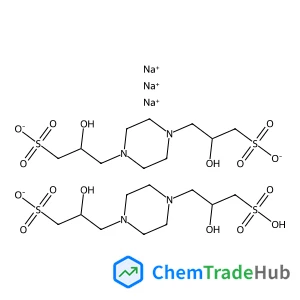
3,3'-(Piperazine-1,4-diyl)bis(2-hydroxypropane-1-sulfonic acid) Sodium Salt
CAS号:
108321-08-0
分子式:
C20H41N4Na3O16S4
推荐供应商




免责声明
本页面提供的学术期刊信息仅供参考和研究使用。我们与任何期刊出版商均无关联,也不处理投稿事宜。如有投稿相关咨询,请直接联系相关期刊出版商。
如发现页面信息有误,请发送邮件至 support@chemtradehub.com 联系我们。我们将及时核实并处理您的问题。