



Effect of multilayer structure on cyclic performance of Si/Fe anode electrode in Lithium-ion secondary batteries
文献信息
发布日期
2012-11-22
DOI
10.1039/C2CP42824E
影响因子
3.676
作者
Hee-Kook Kang, Seong-Rae Lee, Won Il Cho, Byung Won Cho
查看原文
摘要
A buffer-strengthened Si/Fe multilayer film, consisting of amorphous silicon layers and polycrystalline Fe layers, is investigated as the anode for Li-ion batteries. This film can achieve a stable cycle-life performance with a high capacity. Decreasing the thickness of the Fe layer can lead to a higher capacity, which is related to the fast transport of the Li ion, but the cyclic performance deteriorates with repeated cycling. In contrast, increasing the thickness of the Fe buffer layers and the number of deposit stacks improves the cycle life with high reversibility. Because of the strain in the Si layers suppressed by the primary multilayer structure, the long-term strength is preserved and the substantial fracture toughness is enhanced by the increasing numbers of effective grain boundaries and interfacial layers. In addition, we demonstrate that the Ti underlayer promotes the electrochemical properties in the Si/Fe multilayer for various Fe layer thicknesses because of the enhanced adhesion of the interfacial electrode and current collector. The mechanically optimized Si/Fe multilayer films can have superior cycle-life performances and higher capacities. Notably, the 16-bilayer deposited electrode exhibits an excellent capacity retention of ∼95% with ∼204 mAh g−1 over 300 cycles at a 1 C rate.
相关文献
Donor–acceptor–donor structured thioxanthone derivatives as visible photoinitiators
Thi Huong Le, Thanh-Tuân Bui, Frédéric Dumur, Fabrice Goubard
2020-10-29
Paper
DOI: 10.1039/D0PY01244K
Rational molecular design of anion exchange membranes functionalized with alicyclic quaternary ammonium cations
Thanh Huong Pham, Andrit Allushi, Joel S. Olsson, Patric Jannasch
2020-10-19
Paper
DOI: 10.1039/D0PY01291B
Construction of well-defined difluoromethylthio-containing amphiphilic homopolymers by RAFT polymerization
Haoyu Liu, Sen Zhang, Xiaoyu Huang, Aishun Ding, Guolin Lu
2020-11-09
Paper
DOI: 10.1039/D0PY01234C
DFT-calculation-assisted prediction of the copolymerization between cyclic ketene acetals and traditional vinyl monomers
Antoine Tardy, Noémie Gil, Christopher M. Plummer, Chen Zhu, Didier Siri, Julien Nicolas, Didier Gigmes, Yohann Guillaneuf, Catherine Lefay
2020-10-19
Paper
DOI: 10.1039/D0PY01179G
Polyarylene polyimides with hydrocarbon and semi-fluorinated backbones: synthesis, characterization, and properties
Stephen M. Budy, Jamie Dore Hall, David Y. Son
2020-09-01
Paper
DOI: 10.1039/D0PY00814A
3D printed nanocomposites using polymer grafted graphene oxide prepared by multicomponent Passerini reaction
Guannan Wang, Raju Raju, Kiho Cho, Sandy Wong, B. Gangadhara Prusty, Martina H. Stenzel
2020-10-26
Paper
DOI: 10.1039/D0PY01286F
A supramolecular copolymer based on small molecules, used for a multifunctional adhesive and rapid hemostasis
Junying Chen, Dawei Guo, Shihao Liang
2020-10-01
Paper
DOI: 10.1039/D0PY00926A
您可能还喜欢
化合物问答
2-(甲基磺酰基)嘧啶-5-胺(CAS号:56621-92-2)适用哪些法规指南?
该化合物适用的法规指南包括GHS(全球化学品统一分类和标签制度)分类为特定目标器官毒性-单次接触类别3;根据欧盟REACH法规,该化合物需要进行注册和评估;在美...
56621-92-22-(Methylsulfonyl)py...
化合物问答
在合成中是否有4-(4-氯苯基)-1H-咪唑(CAS号:35512-29-9)的替代品?
在合成中,可以考虑使用一些类似的化合物作为4-(4-氯苯基)-1H-咪唑的替代品,如4-(4-溴苯基)-1H-咪唑或4-(4-甲氧基苯基)-1H-咪唑。这些化合...
35512-29-94-(4-Chlorophenyl)-1...
化合物问答
什么是N~2~-甲基丙氨酸酰胺(CAS号:32012-16-1)?
N~2~-甲基丙氨酸酰胺是一种有机化合物,其化学名为2-(Methylamino)propanamide。它是一种酰胺类化合物,分子式为C4H10N2O,相对分...
32012-16-12-(Methylamino)propa...
化合物问答
如何处理含有N-苄基-3-氨基氧杂环丁烷草酸盐(CAS号:1956341-96-0)的废料?
处理含有N-苄基-3-氨基氧杂环丁烷草酸盐(CAS号:1956341-96-0)的废料时,应首先确保遵循相关法规要求,如GHS和REACH等。通常,废液应先进行...
1956341-96-0N-Benzyloxetan-3-ami...
化合物问答
4-bromo-2-chloro-6-methylbenzoic acid(CAS号:877149-07-0)的物理化学性质是什么?
4-溴-2-氯-6-甲基苯甲酸是一种固体化合物,具有较高的熔点和较低的沸点。它的分子量为261.03 g/mol。该化合物在水中几乎不溶,在有机溶剂中溶解度适中...
877149-07-04-Bromo-2-chloro-6-m...
化合物问答
2-[(2,5-二氯-4-嘧啶)氨基]-N-甲基苯甲酰胺(CAS号:761440-08-8)通常如何合成?
该化合物通常通过缩合反应合成,典型的方法是将2,5-二氯嘧啶与N-甲基苯甲酰胺在碱性条件下进行偶联反应。常用的碱包括NaH、LDA等强碱。该合成路线具有较高的选...
761440-08-82-[(2,5-dichloropyri...
4752-10-71,4-Dichlorophthalaz...
化合物问答
在合成中是否有3,5-二溴-4-甲基苯胺(CAS号:13194-73-5)的替代品?
3,5-二溴-4-甲基苯胺在某些合成路线中可能没有直接替代品。然而,在某些应用场景下,可以考虑使用其他类似结构的化合物如3,5-二溴-4-硝基苯胺或3,5-二碘...
13194-73-53,5-Dibromo-4-methyl...
化合物问答
2-氯喹啉-4-羧酸甲酯(CAS号:62482-26-2)的主要用途是什么?
2-氯喹啉-4-羧酸甲酯主要用于有机合成和药物合成领域,作为中间体或原料。它在合成某些药物和染料时具有重要作用。此外,该化合物还可能用于某些特定的化学研究中。
62482-26-2Methyl 2-chloro-4-qu...
化合物问答
i>]吡啶(CAS号:474708-88-8)安全吗?
6-溴-8-氯咪唑[1,2-a]吡啶在操作过程中需要谨慎以确保安全。该化合物具有一定的毒性,吸入其蒸气或粉尘可能导致呼吸道刺激。处理时应佩戴适当的防护装备,如手...
474708-88-86-Bromo-8-chloroimid...
来源期刊
Physical Chemistry Chemical Physics

CiteScore:
5.5
自引率:
10.3%
年发文量:
3036
Physical Chemistry Chemical Physics (PCCP) is an international journal co-owned by 19 physical chemistry and physics societies from around the world. This journal publishes original, cutting-edge research in physical chemistry, chemical physics and biophysical chemistry. To be suitable for publication in PCCP, articles must include significant innovation and/or insight into physical chemistry; this is the most important criterion that reviewers and Editors will judge against when evaluating submissions. The journal has a broad scope and welcomes contributions spanning experiment, theory, computation and data science. Topical coverage includes spectroscopy, dynamics, kinetics, statistical mechanics, thermodynamics, electrochemistry, catalysis, surface science, quantum mechanics, quantum computing and machine learning. Interdisciplinary research areas such as polymers and soft matter, materials, nanoscience, energy, surfaces/interfaces, and biophysical chemistry are welcomed if they demonstrate significant innovation and/or insight into physical chemistry. Joined experimental/theoretical studies are particularly appreciated when complementary and based on up-to-date approaches.
推荐化合物
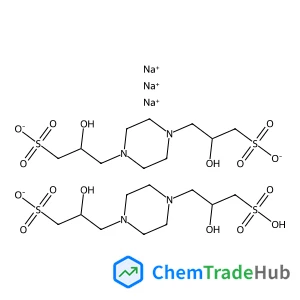
3,3'-(Piperazine-1,4-diyl)bis(2-hydroxypropane-1-sulfonic acid) Sodium Salt
CAS号:
108321-08-0
分子式:
C20H41N4Na3O16S4
推荐供应商







免责声明
本页面提供的学术期刊信息仅供参考和研究使用。我们与任何期刊出版商均无关联,也不处理投稿事宜。如有投稿相关咨询,请直接联系相关期刊出版商。
如发现页面信息有误,请发送邮件至 support@chemtradehub.com 联系我们。我们将及时核实并处理您的问题。