





Turning renewable resources into value-added polymer: development of lignin-based thermoplastic
文献信息
发布日期
2012-10-17
DOI
10.1039/C2GC35933B
影响因子
10.182
作者
Tomonori Saito, Rebecca H. Brown, Marcus A. Hunt, Deanna L. Pickel, Joseph M. Pickel, Jamie M. Messman, Frederick S. Baker, Martin Keller, Amit K. Naskar
查看原文
摘要
Productive uses of lignin, the third most abundant natural polymer, have been sought for decades. One especially attractive possibility is that of developing value-added products including thermoplastics based on lignin. This possibility warrants special attention due to growth of the modern biofuel industries. However, the polydisperse molecular weight and hyper-branched structure of lignin has hindered the creation of high-performance biopolymers. Here, we report the preparation and characterization of novel lignin-based, partially carbon-neutral thermoplastics. We first altered the molecular weight of lignin, either by fractionation with methanol, or by formaldehyde crosslinking. Crosslinking of lignin increases the molecular weight, exhibiting Mn = 31 000 g mol−1, whereas that of as-received lignin is 1840 g mol−1. Tuning the molecular weight of lignin enabled successful preparation of novel lignin-derived thermoplastics, when coupled with telechelic polybutadiene soft-segments at proper feed ratios. Characteristic to thermoplastic rubbers, free-standing films of the resulting copolymers exhibit two-phase morphology and associated relaxations in the dynamic mechanical loss spectrum. To the best of our knowledge this article is the first report to demonstrate phase immiscibility, melt-processibility, and biphasic morphology of soft and hard segments in a lignin-based copolymer for all feed ratios of two macromolecular components. The use of higher molecular weight lignin enhanced the resulting shear modulus due to efficient network formation of telechelic polybutadiene bridges. The storage modulus in the rubbery plateau region increased with increasing lignin content. The successful synthesis of novel lignin-based thermoplastics will open a new pathway to biomass utilization and will help conserve petrochemicals.
相关文献
In situ investigation of mesoporous silicon oxidation kinetics using infrared emittance spectroscopy
Benjamin Bardet, Domingos De Sousa Meneses, Thomas Defforge, Jérôme Billoué, Gaël Gautier
2016-06-17
Paper
DOI: 10.1039/C6CP02086K
Functionalized SPIONs: the surfactant nature modulates the self-assembly and cluster formation
Richard K. Heenan
2016-06-09
Paper
DOI: 10.1039/C6CP01694D
The role of reduction extent of graphene oxide in the photocatalytic performance of Ag/AgX (X = Cl, Br)/rGO composites and the pseudo-second-order kinetics reaction nature of the Ag/AgBr system
Weiyin Gao, Chenxin Ran, Minqiang Wang, Le Li, Zhongwang Sun, Xi Yao
2016-06-09
Paper
DOI: 10.1039/C6CP03110B
Direct 17O NMR experimental evidence for Al–NBO bonds in Si-rich and highly polymerized aluminosilicate glasses
Aleksander Jaworski, Baltzar Stevensson, Mattias Edén
2015-06-23
Communication
DOI: 10.1039/C5CP02985F
Long-living optical gain induced by solvent viscosity in a push–pull molecule
M. M. Mróz, S. Benedini, A. Forni, C. Botta, D. Pasini, E. Cariati, T. Virgili
2016-06-08
Paper
DOI: 10.1039/C6CP02988D
Correction: Gd(iii)–Gd(iii) EPR distance measurements – the range of accessible distances and the impact of zero field splitting
Arina Dalaloyan, Mian Qi, Sharon Ruthstein, Shimon Vega, Adelheid Godt, Akiva Feintuch, Daniella Goldfarb
2016-06-21
Correction
DOI: 10.1039/C6CP90156E
Two-photon-absorption DNA sensitization via solvated electron production: unraveling photochemical pathways by molecular modeling and simulation
Elise Dumont
2016-06-13
Paper
DOI: 10.1039/C6CP02592G
An INS study of entrapped organic cations within the micropores of zeolite RTH
Tetiana Lemishko, Jorge Simancas, Manuel Hernández-Rodríguez, Mónica Jiménez-Ruiz, German Sastre, Fernando Rey
2016-04-11
Paper
DOI: 10.1039/C6CP00971A
Preparation of superhydrophobic films based on the diblock copolymer P(TFEMA-r-Sty)-b-PCEMA
2015-06-23
Paper
DOI: 10.1039/C5CP02751A
您可能还喜欢
化合物问答
奥美沙坦酯杂质4(CAS号:95579-71-8)的主要用途是什么?
奥美沙坦酯杂质4在药物工业中并无特定用途,主要作为生产和质量控制中的监控指标,以确保产品质量和符合相关规范。它具有一定的化学活性,因此在生产过程中需要严格控制其...
95579-71-84-Chloro-4-methyl-5-...
化合物问答
如何储存C3bot (154-182)(CAS号:1246280-79-4)?
C3bot (154-182)应储存在干燥、阴凉、通风良好的环境中,避免阳光直射。具体储存条件需要参考其相关安全数据表(SDS)中的储存信息。建议使用密闭容器存...
1246280-79-4C3bot (154-182)
化合物问答
在合成中是否有4-吡唑甲酸乙酯(CAS号:37622-90-5)的替代品?
在合成过程中,可以考虑使用类似结构的化合物作为替代品,例如4-吡唑甲酸甲酯或其他吡唑类化合物。这些替代品在性质上相似,可以用于相似的合成反应中,但需根据具体应用...
37622-90-5Ethyl 1H-pyrazole-4-...
化合物问答
(2-溴乙基)三甲基硅烷(CAS号:18156-67-7)的主要用途是什么?
(2-溴乙基)三甲基硅烷主要用作有机合成中的溴代试剂,特别是在硅化学领域中,用于制备硅烷衍生物和硅基功能材料。它也用于表面改性、催化剂合成、医药中间体合成以及分...
18156-67-7(2-Bromoethyl)(trime...
化合物问答
如何处理含有2-(4-broMophenyl)-1,1,1-trifluoropropan-2-ol(CAS号:122243-28-1)的废料?
含该化合物的废料需按照危险废物管理规定进行分类和处理。首先,应尽量减少废料的产生,通过改进生产工艺实现废物最小化。对于不可避免的废料,建议采用安全的收集方法,避...
122243-28-12-(4-bromophenyl)-1,...
化合物问答
什么是1,1,1-三氟-6-苯基-5-(e)-己烯-2,4-二酮(CAS号:18931-64-1)?
1,1,1-三氟-6-苯基-5-(e)-己烯-2,4-二酮是一种有机化合物,化学式为C14H8F3O2。它是一种具有特定立体结构的芳香族化合物,属于酮类。
18931-64-1(5E)-1,1,1-Trifluoro...
化合物问答
2-(2-甲基哌啶-1-基)-2-氧代-乙酸(CAS号:77654-61-6)的主要用途是什么?
2-(2-甲基哌啶-1-基)-2-氧代-乙酸主要用于药物合成、有机合成及作为化学试剂。它在医药领域有一定的应用,可用于合成某些药物中间体。此外,它还用于实验室研...
77654-61-6(2-Methyl-1-piperidi...
化合物问答
如何储存(R)-1-(3-Chlorophenyl)-2,2,2-trifluoroethanamine(CAS号:1213627-66-7)?
应将(R)-1-(3-氯苯基)-2,2,2-三氟乙胺储存在阴凉、干燥、通风良好的地方,远离火源和热源。应使用密封的容器储存,并避免光照。储存温度应控制在室温范围...
1213627-66-7(1R)-1-(3-Chlorophen...
化合物问答
N-亚硝基-N,N-二壬基胺(CAS号:84424-96-4)的市场或研究趋势如何?
N-亚硝基-N,N-二壬基胺目前主要应用于有机合成和药物化学领域。市场趋势显示,随着有机合成技术的进步,该化合物在新药研发中的应用将更加广泛。新兴研究领域包括其...
84424-96-4N-Nitroso-N-nonyl-1-...
化合物问答
5-Chloro-2-methoxy-3-(2,2,2-trifluoroethoxy)pyridine(CAS号:1280786-68-6)的市场或研究趋势如何?
该化合物在医药、农药等领域有潜在应用价值,但市场需求较小。目前研究趋势主要集中在探索其在特定领域的应用潜力,如作为药物合成中的中间体。随着研究的深入,预计未来市...
1280786-68-65-Chloro-2-methoxy-3...
来源期刊
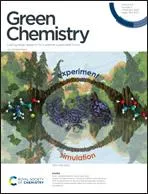
Green Chemistry
CiteScore:
16.1
自引率:
7.5%
年发文量:
944
Green Chemistry provides a unique forum for the publication of innovative research on the development of alternative green and sustainable technologies. The scope of Green Chemistry is based on, but not limited to, the definition proposed by Anastas and Warner (Green Chemistry: Theory and Practice, P T Anastas and J C Warner, Oxford University Press, Oxford, 1998). Green chemistry is the utilisation of a set of principles that reduces or eliminates the use or generation of hazardous substances in the design, manufacture and application of chemical products. Green Chemistry is at the frontiers of this continuously-evolving interdisciplinary science and publishes research that attempts to reduce the environmental impact of the chemical enterprise by developing a technology base that is inherently non-toxic to living things and the environment. Submissions on all aspects of research relating to the endeavour are welcome. The journal publishes original and significant cutting-edge research that is likely to be of wide general appeal. To be published, work must present a significant advance in green chemistry. Papers must contain a comparison with existing methods and demonstrate advantages over those methods before publication can be considered. For more information please see this Editorial. Coverage includes the following, but is not limited to: Design (e.g. biomimicry, design for degradation/recycling/reduced toxicity…) Reagents & Feedstocks (e.g. renewables, CO2, solvents, auxiliary agents, waste utilization…) Synthesis (e.g. organic, inorganic, synthetic biology…) Catalysis (e.g. homogeneous, heterogeneous, enzyme, whole cell…) Process (e.g. process design, intensification, separations, recycling, efficiency…) Energy (e.g. renewable energy, fuels, photovoltaics, fuel cells, energy storage, energy carriers…) Applications (e.g. electronics, dyes, consumer products, coatings, pharmaceuticals, preservatives, building materials, chemicals for industry/agriculture/mining…) Impact (e.g. safety, metrics, LCA, sustainability, (eco)toxicology…) Green chemistry is, by definition, a continuously-evolving frontier. Therefore, the inclusion of a particular material or technology does not, of itself, guarantee that a paper is suitable for the journal. To be suitable, the novel advance should have the potential for reduced environmental impact relative to the state of the art. Green Chemistry does not normally deal with research associated with 'end-of-pipe' or remediation issues.
推荐化合物
推荐供应商


免责声明
本页面提供的学术期刊信息仅供参考和研究使用。我们与任何期刊出版商均无关联,也不处理投稿事宜。如有投稿相关咨询,请直接联系相关期刊出版商。
如发现页面信息有误,请发送邮件至 support@chemtradehub.com 联系我们。我们将及时核实并处理您的问题。