








Evaluation of fundamental transport properties of Li-excess garnet-type Li5+2xLa3Ta2−xYxO12 (x = 0.25, 0.5 and 0.75) electrolytes using AC impedance and dielectric spectroscopy
文献信息
发布日期
2014-05-01
DOI
10.1039/C4CP00418C
影响因子
3.676
作者
Ashok Kumar Baral, Sumaletha Narayanan, Farshid Ramezanipour, Venkataraman Thangadurai
查看原文
摘要
The fundamental electrical transport properties including ionic conductivity, dielectric constants, loss tangent, and relaxation time constants of Li-excess garnet-type cubic (space group Iad) Li5+2xLa3Ta2−xYxO12 (x = 0.25, 0.5 and 0.75) have been studied in the temperature range of −50 to 50 °C using electrochemical AC impedance spectroscopy. A correlation has been established between the excess Li content and the Li+ ion migration pathways. The loss tangent (tan δ) for all samples exhibits a relaxation peak corresponding to the dielectric loss because of dipolar rotations due to Li+ migration. Comparing the modulus analysis of Li-excess garnets with fluorite-type oxygen ion conductors, we propose the local migration of Li+ ions between octahedral sites around the “immobile” Li+ ions in tetrahedral (24d) sites. In the samples with x = 0.25 and 0.5, Li+ ions seem to jump from one octahedral (96h) site to another bypassing the tetrahedral (24d) site between them (path A), both in local and long-range order migration processes, with activation energies of ∼0.69 and 0.54 eV, respectively. For the x = 0.75 member, Li+ ions exhibit mainly long-range order migration, with an activation energy of 0.34 eV, where the Li hopping between two octahedral sites occurs through the edge which is shared between the two LiO6 octahedra and a LiO4 tetrahedron (path B). The present AC impedance analysis is consistent with the ab initio theoretical analysis of Li-excess garnets that showed two conduction paths (A and B) for Li ion conduction with different activation energies.
相关文献
Metal extraction from a deep eutectic solvent, an insight into activities
Peng Cen, Mikhail S. Tyumentsev, Mark R. St. J. Foreman
2020-04-28
Paper
DOI: 10.1039/C9CP05982B
Yields of primary species in the low-linear energy transfer radiolysis of water in the temperature range of 25–700 °C
Abida Sultana, Jintana Meesungnoen, Jean-Paul Jay-Gerin
2020-03-18
Paper
DOI: 10.1039/D0CP00601G
Phosphorus-based metal-free Z-scheme 2D van der Waals heterostructures for visible-light photocatalytic water splitting: a first-principles study
Junyu Lang
2020-03-30
Paper
DOI: 10.1039/D0CP00637H
High-resolution resonance-enhanced multiphoton photoelectron circular dichroism
Alexander Kastner, Greta Koumarianou, Pavle Glodic, Peter C. Samartzis, Nicolas Ladda, Simon T. Ranecky, Tom Ring, Sudheendran Vasudevan, Constantin Witte, Hendrike Braun, Han-Gyeol Lee, Arne Senftleben, Robert Berger, Thomas Baumert
2020-03-16
Paper
DOI: 10.1039/D0CP00470G
Ligand binding to G-quadruplex DNA: new insights from ultraviolet resonance Raman spectroscopy
Silvia Di Fonzo, Jussara Amato, Federica D’Aria, Marco Caterino, Francesco D’Amico, Alessandro Gessini, John W. Brady, Bruno Pagano, Concetta Giancola
2020-03-25
Paper
DOI: 10.1039/D0CP01022G
The energetics of carbonated PuO2 surfaces affects nanoparticle morphology: a DFT+U study
Samuel Moxon, Adam R. Symington, Joshua S. Tse, James Dawson, Joseph M. Flitcroft, Stephen C. Parker, David J. Cooke, Robert M. Harker, Marco Molinari
2020-03-11
Paper
DOI: 10.1039/D0CP00021C
Molecular design of anti-spindle-like molecules by use of siloxanyl terminals for a thermotropic bicontinuous cubic phase
Akane Kawafuchi, Shoichi Kutsumizu, Yuki Kawase, Issei Tokiwa, Taro Udagawa, Yohei Miwa
2020-04-07
Paper
DOI: 10.1039/C9CP06831G
Microfluidic out-of-equilibrium control of molecular nanotubes
Björn Kriete, Carolien J. Feenstra, Maxim S. Pshenichnikov
2020-04-21
Paper
DOI: 10.1039/D0CP01734E
Hydrogen adsorption on two-dimensional germanene and its structural defects: an ab initio investigation
Tran Thi Thu Hanh, Nguyen Minh Phi, Nguyen Van Hoa
2020-03-04
Paper
DOI: 10.1039/D0CP00016G
您可能还喜欢
化合物问答
3 - (二氟甲基)-1 -氟苯(CAS号:26029-52-7)适用哪些法规指南?
3 - (二氟甲基)-1 -氟苯需遵循联合国全球化学品统一分类和标签制度(GHS),包括急性毒性、皮肤腐蚀/刺激、严重眼损伤/眼刺激等分类。同时,该化合物还需符...
26029-52-71-(Difluoromethyl)-3...
化合物问答
3,5-二甲基苯胺(CAS号:108-69-0)通常如何合成?
3,5-二甲基苯胺通常通过乙苯的氨解反应合成。反应中使用硫酸作为催化剂,反应温度为120-130°C。乙苯在硫酸存在下与氨反应,生成3,5-二甲基苯胺和苯胺副产...
108-69-03,5-Dimethylaniline
化合物问答
3-甲基异噻唑-5-胺(CAS号:24340-76-9)安全吗?
3-甲基异噻唑-5-胺在适当使用和储存条件下是相对安全的,但在操作时应注意防护措施。应避免吸入粉尘,避免与皮肤和眼睛直接接触。在操作过程中,应穿戴适当的防护装备...
24340-76-93-Methyl-1,2-thiazol...
化合物问答
3-(1,3-Thiazol-2-yl)-1H-indole(CAS号:135531-86-1)通常如何合成?
3-(1,3-噻唑-2-基)-1H-吲哚通常通过多步合成方法制备。首先,由噻唑-2-基溴化物和吲哚进行偶联反应,得到中间体。然后,通过还原反应将中间体转化为所需...
135531-86-13-(1,3-Thiazol-2-yl)...
化合物问答
4-溴-2-氟苯甲基氯(CAS号:85510-82-3)的主要用途是什么?
4-溴-2-氟苯甲基氯主要用于有机合成中间体,特别是在医药、农药和染料等领域。作为一种具有特定结构的化合物,它在合成复杂有机分子时扮演重要角色。
85510-82-34-Bromo-1-(chloromet...
化合物问答
处理Fmoc-β-(3-噻吩基)-D-Ala-OH(CAS号:220497-90-5)时应注意哪些实验室安全事项?
处理Fmoc-β-(3-噻吩基)-D-Ala-OH时,应佩戴防护手套、护目镜和实验服。操作应在通风橱内进行。如发生泄露,应立即用大量水冲洗,并通知实验室管理人员...
220497-90-5N-[(9H-Fluoren-9-ylm...
化合物问答
氮化硅(CAS号:12033-89-5)通常如何合成?
氮化硅通常通过氮化硅的直接反应合成,即在高温下将四氯化硅与氨气反应。具体步骤是将四氯化硅和氨气混合并加热至1300-1700℃,在该条件下,四氯化硅与氨气反应生...
12033-89-5Trisilicon tetranitr...
化合物问答
Cetirizine EP Impurity B DiHCl(CAS号:1000690-91-4)通常如何合成?
Cetirizine EP Impurity B DiHCl通常通过一锅法合成,首先将4-氯苯基-苯甲基氯甲酸酯与1-哌嗪乙酸反应,生成相应的酸,然后与盐酸反应...
1000690-91-4{4-[(4-Chlorophenyl)...
化合物问答
如何储存1-哌啶-4-基丁-1-酮(CAS号:3509-15-7)?
1-哌啶-4-基丁-1-酮应储存在阴凉、干燥的地方,避免阳光直射。存储容器应密封,并确保通风良好。建议储存温度不超过25℃,湿度保持在相对较低的水平。
3509-15-71-Piperidin-4-ylbuta...
化合物问答
如何处理含有VORUCICLIB(CAS号:1000023-04-0)的废料?
含有VORUCICLIB的废料应进行专业的收集和处理,包括使用适当的容器进行隔离,避免与其他化学品接触。处理方法通常包括化学中和、沉淀反应或吸附过程,随后进行焚...
1000023-04-02-[2-Chloro-4-(trifl...
来源期刊
Physical Chemistry Chemical Physics

CiteScore:
5.5
自引率:
10.3%
年发文量:
3036
Physical Chemistry Chemical Physics (PCCP) is an international journal co-owned by 19 physical chemistry and physics societies from around the world. This journal publishes original, cutting-edge research in physical chemistry, chemical physics and biophysical chemistry. To be suitable for publication in PCCP, articles must include significant innovation and/or insight into physical chemistry; this is the most important criterion that reviewers and Editors will judge against when evaluating submissions. The journal has a broad scope and welcomes contributions spanning experiment, theory, computation and data science. Topical coverage includes spectroscopy, dynamics, kinetics, statistical mechanics, thermodynamics, electrochemistry, catalysis, surface science, quantum mechanics, quantum computing and machine learning. Interdisciplinary research areas such as polymers and soft matter, materials, nanoscience, energy, surfaces/interfaces, and biophysical chemistry are welcomed if they demonstrate significant innovation and/or insight into physical chemistry. Joined experimental/theoretical studies are particularly appreciated when complementary and based on up-to-date approaches.
推荐化合物
![Pyrazolo[1,5-a]pyridine-3-carbothioamide structure](https://cnstatic.chemtradehub.com/structs/885/885275-44-5-aae0.webp "Pyrazolo[1,5-a]pyridine-3-carbothioamide structure")
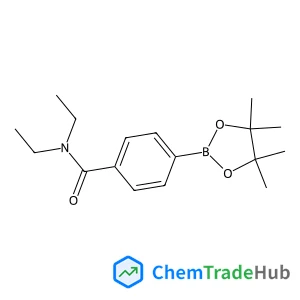
N,N-Diethyl-4-(4,4,5,5-tetramethyl-1,3,2-dioxaborolan-2-yl)benzamide
CAS号:
325142-99-2
分子式:
C17H26BNO3
推荐供应商




免责声明
本页面提供的学术期刊信息仅供参考和研究使用。我们与任何期刊出版商均无关联,也不处理投稿事宜。如有投稿相关咨询,请直接联系相关期刊出版商。
如发现页面信息有误,请发送邮件至 support@chemtradehub.com 联系我们。我们将及时核实并处理您的问题。