



Interstellar H adsorption and H2 formation on the crystalline (010) forsterite surface: a B3LYP-D2* periodic study
文献信息
发布日期
2014-04-15
DOI
10.1039/C4CP00819G
影响因子
3.676
作者
Javier Navarro-Ruiz, Mariona Sodupe, Piero Ugliengo, Albert Rimola
查看原文
摘要
The physisorption/chemisorption of atomic hydrogen on a slab model of the Mg2SiO4 forsterite (010) surface mimicking the interstellar dust particle surface has been modeled using a quantum mechanical approach based on periodic B3LYP-D2* density functional calculations (DFT) combined with flexible polarized Gaussian type basis sets, which allows a balanced description of the hydrogen/surface interactions for both minima and activated complexes. Physisorption of hydrogen is barrierless, very weak and occurs either close to surface oxygen atoms or on Mg surface ions. The contribution of dispersion interactions accounts for almost half of the adsorption energy. Both the hydrogen adsorption energy and barrier to hydrogen jump between equivalent surface sites are overestimated compared to experimental results meant to simulate the interstellar conditions in the laboratory. The hydrogen atom exclusively chemisorbs at the oxygen site of the forsterite (010) surface, forming a SiOH surface group and its spin density being entirely transferred to the neighboring Mg ion. Barrier for chemisorption allows rapid attachment of H at the surface at 100 K, but prevents the same process from occurring at 10 K. From this H-chemisorbed state, the second hydrogen chemisorption mainly occurs on the neighboring Mg ion, thus forming a Mg–H surface group, giving rise to a surface species stabilized by favorable electrostatic interactions between the OH⋯H–Mg pair. The formation of molecular hydrogen at the (010) forsterite surface adopting a Langmuir–Hinshelwood mechanism takes place either starting from two physisorbed H atoms with an almost negligible kinetic barrier through a spin–spin coupling driven reaction or from two chemisorbed H atoms with a barrier surmountable even at T higher than 10 K. We also suggest that a nanosized model of the interstellar dust built from a replica of the forsterite unit cell is able to adsorb half the energy released by the H2 formation by increasing its temperature by about 50 K which could then radiate in about 0.02 s.
相关文献
Ion migration in Br-doped MAPbI3 and its inhibition mechanisms investigated via quantum dynamics simulations
Yinjie Liao, Lei Tong, Yieqin Yang, Xiaogang Wang
2020-03-10
Paper
DOI: 10.1039/D0CP00866D
Composition conserving defects and their influence on the electronic properties of thermoelectric TiNiSn
K. Kirievsky, D. Fuks, Y. Gelbstein
2020-03-12
Paper
DOI: 10.1039/D0CP00956C
Role of hemibonding in the structure and ultraviolet spectroscopy of the aqueous hydroxyl radical
Bhaskar Rana, John M. Herbert
2020-11-12
Paper
DOI: 10.1039/D0CP05216G
On the chemiluminescence emission of luminol: protic and aprotic solvents and encapsulation to improve the properties in aqueous solution
Angelo Giussani, Mercedes Rubio, Daniel Roca-Sanjuán
2020-11-18
Paper
DOI: 10.1039/D0CP04571C
Incorporation of trivalent cations in NaX zeolite nanocrystals for the adsorption of O2 in the presence of CO2
Sarah Komaty, Ayoub Daouli, Michael Badawi, Clément Anfray, Moussa Zaarour, Samuel Valable, Svetlana Mintova
2020-04-14
Paper
DOI: 10.1039/D0CP00111B
The effect of N-heterocyclic carbene units on the absorption spectra of Fe(ii) complexes: a challenge for theory
Omar Baig, Oliver Kühn, Leticia González
2020-11-20
Paper
DOI: 10.1039/D0CP04781C
Hydrogen adsorption on two-dimensional germanene and its structural defects: an ab initio investigation
Tran Thi Thu Hanh, Nguyen Minh Phi, Nguyen Van Hoa
2020-03-04
Paper
DOI: 10.1039/D0CP00016G
Tuning of ORR activity through the stabilization of the adsorbates by hydrogen bonding with substituent groups
Nagaprasad Reddy Samala, Ilya Grinberg
2020-11-04
Paper
DOI: 10.1039/D0CP04478D
Interplay between aggregation number, micelle charge and hydration of catanionic surfactants
Žiga Medoš, Sergej Friesen, Richard Buchner, Marija Bešter-Rogač
2020-04-17
Paper
DOI: 10.1039/D0CP00877J
您可能还喜欢
化合物问答
3 - (二氟甲基)-1 -氟苯(CAS号:26029-52-7)适用哪些法规指南?
3 - (二氟甲基)-1 -氟苯需遵循联合国全球化学品统一分类和标签制度(GHS),包括急性毒性、皮肤腐蚀/刺激、严重眼损伤/眼刺激等分类。同时,该化合物还需符...
26029-52-71-(Difluoromethyl)-3...
化合物问答
3,5-二甲基苯胺(CAS号:108-69-0)通常如何合成?
3,5-二甲基苯胺通常通过乙苯的氨解反应合成。反应中使用硫酸作为催化剂,反应温度为120-130°C。乙苯在硫酸存在下与氨反应,生成3,5-二甲基苯胺和苯胺副产...
108-69-03,5-Dimethylaniline
化合物问答
3-甲基异噻唑-5-胺(CAS号:24340-76-9)安全吗?
3-甲基异噻唑-5-胺在适当使用和储存条件下是相对安全的,但在操作时应注意防护措施。应避免吸入粉尘,避免与皮肤和眼睛直接接触。在操作过程中,应穿戴适当的防护装备...
24340-76-93-Methyl-1,2-thiazol...
化合物问答
3-(1,3-Thiazol-2-yl)-1H-indole(CAS号:135531-86-1)通常如何合成?
3-(1,3-噻唑-2-基)-1H-吲哚通常通过多步合成方法制备。首先,由噻唑-2-基溴化物和吲哚进行偶联反应,得到中间体。然后,通过还原反应将中间体转化为所需...
135531-86-13-(1,3-Thiazol-2-yl)...
化合物问答
4-溴-2-氟苯甲基氯(CAS号:85510-82-3)的主要用途是什么?
4-溴-2-氟苯甲基氯主要用于有机合成中间体,特别是在医药、农药和染料等领域。作为一种具有特定结构的化合物,它在合成复杂有机分子时扮演重要角色。
85510-82-34-Bromo-1-(chloromet...
化合物问答
处理Fmoc-β-(3-噻吩基)-D-Ala-OH(CAS号:220497-90-5)时应注意哪些实验室安全事项?
处理Fmoc-β-(3-噻吩基)-D-Ala-OH时,应佩戴防护手套、护目镜和实验服。操作应在通风橱内进行。如发生泄露,应立即用大量水冲洗,并通知实验室管理人员...
220497-90-5N-[(9H-Fluoren-9-ylm...
化合物问答
氮化硅(CAS号:12033-89-5)通常如何合成?
氮化硅通常通过氮化硅的直接反应合成,即在高温下将四氯化硅与氨气反应。具体步骤是将四氯化硅和氨气混合并加热至1300-1700℃,在该条件下,四氯化硅与氨气反应生...
12033-89-5Trisilicon tetranitr...
化合物问答
Cetirizine EP Impurity B DiHCl(CAS号:1000690-91-4)通常如何合成?
Cetirizine EP Impurity B DiHCl通常通过一锅法合成,首先将4-氯苯基-苯甲基氯甲酸酯与1-哌嗪乙酸反应,生成相应的酸,然后与盐酸反应...
1000690-91-4{4-[(4-Chlorophenyl)...
化合物问答
如何储存1-哌啶-4-基丁-1-酮(CAS号:3509-15-7)?
1-哌啶-4-基丁-1-酮应储存在阴凉、干燥的地方,避免阳光直射。存储容器应密封,并确保通风良好。建议储存温度不超过25℃,湿度保持在相对较低的水平。
3509-15-71-Piperidin-4-ylbuta...
化合物问答
如何处理含有VORUCICLIB(CAS号:1000023-04-0)的废料?
含有VORUCICLIB的废料应进行专业的收集和处理,包括使用适当的容器进行隔离,避免与其他化学品接触。处理方法通常包括化学中和、沉淀反应或吸附过程,随后进行焚...
1000023-04-02-[2-Chloro-4-(trifl...
来源期刊
Physical Chemistry Chemical Physics

CiteScore:
5.5
自引率:
10.3%
年发文量:
3036
Physical Chemistry Chemical Physics (PCCP) is an international journal co-owned by 19 physical chemistry and physics societies from around the world. This journal publishes original, cutting-edge research in physical chemistry, chemical physics and biophysical chemistry. To be suitable for publication in PCCP, articles must include significant innovation and/or insight into physical chemistry; this is the most important criterion that reviewers and Editors will judge against when evaluating submissions. The journal has a broad scope and welcomes contributions spanning experiment, theory, computation and data science. Topical coverage includes spectroscopy, dynamics, kinetics, statistical mechanics, thermodynamics, electrochemistry, catalysis, surface science, quantum mechanics, quantum computing and machine learning. Interdisciplinary research areas such as polymers and soft matter, materials, nanoscience, energy, surfaces/interfaces, and biophysical chemistry are welcomed if they demonstrate significant innovation and/or insight into physical chemistry. Joined experimental/theoretical studies are particularly appreciated when complementary and based on up-to-date approaches.
推荐化合物
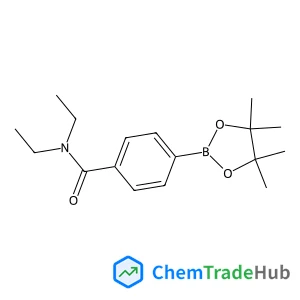
N,N-Diethyl-4-(4,4,5,5-tetramethyl-1,3,2-dioxaborolan-2-yl)benzamide
CAS号:
325142-99-2
分子式:
C17H26BNO3
推荐供应商





免责声明
本页面提供的学术期刊信息仅供参考和研究使用。我们与任何期刊出版商均无关联,也不处理投稿事宜。如有投稿相关咨询,请直接联系相关期刊出版商。
如发现页面信息有误,请发送邮件至 support@chemtradehub.com 联系我们。我们将及时核实并处理您的问题。