


Failure mechanisms of nano-silicon anodes upon cycling: an electrode porosity evolution model
文献信息
发布日期
2014-06-09
DOI
10.1039/C4CP02324B
影响因子
3.676
作者
Etienne Radvanyi, Willy Porcher, Eric De Vito, Alexandre Montani, Sylvain Franger, Séverine Jouanneau Si Larbi
查看原文
摘要
With a specific capacity of 3600 mA h g−1, silicon is a promising anode active material for Li-ion batteries (LIBs). However, because of the huge volume changes undergone by Si particles upon (de)alloying with lithium, Si electrodes suffer from rapid capacity fading. A deep understanding of the associated failure mechanisms is necessary to improve these electrochemical performances. To reach this goal, we investigate here nano-Si based electrodes by several characterization techniques. Thanks to all these techniques, many aspects, such as the behaviour of the active material or the solid electrolyte interphase (SEI) and the lithiation mechanisms, are studied upon cycling. A clear picture of the failure mechanisms of nano-Si based electrodes is provided. In particular, by combining Hg analyses, SEM observations of electrode cross-sections, and EIS measurements, we follow the evolution of the porosity within the electrode. For the first time, our results clearly show a real dynamic of the pore size distribution: the first cycles lead to the formation of a micrometric porosity which is not present initially. During the following cycles, these large pores are progressively filled up with SEI products which form continuously at the Si particle surface. Thus, from the 50th cycle, Li+ ion diffusion is dramatically hindered leading to a strongly heterogeneous lithiation of the electrode and a rapid capacity fading.
相关文献
Initiated and oxidative chemical vapor deposition: a scalable method for conformal and functional polymer films on real substrates
Salmaan H. Baxamusa, Sung Gap Im, Karen K. Gleason
2009-03-26
Perspective
DOI: 10.1039/B900455F
Nitrogen dioxide reactions with atomic lanthanide cations and their monoxides: gas-phase kinetics at room temperature
Michael J. Y. Jarvis, Voislav Blagojevic, Gregory K. Koyanagi, Diethard K. Bohme
2010-03-05
Paper
DOI: 10.1039/B925576A
Direct spectroscopic detection of framework-incorporated vanadium in mesoporous silica materials‡§
Sepideh Zamani, Vera Meynen, Myrjam Mertens, Eveline Popovici, Sabine Van Doorslaer, Pegie Cool
2009-05-08
Paper
DOI: 10.1039/B819442B
Time-resolved spectroscopy of dye-labeled photoactive yellow protein suggests a pathway of light-induced structural changes in the N-terminal cap
Daniel Hoersch, Harald Otto, Michael A. Cusanovich, Maarten P. Heyn
2009-03-03
Paper
DOI: 10.1039/B821345C
Adsorption of cyanodiacetylene on ice: a periodic approach
Frédéric Labat, Claude Pouchan
2009-05-12
Paper
DOI: 10.1039/B817809G
Photoabsorption measurements and theoretical calculations of the electronic state spectroscopy of propionic, butyric, and valeric acids
A. Vicente, R. Antunes, D. Almeida, I. J. A. Franco, S. V. Hoffmann, N. J. Mason, S. Eden, D. Duflot, S. Canneaux, J. Delwiche, M.-J. Hubin-Franskin
2009-05-07
Paper
DOI: 10.1039/B823500G
Electron energy loss spectroscopy and anion formation in gas phase coronene
2009-05-19
Paper
DOI: 10.1039/B904614C
Frequency of negative differential resistance electrochemical oscillators: theory and experiments
István Z. Kiss, Lindsey N. Pelster, Mahesh Wickramasinghe
2009-05-08
Paper
DOI: 10.1039/B904650J
Defect interactions and ionic transport in scandia stabilized zirconia
R. Devanathan, S. Thevuthasan, J. D. Gale
2009-04-22
Paper
DOI: 10.1039/B902764E
您可能还喜欢
化合物问答
2-Bromo-4-chloro-1-(difluoromethyl)benzene(CAS号:1261476-50-9)的市场或研究趋势如何?
随着环保要求的提高和安全意识的增强,该化合物的研究和应用趋势正逐渐转向更安全、更环境友好的替代品。市场关注点主要集中在开发新型合成方法和绿色化学路径,以减少有害...
1261476-50-92-Bromo-4-chloro-1-(...
化合物问答
如何处理含有2,9 - 二苯基-1,10 - 菲罗啉(CAS号:25677-69-4)的废料?
处理含有2,9 - 二苯基 - 1,10 - 菲罗啉的废料时,应先将其收集在适当的容器中,避免与其他化学品混合。随后,可以通过水解或氧化等方法进行处理,直至达到...
25677-69-42,9-Diphenyl-1,10-ph...
化合物问答
处理(6-氯-吡嗪-3-基)-(4-乙基-哌嗪-1-基)-甲酮(CAS号:1178836-15-1)时应注意哪些实验室安全事项?
处理(6-氯-吡嗪-3-基)-(4-乙基-哌嗪-1-基)-甲酮时,应穿戴适当的个人防护装备(PPE),包括手套、护目镜和实验室外套。在通风橱中操作以确保良好的通...
1178836-15-1(6-Chloro-3-pyridazi...
化合物问答
处理(R)-2-氯-1-(2,4-二氯苯基)乙醇(CAS号:114446-57-0)时应注意哪些实验室安全事项?
在处理(R)-2-氯-1-(2,4-二氯苯基)乙醇时,应佩戴防护眼镜、实验室外套和手套,确保通风橱开启以减少接触和吸入的风险。避免直接接触皮肤和眼睛。处理过程中...
114446-57-0(1R)-2-Chloro-1-(2,4...
化合物问答
在合成中是否有3-氯-6-(3-氯哌啶-1-基)吡嗪(CAS号:1185310-37-5)的替代品?
可考虑使用类似结构的化合物作为替代品,如3-氯-6-(哌啶-1-基)吡嗪或3-氯-6-(2-氯哌啶-1-基)吡嗪,这些化合物在结构上与目标化合物相似,可能具有相...
1185310-37-53-Chloro-6-(3-chloro...
化合物问答
苯并三氮唑-5-甲酸乙酯(CAS号:73605-91-1)通常如何合成?
该化合物可以通过乙酸乙酯与5-溴-1H-苯并三氮唑的反应合成,通常在无水条件下进行。合成过程中,需要使用适当的溶剂如乙酸乙酯,并在适当的温度下反应。该反应具有较...
73605-91-1Ethyl 1H-benzotriazo...
化合物问答
什么是一水硫酸镁(CAS号:14168-73-1)?
一水硫酸镁是一种无机化合物,化学式为MgSO₄·H₂O,CAS号为14168-73-1。它由镁离子、硫酸根离子和一个结晶水分子组成,通常呈现为白色粉末或颗粒状固...
14168-73-1Magnesium sulfate hy...
化合物问答
氘代-1,3-二氯-2-丙醇(CAS号:1173020-20-6)应用于哪些行业?
氘代-1,3-二氯-2-丙醇主要应用于医药和有机合成领域,作为研究化合物的氘代替代品,用于标记和追踪反应过程。此外,在聚合物和半导体生产中也有一定的应用潜力。
1173020-20-61,3-Dichloro-2-(~2~H...
化合物问答
如何储存氰乙酸环己酯(CAS号:52688-11-6)?
氰乙酸环己酯应储存在阴凉、干燥、通风良好的环境中,远离火源和热源,防止阳光直射。储存容器应密封良好,避免与空气接触,防止发生不必要的反应。
52688-11-6Cyclohexyl cyanoacet...
化合物问答
2-碘-4-硝基苯胺(CAS号:6293-83-0)的市场或研究趋势如何?
目前,2-碘-4-硝基苯胺在医药和农药领域有一定的研究和应用,尤其是在开发新型药物和农药产品方面。然而,由于其潜在的环境和健康风险,行业正趋向于寻找更为安全和环...
6293-83-02-iodo-4-nitroanilin...
来源期刊
Physical Chemistry Chemical Physics

CiteScore:
5.5
自引率:
10.3%
年发文量:
3036
Physical Chemistry Chemical Physics (PCCP) is an international journal co-owned by 19 physical chemistry and physics societies from around the world. This journal publishes original, cutting-edge research in physical chemistry, chemical physics and biophysical chemistry. To be suitable for publication in PCCP, articles must include significant innovation and/or insight into physical chemistry; this is the most important criterion that reviewers and Editors will judge against when evaluating submissions. The journal has a broad scope and welcomes contributions spanning experiment, theory, computation and data science. Topical coverage includes spectroscopy, dynamics, kinetics, statistical mechanics, thermodynamics, electrochemistry, catalysis, surface science, quantum mechanics, quantum computing and machine learning. Interdisciplinary research areas such as polymers and soft matter, materials, nanoscience, energy, surfaces/interfaces, and biophysical chemistry are welcomed if they demonstrate significant innovation and/or insight into physical chemistry. Joined experimental/theoretical studies are particularly appreciated when complementary and based on up-to-date approaches.
推荐化合物
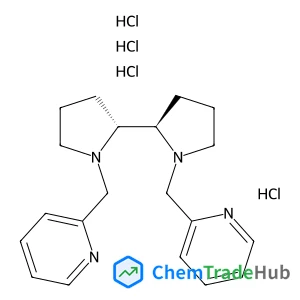
(2R,2'R)-1,1'-Bis(2-pyridinylmethyl)-2,2'-bipyrrolidine tetrahydrochloride
CAS号:
1228077-88-0
分子式:
C20H30Cl4N4
推荐供应商




免责声明
本页面提供的学术期刊信息仅供参考和研究使用。我们与任何期刊出版商均无关联,也不处理投稿事宜。如有投稿相关咨询,请直接联系相关期刊出版商。
如发现页面信息有误,请发送邮件至 support@chemtradehub.com 联系我们。我们将及时核实并处理您的问题。