




Probing a chemical compass: novel variants of low-frequency reaction yield detected magnetic resonance
文献信息
发布日期
2014-12-24
DOI
10.1039/C4CP04095C
影响因子
3.676
作者
Kiminori Maeda, Jonathan G. Storey, Paul A. Liddell, Devens Gust, P. J. Hore, C. J. Wedge, Christiane R. Timmel
查看原文
摘要
We present a study of a carotenoid–porphyrin–fullerene triad previously shown to function as a chemical compass: the photogenerated carotenoid–fullerene radical pair recombines at a rate sensitive to the orientation of an applied magnetic field. To characterize the system we develop a time-resolved Low-Frequency Reaction Yield Detected Magnetic Resonance (tr-LF-RYDMR) technique; the effect of varying the relative orientation of applied static and 36 MHz oscillating magnetic fields is shown to be strongly dependent on the strength of the oscillating magnetic field. RYDMR is a diagnostic test for involvement of the radical pair mechanism in the magnetic field sensitivity of reaction rates or yields, and has previously been applied in animal behavioural experiments to verify the involvement of radical-pair-based intermediates in the magnetic compass sense of migratory birds. The spectroscopic selection rules governing RYDMR are well understood at microwave frequencies for which the so-called ‘high-field approximation’ is valid, but at lower frequencies different models are required. For example, the breakdown of the rotating frame approximation has recently been investigated, but less attention has so far been given to orientation effects. Here we gain physical insights into the interplay of the different magnetic interactions affecting low-frequency RYDMR experiments performed in the challenging regime in which static and oscillating applied magnetic fields as well as internal electron–nuclear hyperfine interactions are of comparable magnitude. Our observations aid the interpretation of existing RYDMR-based animal behavioural studies and will inform future applications of the technique to verify and characterize further the biological receptors involved in avian magnetoreception.
相关文献
Influence of NO and (NO)2 adsorption on the properties of Fe-N4 porphyrin-like graphene sheets
Elham Ashori, Francesc Illas
2017-01-03
Paper
DOI: 10.1039/C6CP07898B
Single-molecule force spectroscopy of fast reversible bonds
Johanna Blass, Marcel Albrecht, Gerhard Wenz, Yan Nan Zang, Roland Bennewitz
2017-01-25
Paper
DOI: 10.1039/C6CP07532K
On the multi-reference nature of plutonium oxides: PuO22+, PuO2, PuO3 and PuO2(OH)2
Florent Réal, Paweł Tecmer, André Severo Pereira Gomes, Örs Legeza, Paul W. Ayers, Valérie Vallet
2017-01-13
Paper
DOI: 10.1039/C6CP05429C
Cobalt disulfide/graphite foam composite films as self-standing electrocatalytic electrodes for overall water splitting
Yue Tong, Xiaowen Yu, Gaoquan Shi
2017-01-16
Paper
DOI: 10.1039/C6CP08176B
Prediction of a novel 10-fold gold coordinated structure in AuIn2 above 10 GPa
P. Modak, Ashok K. Verma
2017-01-06
Paper
DOI: 10.1039/C6CP07805B
Photoassist-phosphorylated TiO2 as a catalyst for direct formation of 5-(hydroxymethyl)furfural from glucose
Masashi Hattori, Keigo Kamata
2016-12-23
Paper
DOI: 10.1039/C6CP06864B
Molecular dynamics simulations of the effect of waviness and agglomeration of CNTs on interface strength of thermoset nanocomposites
A. R. Alian, S. A. Meguid
2017-01-13
Paper
DOI: 10.1039/C6CP07464B
Ligand non-innocence and strong correlation in manganese superoxide dismutase mimics
Alexandra R. McIsaac, David A. Mazziotti
2017-01-26
Paper
DOI: 10.1039/C6CP07563K
An insight into the communication between β-olefin/phenyl olefin-mediated acceptors and porphyrin π-system: a way to establish porphyrin based chemodosimeters and chemosensors
Mandeep K. Chahal, Muniappan Sankar, Ray J. Butcher
2017-01-04
Paper
DOI: 10.1039/C6CP08396J
您可能还喜欢
化合物问答
6-氯-2H-1,4-苯并噁嗪-3(4H)-酮(CAS号:7652-29-1)应用于哪些行业?
6-氯-2H-1,4-苯并噁嗪-3(4H)-酮主要应用于医药、农药和聚合物等领域。在医药领域,该化合物可用于合成抗菌药物;在农药领域,可用作杀虫剂的中间体;在聚...
7652-29-16-Chloro-2H-1,4-benz...
化合物问答
活性氧化铝(CAS号:1302-74-5)应用于哪些行业?
活性氧化铝广泛应用于医药、聚合物、传感器、半导体和催化等领域。在医药行业,活性氧化铝用作吸附剂和干燥剂,有助于去除杂质和水分。在聚合物行业,它用作增白剂和抗结块...
1302-74-5aluminum;trihydrate
化合物问答
什么是硅胶(CAS号:112926-00-8)?
硅胶(Silica gel, pptd.,cryst.-free)是一种无定形、多孔的硅酸盐材料,主要成分为二氧化硅(SiO₂)。其结构由硅氧四面体构成,通过酸...
112926-00-8Silica gel, pptd.,cr...
化合物问答
二乙基甲基一氢硅烷(CAS号:760-32-7)的主要用途是什么?
二乙基甲基一氢硅烷主要用于有机合成、表面处理以及作为溶剂。它还被用作合成其他硅烷化合物的原料,以及在涂料、粘合剂和密封剂中的应用。
760-32-7Diethyl(methyl)silan...
化合物问答
在合成中是否有N-花生四烯酰基甘氨酸(CAS号:179113-91-8)的替代品?
在合成过程中,可以考虑使用类似结构的化合物作为替代品,例如N-亚油酰基甘氨酸或N-花生二烯酰基甘氨酸。这些替代品在结构上有类似的双键位置,但可能具有不同的物理化...
179113-91-8Glycine, N-[(5Z,8Z,1...
化合物问答
在合成中是否有1-(4-甲氧基苯基)丙烷-1,2-二酮(CAS号:10557-27-4)的替代品?
在合成过程中,可以考虑使用类似结构的化合物作为替代品,例如1-(3-甲氧基苯基)丙烷-1,2-二酮或1-(4-羟基苯基)丙烷-1,2-二酮。这些替代品具有相似的...
10557-27-41-(4-Methoxyphenyl)p...
化合物问答
N-(4-氨基-1-苄基-3-羟基-5-苯基戊基)-3-甲基-2-(2-氧代四氢嘧啶-1-基)-丁酰胺 5-氧代吡咯烷-2-甲酸(CAS号:192726-06-0)通常如何合成?
该化合物通常通过一系列复杂的有机合成步骤获得。首先,通过芳香族化合物的羟基化反应获得羟基化产物,然后通过酰化反应形成酰胺中间体,最后通过环化反应得到目标产物。常...
192726-06-05-Oxo-L-proline - (2...
化合物问答
(S)-2-氨基-3-喹啉-2-丙酸(CAS号:161513-46-8)的市场或研究趋势如何?
该化合物作为生物活性化合物,尤其是在药物化学领域表现出色。近年来,随着对新型抗炎、抗病毒和抗癌药物的研究增加,其市场和研究趋势持续增长。此外,其在神经科学领域的...
161513-46-8(S)-2-Amino-3-quinol...
化合物问答
核黄素磷酸钠(CAS号:130-40-5)安全吗?
核黄素磷酸钠在常规使用条件下安全,但高剂量可能引起刺激性反应。操作时需佩戴防护手套和护目镜,避免吸入粉尘。若接触皮肤或眼睛,应立即用大量清水冲洗。急救时需根据接...
130-40-5Sodium 1-deoxy-1-(7,...
化合物问答
盐酸丙胺卡因杂质A(EP) 标准品(CAS号:19281-31-3)通常如何合成?
盐酸丙胺卡因杂质A(EP) 标准品可通过重氮化反应和随后的酰胺化反应合成。首先,利用氯化反应将苯环上的氢原子转化为氯原子,然后通过芳香族重氮化反应引入氨基,最后...
19281-31-32-Chloro-N-(2-methyl...
来源期刊
Physical Chemistry Chemical Physics

CiteScore:
5.5
自引率:
10.3%
年发文量:
3036
Physical Chemistry Chemical Physics (PCCP) is an international journal co-owned by 19 physical chemistry and physics societies from around the world. This journal publishes original, cutting-edge research in physical chemistry, chemical physics and biophysical chemistry. To be suitable for publication in PCCP, articles must include significant innovation and/or insight into physical chemistry; this is the most important criterion that reviewers and Editors will judge against when evaluating submissions. The journal has a broad scope and welcomes contributions spanning experiment, theory, computation and data science. Topical coverage includes spectroscopy, dynamics, kinetics, statistical mechanics, thermodynamics, electrochemistry, catalysis, surface science, quantum mechanics, quantum computing and machine learning. Interdisciplinary research areas such as polymers and soft matter, materials, nanoscience, energy, surfaces/interfaces, and biophysical chemistry are welcomed if they demonstrate significant innovation and/or insight into physical chemistry. Joined experimental/theoretical studies are particularly appreciated when complementary and based on up-to-date approaches.
推荐化合物
![4-{2-[4-(2-Methyl-2-propanyl)phenyl]ethoxy}quinazoline structure](https://cnstatic.chemtradehub.com/structs/120/120928-09-8-d3db.webp "4-{2-[4-(2-Methyl-2-propanyl)phenyl]ethoxy}quinazoline structure")
![[4-(Heptyloxy)phenyl]boronic acid structure](https://cnstatic.chemtradehub.com/structs/136/136370-19-9-ad33.webp "[4-(Heptyloxy)phenyl]boronic acid structure")
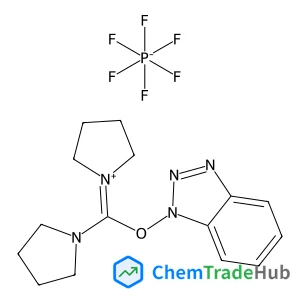
(1H-Benzotriazol-1-yloxy)(di-1-pyrrolidinyl)methylium hexafluorophosphate
CAS号:
105379-24-6
分子式:
C15H21F6N5OP
![1,2-Diphenyl-4-[2-(phenylsulfinyl)ethyl]-3,5-pyrazolidinedione structure](https://cnstatic.chemtradehub.com/structs/57-/57-96-5-efcc.webp "1,2-Diphenyl-4-[2-(phenylsulfinyl)ethyl]-3,5-pyrazolidinedione structure")
推荐供应商






免责声明
本页面提供的学术期刊信息仅供参考和研究使用。我们与任何期刊出版商均无关联,也不处理投稿事宜。如有投稿相关咨询,请直接联系相关期刊出版商。
如发现页面信息有误,请发送邮件至 support@chemtradehub.com 联系我们。我们将及时核实并处理您的问题。