












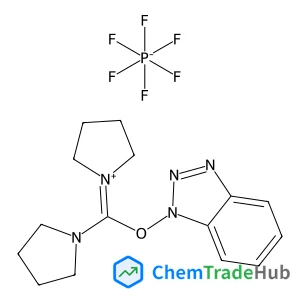
(1H-Benzotriazol-1-yloxy)(di-1-pyrrolidinyl)methylium hexafluorophosphate
CAS号:
105379-24-6
分子式:
C15H21F6N5OP
Agnieszka Adamska-Venkatesh, Trevor R. Simmons, Judith F. Siebel, Vincent Artero, Edward Reijerse, Wolfgang Lubitz
Hydrogenases are enzymes that catalyze the oxidation of H2 as well as the reduction of protons to form H2. The active site of [FeFe] hydrogenase is referred to as the “H-cluster” and consists of a “classical” [4Fe–4S] cluster connected via a bridging cysteine thiol group to a unique [2Fe]H sub-cluster, containing CN− and CO ligands as well as a bidentate azadithiolate ligand. It has been recently shown that the biomimetic [Fe2(adt)(CO)4(CN)2]2− (adt2− = azadithiolate) complex resembling the diiron sub-cluster can be inserted in vitro into the apo-protein of [FeFe] hydrogenase, which contains only the [4Fe–4S] part of the H-cluster, resulting in a fully active enzyme. This synthetic tool allows convenient incorporation of a variety of diiron mimics, thus generating hydrogenases with artificial active sites. [FeFe] hydrogenase from Chlamydomonas reinhardtii maturated with the biomimetic complex [Fe2(pdt)(CO)4(CN)2]2− (pdt2− = propanedithiolate), in which the bridging adt2− ligand is replaced by pdt2−, can be stabilized in a state strongly resembling the active oxidized (Hox) state of the native protein. This state is EPR active and the signal originates from the mixed valence FeIFeII state of the diiron sub-cluster. Taking advantage of the variant with 15N and 13C isotope labeled CN− ligands we performed HYSCORE and ENDOR studies on this hybrid protein. The 13C hyperfine couplings originating from both CN− ligands were determined and assigned. Only the 15N coupling from the CN− ligand bound to the terminal iron was observed. Detailed orientation selective ENDOR and HYSCORE experiments at multiple field positions enabled the extraction of accurate data for the relative orientations of the nitrogen and carbon hyperfine tensors. These data are consistent with the crystal structure assuming a g-tensor orientation following the local symmetry of the binuclear sub-cluster.
Yuan-Yuan Ren, Shou-Fei Zhu
DOI: 10.1039/C8OB00473K
Lorenzo Sernissi, Luciano Ricci, Dina Scarpi, Francesca Bianchini, Daniela Arosio, Alessandro Contini, Ernesto G. Occhiato
DOI: 10.1039/C8OB00534F
K. Gruhle, S. Müller, A. Meister, S. Drescher
DOI: 10.1039/C8OB00424B
Qun-yan Wu, Shuai Wang, Zhi-wei Huang, Kong-qiu Hu, Ji-pan Yu, Lei Mei, Meng Zhang
DOI: 10.1039/D1QO00536G
Jinhui Shen, Yang Yang, Xiaoli Hou, Wenlei Zeng, Aimin Yu, Xiaowei Zhao, Xiangtai Meng
DOI: 10.1039/C8OB00402A
Shanshan Ma, Aimin Yu, Xiangtai Meng
DOI: 10.1039/C8OB00004B
Jixing Li, Wenxia Cong, Jinlong Zhang, Huameng Yang, Gaoxi Jiang
DOI: 10.1039/C8OB00318A
Paul R. Savoie, Cortney N. von Hahmann, Alexander Penger, Zheng Wei, John T. Welch
DOI: 10.1039/C7OB03146G
Hang T. Dang, Vu T. Nguyen, Viet D. Nguyen, Hadi D. Arman, Oleg V. Larionov
DOI: 10.1039/C8OB00745D
DOI: 10.1039/C8OB00469B
该化合物需遵循REACH法规以确保其安全使用和管理。同时,根据其潜在的生物降解性和毒性,也需要符合GHS分类中的相应要求。此外,若用于医药或食品相关领域,则还需...
反式-度骨化醇是一种脂溶性维生素D3的衍生物,呈无色或白色结晶性粉末,不溶于水,溶于乙醇、丙酮、氯仿等有机溶剂。其分子式为C28H44O,分子量为404.65。...
莲花掌苷作为一种天然产物,近年来在抗炎、抗癌等生物活性研究方面显示出一定的潜力,因此市场需求逐渐增长。市场动态方面,随着天然产物开发的深入,预计该化合物的研究会...
2-溴-6-(吡咯烷-1-基)吡啶-4-硼酸频那醇酯在医药领域有着广泛的应用,它可以用作药物合成中的中间体。此外,它还可以用于有机合成,特别是在构建复杂杂环化合...
methyl 2-(4-溴苯基)-3-甲基丁酸甲酯是一种化学物质,分子式为C12H13BrO2。它是一种有机化合物,具有一定的挥发性和易燃性。
CJC1-295是一种具有复杂肽链结构的化合物,其分子量约为1875 Da。该化合物在水中具有一定的溶解性,但在有机溶剂中的溶解性不佳。它是一种反应活性化合物,...
三正丁基锍碘作为一种重要的有机硫化合物,主要用于有机合成中作为亲电试剂。近年来,由于其在合成中的广泛应用,市场对其需求持续增长。此外,随着绿色化学的发展,对其替...
雌二醇-[13C3]同位素内标通常通过在雌二醇分子中引入[13C3]同位素来合成。常见的方法是通过化学标记反应,如与[13C3]标记的甲基溴化物进行亲核取代反应...
N1-(2-吡啶甲基)-N2-(2-甲基-1-萘基)草酰胺为固体化合物,具有良好的结晶形态,分子量为340.34 g/mol。该化合物在水中的溶解度较低,但在有...
含有十五碳烯酸甲酯(顺-10)(C15:1)标准品的废料应首先进行适当收集和储存,避免与其他化学品混合。然后,可采用焚烧或交由专业废物处理公司进行处理。处理过程...

Physical Chemistry Chemical Physics (PCCP) is an international journal co-owned by 19 physical chemistry and physics societies from around the world. This journal publishes original, cutting-edge research in physical chemistry, chemical physics and biophysical chemistry. To be suitable for publication in PCCP, articles must include significant innovation and/or insight into physical chemistry; this is the most important criterion that reviewers and Editors will judge against when evaluating submissions. The journal has a broad scope and welcomes contributions spanning experiment, theory, computation and data science. Topical coverage includes spectroscopy, dynamics, kinetics, statistical mechanics, thermodynamics, electrochemistry, catalysis, surface science, quantum mechanics, quantum computing and machine learning. Interdisciplinary research areas such as polymers and soft matter, materials, nanoscience, energy, surfaces/interfaces, and biophysical chemistry are welcomed if they demonstrate significant innovation and/or insight into physical chemistry. Joined experimental/theoretical studies are particularly appreciated when complementary and based on up-to-date approaches.

![5-Acetyl-2,3-dihydrobenzo[b]furan structure](https://cnstatic.chemtradehub.com/structs/908/90843-31-5-eea4.webp "5-Acetyl-2,3-dihydrobenzo[b]furan structure")




