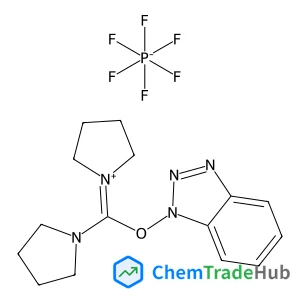
(1H-Benzotriazol-1-yloxy)(di-1-pyrrolidinyl)methylium hexafluorophosphate
CAS号:
105379-24-6
分子式:
C15H21F6N5OP
Xiaotian Kong, Peichen Pan, Dan Li, Sheng Tian, Youyong Li
Anaplastic lymphoma kinase (ALK) has gained increased attention as an attractive therapeutic target for the treatment of various cancers, especially non-small-cell lung cancer (NSCLC). Recently, piperidine carboxamides were reported as Type I1/2 inhibitors of ALK, which occupy both the ATP binding site and the back ATP hydrophobic cavity in DFG-in conformation. Due to the dynamic behavior of ALK in the binding of Type I1/2 inhibitors, the accurate predictions of the binding structures and relative binding potencies of these inhibitors are quite challenging. In this study, different modeling techniques, including molecular docking, ensemble docking based on multiple receptor conformations, molecular dynamics simulations and free energy calculations, were utilized to explore the binding mechanisms of piperidine carboxamides. Our predictions show that the conventional docking protocols are not sufficient to predict the relative binding potencies of the studied inhibitors with high accuracy, but incorporating protein flexibility before or after docking is quite effective to improve the prediction accuracy. Notably, the binding free energies predicted by MM/GBSA or MM/PBSA based on the MD simulations for the docked poses give the highest correlation with the experimental data, highlighting the importance of the inclusion of receptor flexibility for the accurate predictions of the binding potencies for Type I1/2 inhibitors of ALK. Furthermore, the comprehensive analysis of several pairs of representative inhibitors demonstrates the importance of hydrophobic interactions in improving the binding affinities of the inhibitors with the hot-spot residues surrounding the binding pocket. This work is expected to provide valuable clues for further rational design of novel and potent Type I1/2 ALK inhibitors.

Polycyclic Aromatic Compounds
Critical Reviews in Solid State and Materials Sciences

Atomization and Sprays
Journal of Chemical Sciences

Topics in Catalysis

Main Group Chemistry
Bioorganic & Medicinal Chemistry Letters

NDT & E International
Bioorganic & Medicinal Chemistry

Journal of Asian Natural Products Research
Sandeep Kumar, Tharmalingam Punniyamurthy
DOI: 10.1039/D0QO01369B
Yao Sun, Zhenbin Lyu, Xiaodong Zeng, Hui Zhou, Fuchun Xu, Ziyang Chen, Yuling Xu, Ping Xu
DOI: 10.1039/C8OB00536B
Mengyuan Xia, Yuehu Wang, Shuzhen Mu
DOI: 10.1039/C8OB00677F
Mengmeng Jia, Heng Zhang, Yongjia Lin, Dimei Chen, Yanmei Chen
DOI: 10.1039/C8OB00490K
Narendra N., Vishwanatha M. Thimmalapura, Basavaprabhu Hosamani, Girish Prabhu, L. Roopesh Kumar, Vommina V. Sureshbabu
DOI: 10.1039/C8OB00512E
Xin Li, Guoliang Gao, Songtao He
DOI: 10.1039/D1QO00632K
Tinghua Wang, Swati S. Nigudkar, Jagodige P. Yasomanee, Nigam P. Rath, Keith J. Stine, Alexei V. Demchenko
DOI: 10.1039/C8OB00477C
Li Yuan, Sheng-Ming Jiang, Zeng-Zeng Li, Yong Zhu, Jian Yu, Lan Li, Ming-Zhu Li, Shi Tang
DOI: 10.1039/C8OB00132D
Marius Gaedke, Henrik Hupatz, Hendrik V. Schröder, Simon Suhr, Kurt F. Hoffmann, Arto Valkonen, Biprajit Sarkar, Sebastian Riedel, Kari Rissanen, Christoph A. Schalley
DOI: 10.1039/D1QO00503K
该化合物需遵循REACH法规以确保其安全使用和管理。同时,根据其潜在的生物降解性和毒性,也需要符合GHS分类中的相应要求。此外,若用于医药或食品相关领域,则还需...
反式-度骨化醇是一种脂溶性维生素D3的衍生物,呈无色或白色结晶性粉末,不溶于水,溶于乙醇、丙酮、氯仿等有机溶剂。其分子式为C28H44O,分子量为404.65。...
莲花掌苷作为一种天然产物,近年来在抗炎、抗癌等生物活性研究方面显示出一定的潜力,因此市场需求逐渐增长。市场动态方面,随着天然产物开发的深入,预计该化合物的研究会...
2-溴-6-(吡咯烷-1-基)吡啶-4-硼酸频那醇酯在医药领域有着广泛的应用,它可以用作药物合成中的中间体。此外,它还可以用于有机合成,特别是在构建复杂杂环化合...
methyl 2-(4-溴苯基)-3-甲基丁酸甲酯是一种化学物质,分子式为C12H13BrO2。它是一种有机化合物,具有一定的挥发性和易燃性。
CJC1-295是一种具有复杂肽链结构的化合物,其分子量约为1875 Da。该化合物在水中具有一定的溶解性,但在有机溶剂中的溶解性不佳。它是一种反应活性化合物,...
三正丁基锍碘作为一种重要的有机硫化合物,主要用于有机合成中作为亲电试剂。近年来,由于其在合成中的广泛应用,市场对其需求持续增长。此外,随着绿色化学的发展,对其替...
雌二醇-[13C3]同位素内标通常通过在雌二醇分子中引入[13C3]同位素来合成。常见的方法是通过化学标记反应,如与[13C3]标记的甲基溴化物进行亲核取代反应...
N1-(2-吡啶甲基)-N2-(2-甲基-1-萘基)草酰胺为固体化合物,具有良好的结晶形态,分子量为340.34 g/mol。该化合物在水中的溶解度较低,但在有...
含有十五碳烯酸甲酯(顺-10)(C15:1)标准品的废料应首先进行适当收集和储存,避免与其他化学品混合。然后,可采用焚烧或交由专业废物处理公司进行处理。处理过程...

Physical Chemistry Chemical Physics (PCCP) is an international journal co-owned by 19 physical chemistry and physics societies from around the world. This journal publishes original, cutting-edge research in physical chemistry, chemical physics and biophysical chemistry. To be suitable for publication in PCCP, articles must include significant innovation and/or insight into physical chemistry; this is the most important criterion that reviewers and Editors will judge against when evaluating submissions. The journal has a broad scope and welcomes contributions spanning experiment, theory, computation and data science. Topical coverage includes spectroscopy, dynamics, kinetics, statistical mechanics, thermodynamics, electrochemistry, catalysis, surface science, quantum mechanics, quantum computing and machine learning. Interdisciplinary research areas such as polymers and soft matter, materials, nanoscience, energy, surfaces/interfaces, and biophysical chemistry are welcomed if they demonstrate significant innovation and/or insight into physical chemistry. Joined experimental/theoretical studies are particularly appreciated when complementary and based on up-to-date approaches.