





A base–conjugate-acid pair for living/controlled ring-opening polymerization of trimethylene carbonate through hydrogen-bonding bifunctional synergistic catalysis
文献信息
发布日期
2014-06-27
DOI
10.1039/C4PY00773E
影响因子
5.582
作者
Xin Wang, Saide Cui, Zhenjiang Li, Suli Kan, Qiguo Zhang, Chengxu Zhao, Hao Wu, Jingjing Liu, Wenzhuo Wu, Kai Guo
查看原文
摘要
The ring-opening polymerization (ROP) of trimethylene carbonate (TMC) using a base–acid binary organocatalyst system of 7-methyl-1,5,7-triazabicyclo[4.4.0]dec-5-ene (MTBD) and Brønsted acid trifluoromethanesulfonic acid (TFA) with benzyl alcohol (BnOH) as the initiator has been investigated. The MTBD and its conjugate-acid pair H-bonding bifunctional synergistic activation mechanism was demonstrated by NMR measurements, and the living/controlled nature of MTBD/TFA catalyzed ROP of TMC was confirmed by the kinetic and chain extension experiments. The controlled ROP of TMC with the optimal molar ratio of MTBD/TFA = 2/1 proceeded to afford well-defined PTMC with narrow molecular weight distributions (Mw/Mn ∼ 1.1). The molecular weights determined by 1H NMR are in precise agreement with the theoretical values. 1H NMR, SEC, and MALDI-ToF MS measurements confirmed the structure of the obtained homopolymer PTMC. In addition, a diblock copolymer consisting of poly(trimethylene carbonate) and poly(L-lactide) (PTMC-b-PLLA) was synthesized successfully by the MTBD/TFA binary catalyst system.
相关文献
3D-Printed OFETs of the 1,4-bis(3-phenylquinoxalin-2-yl)benzene-based polymer semiconductors
Yuli Huang, Hua Chen, Junwei Yang, Wanli Tian, Weizhi Wang
2017-07-20
Paper
DOI: 10.1039/C7PY00810D
(Co)polymers containing boron difluoride 3-cyanoformazanate complexes: emission enhancement via random copolymerization
Samantha Novoa, Joe B. Gilroy
2017-08-10
Paper
DOI: 10.1039/C7PY01120B
Localisation of electrochemical oxidation processes in nickel and cobalt hexacyanoferrates investigated by analysis of the multiplet patterns in X-ray photoelectron spectra
Stefan Sauter, Gunther Wittstock, Rüdiger Szargan
2001-01-23
Paper
DOI: 10.1039/B008430L
Synthesis and characterization of anion-exchange membranes based on hydrogenated poly(norbornene)
S. C. Price, X. Ren, A. M. Savage, F. L. Beyer
2017-08-22
Paper
DOI: 10.1039/C7PY01084B
Configuration-independent AIE-active supramolecular polymers of cyanostilbene through the photo-stable host–guest interaction of pillar[5]arene
Manivannan Kalavathi Dhinakaran, Weitao Gong, Yue Yin, Ali Wajahat, Xiaojun Kuang, Guiling Ning
2017-07-20
Paper
DOI: 10.1039/C7PY00845G
Synthesis of microporous organic polymers via radical polymerization of fumaronitrile with divinylbenzene
Feifei Xie, Wei Hu, Lei Ding, Ke Tian, Zhengchen Wu, Lei Li
2017-09-11
Paper
DOI: 10.1039/C7PY01240C
Free radical and RAFT polymerization of vinyl esters in metal–organic-frameworks
Jongkook Hwang, Hui-Chun Lee, Markus Antonietti, Bernhard V. K. J. Schmidt
2017-09-29
Communication
DOI: 10.1039/C7PY01607G
Electrolyte composition and ionic mobility in micropores
Bertel Kastening, Matthias Heins
2000-10-27
Paper
DOI: 10.1039/B005206J
Rapid copolymerization of canola oil derived epoxide monomers with anhydrides and carbon dioxide (CO2)
Liejiang Jin, Hongbo Zeng, Aman Ullah
2017-09-25
Paper
DOI: 10.1039/C7PY01429E
One-pot synthesis of PLA-b-PHEA via sequential ROP and RAFT polymerizations
Diana Kalden, Matthias Westerhausen
2017-09-04
Paper
DOI: 10.1039/C7PY01176H
您可能还喜欢
化合物问答
4,5-二甲基-2-硝基苯甲酸(CAS号:4315-14-4)的市场或研究趋势如何?
4,5-二甲基-2-硝基苯甲酸主要应用于制药、染料和农药等行业。由于其潜在的毒性,其市场趋势可能受到法规限制和环保考量的影响,推动了替代产品的研发。在研究领域,...
4315-14-44,5-Dimethyl-2-nitro...
化合物问答
处理直接黑22(CAS号:6473-13-8)时应注意哪些实验室安全事项?
处理直接黑22时应穿戴适当的个人防护装备(PPE),包括实验服、手套、护目镜和口罩。操作应在通风橱内进行,以避免吸入有害气体。如果发生泄漏,应立即清理,并使用大...
6473-13-82-Naphthalenesulfoni...
化合物问答
处理2,1,3-苯并噻二唑-4-基异氰酸酯(CAS号:342411-14-7)时应注意哪些实验室安全事项?
处理2,1,3-苯并噻二唑-4-基异氰酸酯时应注意以下安全事项:穿戴个人防护装备,如实验室外套、防护眼镜和手套;在通风橱中操作,确保良好的通风;保持实验室环境干...
342411-14-74-Isocyanato-2,1,3-b...
化合物问答
如何处理含有Δ-8,9-脱氢雌酮(CAS号:204077-66-7)的废料?
含有Δ-8,9-脱氢雌酮的废料需要进行适当的处理以确保环境和人体安全。首先,收集废液并存放于密封容器中,避免泄漏。其次,可以考虑将其转化为无害物质或通过专业处理...
204077-66-7Thioquinapiperifil d...
化合物问答
如何储存5-溴戊酸(CAS号:2067-33-6)?
5-溴戊酸应储存在阴凉、干燥、通风良好的环境中,避免阳光直射。建议在室温(约15-25°C)下保存,保持相对湿度低于60%。应使用密封的玻璃或塑料容器,并远离热...
2067-33-65-Bromopentanoic aci...
化合物问答
4-(甲基亚磺酰基)苯胺(CAS号:22865-62-9)应用于哪些行业?
4-(甲基亚磺酰基)苯胺在医药、聚合物和传感器等领域有一定的应用。在医药方面,它可以用作合成药物的中间体;在聚合物领域,可以作为合成特殊性能高分子材料的单体;在...
22865-62-94-Methylsulfinylanil...
化合物问答
什么是1-(2-FLUOROPHENYL)-5-METHYL-1H-PYRAZOLE-4-CARBOHYDRAZIDE(CAS号:618092-58-3)?
1-(2-氟苯基)-5-甲基-1H-吡唑-4-亚甲基肼是一种有机化合物,其分子式为C9H9FN3O。该化合物具有特定的物理化学性质,如熔点、沸点等,但具体值需查...
618092-58-31-(2-Fluorophenyl)-5...
化合物问答
Dauricumine(CAS号:345641-00-1)通常如何合成?
Dauricumine通常通过复杂的合成路线制备,涉及多个步骤,包括环化、氧化、卤化等反应。合成过程中使用了多种催化剂和试剂,例如金属催化剂、氧化剂等。产率通常...
345641-00-1(1R,1'S,5R,6'S,8'S)-...
化合物问答
5-氰基苯酞(CAS号:82104-74-3)安全吗?
5-氰基苯酞在正常使用条件下相对安全,但其具有一定的毒性,需谨慎操作。在实验或工业应用中,应采取适当的防护措施,如佩戴防护手套、护目镜和实验服,确保通风良好。误...
82104-74-31-Oxo-1,3-dihydro-2-...
化合物问答
2-Methyl-1-(phenylsulfonyl)-1H-pyrrolo[2,3-b]pyridin-5-amine(CAS号:1186502-59-9)安全吗?
该化合物在使用时需要谨慎操作。虽然其毒性和健康风险尚未完全明确,但建议在通风良好的环境中操作,并穿戴适当的个人防护装备,如手套和防护眼镜。
1186502-59-92-Methyl-1-(phenylsu...
来源期刊
Polymer Chemistry

CiteScore:
8.6
自引率:
7.3%
年发文量:
457
Polymer Chemistry welcomes submissions in all areas of polymer science that have a strong focus on macromolecular chemistry. Manuscripts may cover a broad range of fields, yet no direct application focus is required.
推荐化合物
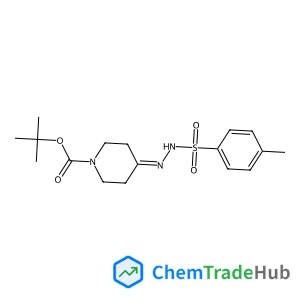
tert-Butyl 4-(2-(p-Tolylsulfonyl)hydrazono)piperidine-1-carboxylate
CAS号:
1046478-89-0
分子式:
C17H25N3O4S
推荐供应商





免责声明
本页面提供的学术期刊信息仅供参考和研究使用。我们与任何期刊出版商均无关联,也不处理投稿事宜。如有投稿相关咨询,请直接联系相关期刊出版商。
如发现页面信息有误,请发送邮件至 support@chemtradehub.com 联系我们。我们将及时核实并处理您的问题。