








(Co)polymers containing boron difluoride 3-cyanoformazanate complexes: emission enhancement via random copolymerization
文献信息
发布日期
2017-08-10
DOI
10.1039/C7PY01120B
影响因子
5.582
作者
Samantha Novoa, Joe B. Gilroy
查看原文
摘要
Ring-opening metathesis polymerization was used to produce polymers bearing an asymmetrically substituted boron difluoride 3-cyanoformazanate complex. The polymers were found to retain many of the unique characteristics of the molecular boron difluoride complexes of 3-cyanoformazanates, including intense light absorption at ca. 560 nm and reversible electrochemical reductions implicating the radical anion and dianion forms of the formazanate complexes in the repeating unit of the polymer backbone. The polymers were also found to be emissive, with emission maxima centred at ca. 665 nm. The monomer employed in this study had a fluorescence quantum yield of 30%, while homopolymers were weakly emissive and block copolymers were essentially non-emissive. The development of a monomer ‘dilution’ strategy, via random copolymerization, resulted in rejuvination of the emission at ca. 665 nm up to a maximum quantum yield of 24% when the mole fraction of the repeating units bearing boron difluoride 3-cyanoformazanate complexes (fBF2N) was 0.08.
相关文献
Microstructure analysis of biocompatible phosphoester copolymers
Romina Schröder, Sandra Ritz, Frederik R. Wurm
2013-06-06
Paper
DOI: 10.1039/C3PY00563A
CO2 capture enhancement in MOFs via the confinement of molecules
Vanesa del C. Cotlame-Salinas, Alfredo López-Olvera, Alejandro Islas-Jácome, Eduardo González-Zamora, Ilich A. Ibarra
2021-01-04
Minireview
DOI: 10.1039/D0RE00410C
Intracellular pH-activated PEG-b-PDPA wormlike micelles for hydrophobic drug delivery
Haijun Yu, Zhiai Xu, Dangge Wang, Xianzhi Chen, Zhiwen Zhang, Qi Yin, Yaping Li
2013-07-16
Communication
DOI: 10.1039/C3PY00849E
Surface reaction kinetics of the methanol synthesis and the water gas shift reaction on Cu/ZnO/Al2O3
Bruno Lacerda de Oliveira Campos, Karla Herrera Delgado, Stefan Wild, Stephan Pitter, Jörg Sauer
2021-03-19
Paper
DOI: 10.1039/D1RE00040C
Macromolecular engineering viaring-opening polymerization (2): l-lactide/trimethylene carbonate copolymerization – kinetic and microstructural control via catalytic tuning
William Guerin, Martine Slawinski, Jean-Michel Brusson, Sophie M. Guillaume, Jean-François Carpentier
2013-04-19
Paper
DOI: 10.1039/C3PY00397C
Bipyridyl-modified phosphonium polyelectrolytes: synthesis, photophysics, metal ion coordination and layer-by-layer assembly with anionic conjugated polymers
Samantha L. Kristufek, Thora R. Maltais, Eleanor G. Tennyson, Naresh C. Osti, Dvora Perahia, Andrew G. Tennyson, Rhett C. Smith
2013-08-15
Paper
DOI: 10.1039/C3PY20765J
Electrografting onto ITO substrates of poly(thiophene)-based micelles decorated by acrylate groups
Farid Ouhib, Simon Desbief, Roberto Lazzaroni, Sorin Melinte, Constantin Augustin Duţu, Christine Jerôme, Christophe Detrembleur
2013-05-09
Paper
DOI: 10.1039/C3PY00511A
Synthesis of multi-responsive polymeric nanocarriers for controlled release of bioactive agents
Guohua Jiang, Caiyi Mai
2013-07-04
Communication
DOI: 10.1039/C3PY00746D
您可能还喜欢
化合物问答
4-[4-三氟甲基苯基]恶唑(CAS号:1126636-40-5)通常如何合成?
4-[4-三氟甲基苯基]恶唑通常通过将4-三氟甲基苯酚与异硫氰酸苯酯在有机溶剂中进行酯化反应合成。该反应可在无水条件下,使用适当的催化剂,如四丁基氢氧化铵,以提...
1126636-40-54-(4-(Trifluoromethy...
59729-32-71-[3-(Dimethylamino)...
化合物问答
RockPhos Pd G3(CAS号:2009020-38-4)通常如何合成?
RockPhos Pd G3 通常通过钯催化偶联反应合成,使用配体 (2'-Amino-2-biphenylyl)(methanesulfonato-kappa...
2009020-38-4(2'-Amino-2-biphenyl...
化合物问答
1-哌啶甲酰胺(CAS号:2158-03-4)的市场或研究趋势如何?
1-哌啶甲酰胺作为有机合成中的重要中间体,其市场需求主要受医药、农药、染料等行业推动。近年来,随着新药开发和绿色化学的发展,该化合物的研究趋势集中在开发更高效、...
2158-03-41-Piperidinecarboxam...
化合物问答
2-(二苯基膦基)乙胺(CAS号:4848-43-5)适用哪些法规指南?
2-(二苯基膦基)乙胺适用于多种法规指南,包括但不限于《全球化学品统一分类和标签制度》(GHS),欧盟《化学品注册、评估、授权和限制》法规(REACH),以及美...
4848-43-52-(Diphenylphosphino...
化合物问答
如何储存间苯二甲酸二烯丙酯(CAS号:1087-21-4)?
间苯二甲酸二烯丙酯应储存在阴凉、干燥、通风良好的地方,远离火源和热源。储存容器应密封,避免光照和高温。储存温度应控制在25℃以下,相对湿度应低于80%。避免与其...
1087-21-4Diallyl isophthalate
化合物问答
什么是间甲苯异硫代异氰酸酯(CAS号:621-30-7)?
间甲苯异硫代异氰酸酯是一种有机化合物,分子式为C7H7NO2S,具有刺激性气味。它是一种重要的有机合成中间体,在合成其他化合物时广泛应用。
621-30-71-Isothiocyanato-3-m...
化合物问答
在合成中是否有N-Boc-D-苯丙氨醇(CAS号:106454-69-7)的替代品?
在合成中,可以考虑使用N-Cbz-D-苯丙氨醇或N-Fmoc-D-苯丙氨醇作为替代品。这些化合物同样具有保护氨基的功能,且在合成过程中表现出良好的反应性能。
106454-69-72-Methyl-2-propanyl ...
化合物问答
3-羟甲基-2-氧异丙基吡啶(CAS号:954240-50-7)的主要用途是什么?
3-羟甲基-2-氧异丙基吡啶主要用于有机合成领域,可以作为合成其他药物、农药或精细化学品的中间体。此外,它还可能在实验室研究中作为特定反应的前体或溶剂。
954240-50-7(2-Isopropoxy-3-pyri...
化合物问答
6-氨基-9-甲基嘌呤(CAS号:700-00-5)应用于哪些行业?
6-氨基-9-甲基嘌呤目前主要应用于医药行业,作为某些药物的中间体。此外,它还可能用于聚合物、传感器和半导体的某些领域,作为功能性单体或掺杂剂。
700-00-59-Methyl-9H-purin-6-...
来源期刊
Polymer Chemistry

CiteScore:
8.6
自引率:
7.3%
年发文量:
457
Polymer Chemistry welcomes submissions in all areas of polymer science that have a strong focus on macromolecular chemistry. Manuscripts may cover a broad range of fields, yet no direct application focus is required.
推荐化合物
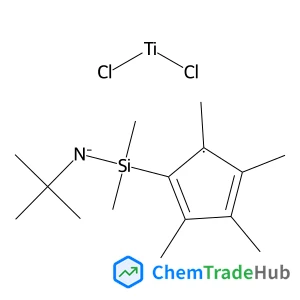
2,3,4,5-TETRAMETHYLCYCLOPENTADIENEDIMETHYLSILYL-TERT-BUTYLAMIDO TITANIUM DICHLORIDE
CAS号:
135072-61-6
分子式:
C15H27Cl2NSiTi-
推荐供应商




免责声明
本页面提供的学术期刊信息仅供参考和研究使用。我们与任何期刊出版商均无关联,也不处理投稿事宜。如有投稿相关咨询,请直接联系相关期刊出版商。
如发现页面信息有误,请发送邮件至 support@chemtradehub.com 联系我们。我们将及时核实并处理您的问题。