








Luminescent ZnO quantum dots as an efficient sensor for free chlorine detection in water
文献信息
发布日期
2016-03-07
DOI
10.1039/C5AN02599K
影响因子
4.616
作者
Kulvinder Singh, S. K. Mehta
查看原文
摘要
Highly luminescent ZnO quantum dots (QDs) synthesized via a simple and facile route are used for the preparation of an optical sensor for the detection of free chlorine. The concentration of free chlorine greatly affects the PL emission of the ZnO QDs at 525 nm. Since hypochlorite gains electrons with high efficiency, it takes electrons from the oxygen vacancies of ZnO QDs, which gives rise to defect emission in ZnO QDs. UV-vis data analysis shows that free chlorine does not affect the optical absorption spectra of ZnO QDs. The optical sensing of free chlorine using ZnO QDs has several advantages, like quick response time, good selectivity and of course high sensitivity. The pH has very little effect on the PL emission of ZnO QDs. It does not interfere in the sensing mechanism for free chlorine. After 60 s, the response of the ZnO QDs remains stable. The present sensor shows high selectivity with respect to various common cations, as well as anions.
相关文献
Liquid–liquid phase separation and evaporation of a laser-trapped organic–organic airborne droplet using temporal spatial-resolved Raman spectroscopy
Aimable Kalume, Chuji Wang, Joshua Santarpia, Yong-Le Pan
2018-06-14
Paper
DOI: 10.1039/C8CP02372G
Analysis of the interfacial characteristics of BiVO4/metal oxide heterostructures and its implication on their junction properties
Sebastián Murcia-López, Andreas Klein, Roel van de Krol, Teresa Andreu, Joan Ramón Morante, Thierry Toupance, Wolfram Jaegermann
2019-01-29
Paper
DOI: 10.1039/C8CP07483F
Electronic and magnetic properties of CoPc and FePc molecules on graphene: the substrate, defect, and hydrogen adsorption effects
Xiaoguang Li, Jinlong Yang
2019-02-12
Paper
DOI: 10.1039/C8CP07091A
Reconsideration of the relaxational and vibrational line shapes of liquid water based on ultrabroadband dielectric spectroscopy
Keiichiro Shiraga, Takashi Arikawa, Yuichi Ogawa
2018-10-08
Paper
DOI: 10.1039/C8CP04778B
Globule–stretch transition of a self-attracting chain in the repulsive active particle bath
Yi-qi Xia, Wen-de Tian
2019-01-24
Paper
DOI: 10.1039/C8CP05976D
Computational modelling of atomic layer etching of chlorinated germanium surfaces by argon
Shenli Zhang, Yihan Huang, Gulcin Tetiker, Saravanapriyan Sriraman, Alex Paterson, Roland Faller
2019-02-20
Communication
DOI: 10.1039/C9CP00125E
Growth of nanodroplets on a still microfiber under flow conditions
Maaike Rump, Shantanu Maheshwari, Lei Bao
2018-06-18
Paper
DOI: 10.1039/C8CP02353K
Dynamic micellar oligomers of amyloid beta peptides play a crucial role in their aggregation mechanisms
Bertrand Morel, Maria Paz Carrasco, Samuel Jurado, Carmen Marco, Francisco Conejero-Lara
2018-07-23
Paper
DOI: 10.1039/C8CP02685H
Gold substrates of controlled roughness and electrokinetic properties formed by nanoparticle deposition
Maria Morga, Małgorzata Nattich-Rak, Magdalena Oćwieja, Zbigniew Adamczyk
2019-02-22
Paper
DOI: 10.1039/C9CP00440H
您可能还喜欢
化合物问答
6-氯-2H-1,4-苯并噁嗪-3(4H)-酮(CAS号:7652-29-1)应用于哪些行业?
6-氯-2H-1,4-苯并噁嗪-3(4H)-酮主要应用于医药、农药和聚合物等领域。在医药领域,该化合物可用于合成抗菌药物;在农药领域,可用作杀虫剂的中间体;在聚...
7652-29-16-Chloro-2H-1,4-benz...
化合物问答
活性氧化铝(CAS号:1302-74-5)应用于哪些行业?
活性氧化铝广泛应用于医药、聚合物、传感器、半导体和催化等领域。在医药行业,活性氧化铝用作吸附剂和干燥剂,有助于去除杂质和水分。在聚合物行业,它用作增白剂和抗结块...
1302-74-5aluminum;trihydrate
化合物问答
什么是硅胶(CAS号:112926-00-8)?
硅胶(Silica gel, pptd.,cryst.-free)是一种无定形、多孔的硅酸盐材料,主要成分为二氧化硅(SiO₂)。其结构由硅氧四面体构成,通过酸...
112926-00-8Silica gel, pptd.,cr...
化合物问答
二乙基甲基一氢硅烷(CAS号:760-32-7)的主要用途是什么?
二乙基甲基一氢硅烷主要用于有机合成、表面处理以及作为溶剂。它还被用作合成其他硅烷化合物的原料,以及在涂料、粘合剂和密封剂中的应用。
760-32-7Diethyl(methyl)silan...
化合物问答
在合成中是否有N-花生四烯酰基甘氨酸(CAS号:179113-91-8)的替代品?
在合成过程中,可以考虑使用类似结构的化合物作为替代品,例如N-亚油酰基甘氨酸或N-花生二烯酰基甘氨酸。这些替代品在结构上有类似的双键位置,但可能具有不同的物理化...
179113-91-8Glycine, N-[(5Z,8Z,1...
化合物问答
在合成中是否有1-(4-甲氧基苯基)丙烷-1,2-二酮(CAS号:10557-27-4)的替代品?
在合成过程中,可以考虑使用类似结构的化合物作为替代品,例如1-(3-甲氧基苯基)丙烷-1,2-二酮或1-(4-羟基苯基)丙烷-1,2-二酮。这些替代品具有相似的...
10557-27-41-(4-Methoxyphenyl)p...
化合物问答
N-(4-氨基-1-苄基-3-羟基-5-苯基戊基)-3-甲基-2-(2-氧代四氢嘧啶-1-基)-丁酰胺 5-氧代吡咯烷-2-甲酸(CAS号:192726-06-0)通常如何合成?
该化合物通常通过一系列复杂的有机合成步骤获得。首先,通过芳香族化合物的羟基化反应获得羟基化产物,然后通过酰化反应形成酰胺中间体,最后通过环化反应得到目标产物。常...
192726-06-05-Oxo-L-proline - (2...
化合物问答
(S)-2-氨基-3-喹啉-2-丙酸(CAS号:161513-46-8)的市场或研究趋势如何?
该化合物作为生物活性化合物,尤其是在药物化学领域表现出色。近年来,随着对新型抗炎、抗病毒和抗癌药物的研究增加,其市场和研究趋势持续增长。此外,其在神经科学领域的...
161513-46-8(S)-2-Amino-3-quinol...
化合物问答
核黄素磷酸钠(CAS号:130-40-5)安全吗?
核黄素磷酸钠在常规使用条件下安全,但高剂量可能引起刺激性反应。操作时需佩戴防护手套和护目镜,避免吸入粉尘。若接触皮肤或眼睛,应立即用大量清水冲洗。急救时需根据接...
130-40-5Sodium 1-deoxy-1-(7,...
化合物问答
盐酸丙胺卡因杂质A(EP) 标准品(CAS号:19281-31-3)通常如何合成?
盐酸丙胺卡因杂质A(EP) 标准品可通过重氮化反应和随后的酰胺化反应合成。首先,利用氯化反应将苯环上的氢原子转化为氯原子,然后通过芳香族重氮化反应引入氨基,最后...
19281-31-32-Chloro-N-(2-methyl...
来源期刊
Analyst

CiteScore:
7.8
自引率:
5.6%
年发文量:
653
Analyst publishes analytical and bioanalytical research that reports premier fundamental discoveries and inventions, and the applications of those discoveries, unconfined by traditional discipline barriers.
推荐化合物
![2,6-Bis({(2R)-2-[hydroxy(diphenyl)methyl]-1-pyrrolidinyl}methyl)-4-methylphenol structure](https://cnstatic.chemtradehub.com/structs/877/877395-58-9-70bf.webp "2,6-Bis({(2R)-2-[hydroxy(diphenyl)methyl]-1-pyrrolidinyl}methyl)-4-methylphenol structure")
![4-Chloro-3-(trifluoromethyl)-1H-pyrrolo[2,3-b]pyridine structure](https://cnstatic.chemtradehub.com/structs/869/869335-75-1-a9d0.webp "4-Chloro-3-(trifluoromethyl)-1H-pyrrolo[2,3-b]pyridine structure")
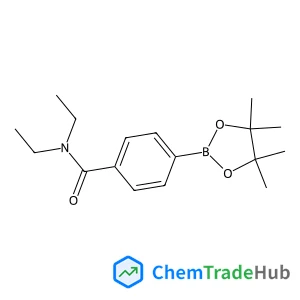
N,N-Diethyl-4-(4,4,5,5-tetramethyl-1,3,2-dioxaborolan-2-yl)benzamide
CAS号:
325142-99-2
分子式:
C17H26BNO3
推荐供应商



免责声明
本页面提供的学术期刊信息仅供参考和研究使用。我们与任何期刊出版商均无关联,也不处理投稿事宜。如有投稿相关咨询,请直接联系相关期刊出版商。
如发现页面信息有误,请发送邮件至 support@chemtradehub.com 联系我们。我们将及时核实并处理您的问题。