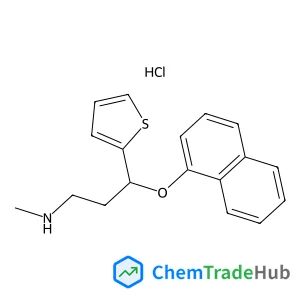
N-Methyl-3-(1-naphthyloxy)-3-(2-thienyl)-1-propanamine hydrochloride (1:1)
CAS号:
1188266-11-6
分子式:
C18H20ClNOS
Zachary P. L. Laker, Jonathan P. Rourke, Neil R. Wilson
The electrochemical activity of graphene is of fundamental importance to applications from energy storage to sensing, but has proved difficult to unambiguously determine due to the challenges innate to fabricating well defined graphene electrodes free from contamination. Here, we report the electrochemical activity of chemical vapour deposition (CVD) graphene grown on copper foil without further treatment, through appropriate choice of electrolyte. Fast electron transfer kinetics are observed for both inner and outer sphere redox couples with fully covered graphene on copper electrodes (k° = 0.014 ± 0.001 cm s−1 or k° = 0.012 ± 0.001 cm s−1 for potassium ferrocyanide(II) and hexaamineruthenium(III) chloride, respectively). Unlike highly oriented pyrolytic graphite electrodes, the electrochemical response of the graphene on copper electrodes is stable, with no apparent electrode fouling even with inner sphere redox couples, and reproducible independent of the time between growth and measurement. Comparison between fully covered electrodes, and partial coverage of graphene with varying graphene grain sizes (from roughly 50 μm to <10 μm) shows that in this instance the basal plane of graphene is electrochemically active. These CVD grown graphene on copper electrodes are quick, cheap and reproducible to make and hence provide a convenient platform for further investigation of graphene electrochemistry and the effect of covalent and non-covalent modification.
Nature Medicine

Journal of Saudi Chemical Society

Russian Journal of Bioorganic Chemistry
Drug Discovery Today

Russian Chemical Bulletin

Russian Journal of Coordination Chemistry

Current Opinion in Colloid & Interface Science

Saudi Pharmaceutical Journal

Journal of Peptide Science

Current Opinion in Solid State & Materials Science
Sandeep Sharma, Konstantinos Ntetsikas, Viko Ladelta, Saibal Bhaumik, Nikos Hadjichristidis
DOI: 10.1039/D1PY01337H
Zhe Wang, Hongwen Liang, Mo Xian, Xiaowu Wang
DOI: 10.1039/D0PY00572J
Monika Topa-Skwarczyńska, Mariusz Galek, Magdalena Jankowska, Fabrice Morlet-Savary, Bernadette Graff, Jacques Lalevée, Roman Popielarz
DOI: 10.1039/D1PY01263K
Fang Guo, Ming Deng, Fan Li, Shoulong Chen
DOI: 10.1039/D1PY00938A
Taijun He, Zhenyu Xing, Yixing Wang, Difeng Wu, Yang Liu, Xiangyang Liu
DOI: 10.1039/D0PY00860E
Ming Zhang, Yifei Tu, Zibo Zhou, Guozhang Wu
DOI: 10.1039/D0PY00764A
Hu Zhang, Ru Xiao, Zhengguo Cai
DOI: 10.1039/D0PY00857E
Gervase Ng, Kenward Jung, Jun Li, Chenyu Wu, Liwen Zhang, Cyrille Boyer
DOI: 10.1039/D1PY01258D
Rodrigo Navarro, Carolina García, Juan Rodríguez-Hernández, Carlos Elvira, Angel Marcos-Fernández, Alberto Gallardo, Helmut Reinecke
DOI: 10.1039/D0PY00989J
(5-氨基吡唑-3-基)乙酸是一种无色至白色固体,分子量为174.15 g/mol。它在水中具有较好的溶解性,在有机溶剂中的溶解度较低。该化合物具有较好的反应活...
3-氟-4,5-二氯苯胺受到多项法规指南的约束,包括但不限于GHS(全球化学品统一分类和标签制度)的危险分类标准、欧盟的REACH法规(注册、评估、授权和限制)...
这是一种有机化合物,化学名为(R)-(+)-2,2',6,6'-四甲氧基-4,4'-联(二(3,5-二甲苯基基)膦基)-3,3'-二联吡啶,CAS号为44290...
1-氨基-2-氰基萘在医药、聚合物、传感器和半导体等行业中有应用。在医药领域,它可用作中间体合成某些药物。在聚合物行业,它可以用于制备具有特定性能的聚合物。此外...
处理含1-溴-4-(异丙氧基甲基)苯的废料时,首先应确保废液收集在防渗漏的容器中,避免泄露。然后,可以考虑采用化学降解法或物理吸附法进行处理。在特定条件下,可通...
6-氯-8-三氟甲基-2,3-二氢-4H-色喃-4-酮主要用于有机合成中的中间体,也可作为研究试剂使用。
7-乙氧基-2-萘酚通常通过N-乙氧基化反应合成,首先将2-萘酚与乙醇钠在乙醇中反应生成7-乙氧基-2-萘酚钠盐,再通过酸化进一步得到7-乙氧基-2-萘酚。该合...
该化合物需遵循一系列的法规指南,包括但不限于GHS全球统一分类和标签制度,其分类可能包括易燃液体和可能危害水生环境。在欧洲,还需遵循REACH法规,确保物质和混...
4-甲氧基苄基叠氮甲酸酯是一种无色液体,具有一定的挥发性。其分子量为198.16,熔点为-69°C,沸点为105°C。该化合物在水中溶解度较低,在有机溶剂如乙醇...
含有4-氯-2-氟嘧啶的废料应按照危险废物处理。首先,应收集并分类这些废料,避免与其他废物混合。然后,可以采用焚烧处理或者交由专业机构进行处置。在处理过程中,需...

Physical Chemistry Chemical Physics (PCCP) is an international journal co-owned by 19 physical chemistry and physics societies from around the world. This journal publishes original, cutting-edge research in physical chemistry, chemical physics and biophysical chemistry. To be suitable for publication in PCCP, articles must include significant innovation and/or insight into physical chemistry; this is the most important criterion that reviewers and Editors will judge against when evaluating submissions. The journal has a broad scope and welcomes contributions spanning experiment, theory, computation and data science. Topical coverage includes spectroscopy, dynamics, kinetics, statistical mechanics, thermodynamics, electrochemistry, catalysis, surface science, quantum mechanics, quantum computing and machine learning. Interdisciplinary research areas such as polymers and soft matter, materials, nanoscience, energy, surfaces/interfaces, and biophysical chemistry are welcomed if they demonstrate significant innovation and/or insight into physical chemistry. Joined experimental/theoretical studies are particularly appreciated when complementary and based on up-to-date approaches.
![1-{3-[4-Amino-3-(4-phenoxyphenyl)-1H-pyrazolo[3,4-d]pyrimidin-1-yl]-1-piperidinyl}-2,3-dihydroxy-1-propanone structure](https://cnstatic.chemtradehub.com/structs/122/1226872-27-0-e037.webp "1-{3-[4-Amino-3-(4-phenoxyphenyl)-1H-pyrazolo[3,4-d]pyrimidin-1-yl]-1-piperidinyl}-2,3-dihydroxy-1-propanone structure")
![5'-Fluoro-[2,3'-biindolinylidene]-2',3-dione structure](https://cnstatic.chemtradehub.com/structs/251/251903-00-1-9cb1.webp "5'-Fluoro-[2,3'-biindolinylidene]-2',3-dione structure")