


pulSED: pulsed sonoelectrodeposition of fractal nanoplatinum for enhancing amperometric biosensor performance
文献信息
发布日期
2016-04-20
DOI
10.1039/C6AN00069J
影响因子
4.616
作者
M. Taguchi, N. Schwalb, Y. Rong, N. Garland, M. Tan, H. Yamaguchi, J. C. Claussen, E. S. McLamore
查看原文
摘要
For the first time, we combine pulsed electrodeposition with out-of-phase pulsed sonication for controlled synthesis of fractal nanoplatinum structures as the transducer layer in electrochemical sensing. We develop and test this technique, called bimodal pulsed sonoelectrodeposition (pulSED), as a simple approach for creating highly conductive transducer nanometals for use in sensing and biosensing. We first compared the efficiency of pulSED nanoplatinum to other pulsed electrodeposition techniques, and then explored the effect of duty cycle and plating time on electroactive surface area and nanoparticle size/morphology. The developed pulSED nanoplatinum displayed fractal features with a relatively homogenous size distribution (26.31 ± 1.3 nm) and extremely high electroactive surface (0.28 ± 0.04 cm2) relative to other electroplating techniques (up to one order of magnitude higher). A high duty cycle (900 mHz) promotes formation of stable nanostructures (including fractal nanostructures) and reduces amorphous structure formation due to bubble cavitation and enhanced mass transport of metal ions to the electrode surface. To demonstrate the applicability of the pulSED technique, non-enzymatic and enzymatic sensors were developed for measuring hydrogen peroxide and glucose. The sensitivity for non-enzymatic peroxide sensing (3335 ± 305 μA cm−2 mM−1), non-enzymatic glucose sensing (73 ± 14 μA cm−2 mM−1) and enzymatic glucose biosensing (155 ± 25 μA cm−2 mM−1) was higher than, or similar to, other nanomaterial-mediated amperometric sensors reported in the literature. The pulSED technique is a one pot method for tunable synthesis of nanometal structures as a transducer layer in electrochemical sensing and biosensing that requires no precursors or capping agents, and can be carried out at room temperature with inexpensive hardware.
期刊推荐
Russian Journal of Bioorganic Chemistry

Chemistry Education Research and Practice

Nature Medicine

Journal of Natural Medicines
Russian Chemical Bulletin

Saudi Pharmaceutical Journal
Russian Journal of General Chemistry

Journal of Peptide Science

New Journal of Chemistry
Russian Journal of Coordination Chemistry
相关文献
Probing the origins of photodegradation in organic–inorganic metal halide perovskites with time-resolved mass spectrometry
Zhaoning Song, Changlei Wang, Adam B. Phillips, Corey R. Grice, Dewei Zhao, Yue Yu, Cong Chen, Chongwen Li, Xinxing Yin, Randy J. Ellingson, Michael J. Heben, Yanfa Yan
2018-08-20
Paper
DOI: 10.1039/C8SE00358K
The improved ion clustering and conductivity of a di-quaternized poly(arylene ether ketone sulfone)-based alkaline fuel cell membrane
2017-04-11
Paper
DOI: 10.1039/C7SE00097A
A long cycle life, high coulombic efficiency iron molten air battery
Stuart Licht
2017-03-07
Paper
DOI: 10.1039/C6SE00082G
Effect of single metal doping on the thermoelectric properties of SnTe
Masoud Aminzare, Yu-Chih Tseng, Anbalagan Ramakrishnan, Kuei-Hsien Chen, Yurij Mozharivskyj
2018-11-06
Paper
DOI: 10.1039/C8SE00385H
The use of silver nanoparticles for the recovery of uranium from seawater by means of biofouling mitigation
Margaret Flicker Byers, Sheldon Landsberger, Erich Schneider
2018-08-17
Paper
DOI: 10.1039/C8SE00228B
Conversion of landfill gas to liquid fuels through a TriFTS (tri-reforming and Fischer–Tropsch synthesis) process: a feasibility study
Xianhui Zhao, Ahmad Naqi, Devin M. Walker, Tim Roberge, Matthew Kastelic
2018-12-26
Paper
DOI: 10.1039/C8SE00344K
Ultralayered core–shell metal oxide nanosheet arrays for supercapacitors with long-term electrochemical stability
Ye Shen, Yifan Pan, Zhenyu Cheng, Yen Wei, Guangjian Zeng, Liucheng Mao
2018-07-03
Paper
DOI: 10.1039/C8SE00290H
Hierarchical porous carbon nanosheet derived from waste engine oil for high-performance supercapacitor application
Yubing Li, Jingjing He, Yulin Wang, Xiai Zhang, Yameng Zhang, Xuexin Liu, Kunjie Wang, Yi Wang
2018-12-11
Paper
DOI: 10.1039/C8SE00449H
An investigation of Cu–Re–ZnO catalysts for the hydrogenolysis of glycerol under continuous flow conditions
Mzamo L. Shozi, Venkata D. B. C. Dasireddy, Sooboo Singh, Pheladi Mohlala, David J. Morgan, Sarwat Iqbal, Holger B. Friedrich
2017-06-28
Paper
DOI: 10.1039/C7SE00199A
您可能还喜欢
化合物问答
什么是2-氨基戊烷(CAS号:63493-28-7)?
2-氨基戊烷,又名pentan-2-amine,是一种有机化合物,分子式为C5H11NH2。它是一种无色透明液体,有氨味。该化合物在工业和研究中有一定的应用。
63493-28-7pentan-2-amine
化合物问答
反式-4-[4-[[[5-[(3,4-二氟苯基)氨基]-1,3,4-恶二唑-2-基]羰基]氨基]苯基]环己烷乙酸(CAS号:892489-52-0)的物理化学性质是什么?
该化合物为白色固体,分子量为552.31 g/mol。它在水中溶解度较低,在有机溶剂如乙腈、乙酸乙酯中有较好的溶解性。该化合物具有较高的化学稳定性,对酸和碱具有...
892489-52-0Trans-4-[4-[[[5-[(3,...
化合物问答
如何处理含有Pyrotinib dimaleate(CAS号:1397922-61-0)的废料?
处理含有Pyrotinib dimaleate 的废料时,应遵循当地的法规要求。首先,收集废料并进行分类,确保没有与其他化学品混合。然后,采取适当的物理和化学处...
1397922-61-0(2E)-N-(4-{[3-Chloro...
化合物问答
在合成中是否有4-(5-5-乙基-1,2,4-噁二唑-3-基)苯甲酸乙酯(CAS号:1166756-79-1)的替代品?
在合成过程中,可以考虑使用其他结构类似的化合物作为替代品,例如苯甲酸酯类化合物,如2-乙基-5-甲基噁二唑基苯甲酸乙酯等。这些替代品可能具有相似的化学性质,但在...
1166756-79-1Ethyl 4-(5-ethyl-1,2...
化合物问答
如何处理含有1-((叔丁氧基羰基)氨基)环丁烷甲酸甲酯(CAS号:880166-10-9)的废料?
处理含有该化合物的废液时,应先确保其完全反应并转化为无害物质。对于未反应的化合物,建议采用中和处理后进行蒸馏回收,剩余物可使用化学氧化法或焚烧法进行无害化处理。...
880166-10-9Methyl 1-({[(2-methy...
化合物问答
2-({[3,5-二(三氟甲基)苯基]磺酰基}氨基)-4-(甲基硫代)丁酸甲酯(CAS号:175202-21-8)的市场或研究趋势如何?
目前该化合物主要应用于药物合成领域,尤其在开发新型抗癌药物方面具有潜在应用。随着制药行业的持续发展,对于高效、低毒的合成中间体需求增加,预计该化合物的研究和应用...
175202-21-8Methyl N-{[3,5-bis(t...
化合物问答
N,N-乙烯双(碘乙酰胺)(CAS号:7250-43-3)的物理化学性质是什么?
N,N-乙烯双(碘乙酰胺)是一种白色或类白色固体,易溶于乙醇、丙酮等有机溶剂,但在水中溶解度较低。该化合物具有较高的反应活性,可以与其他含有活性氢的化合物发生酰...
7250-43-3N,N'-1,2-Ethanediylb...
化合物问答
7-Fluoro-1H-spiro[furo[3,4-c]pyridine-3,4'-piperidine](CAS号:1283090-73-2)通常如何合成?
该化合物可以通过环合反应合成,首先合成吡啶和哌啶的衍生物,然后在合适的条件下进行环合反应得到目标化合物。常用的催化剂包括某些金属盐类,产率一般在70%-90%之...
1283090-73-27-Fluoro-1H-spiro[fu...
化合物问答
处理3-乙酰滇乌碱(CAS号:80787-51-5)时应注意哪些实验室安全事项?
在处理3-乙酰滇乌碱时,应穿戴适当的个人防护装备(PPE),如实验服、手套(丁腈手套或PVC手套)、护目镜和口罩。实验应在通风橱中进行,以减少吸入或皮肤接触的风...
80787-51-54-Methylaconitane-1,...
化合物问答
如何储存2-溴-5-硝基-4-羧酸(CAS号:1053655-82-5)?
2-溴-5-硝基-4-羧酸应存放在阴凉、干燥、通风良好的地方,远离火源和热源。避免与还原剂、碱性物质接触。储存容器应密封,防止吸湿。
1053655-82-52-Bromo-5-nitropyrid...
来源期刊
Analyst

CiteScore:
7.8
自引率:
5.6%
年发文量:
653
Analyst publishes analytical and bioanalytical research that reports premier fundamental discoveries and inventions, and the applications of those discoveries, unconfined by traditional discipline barriers.
推荐化合物
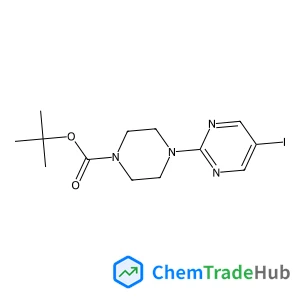
2-Methyl-2-propanyl 4-(5-iodo-2-pyrimidinyl)-1-piperazinecarboxylate
CAS号:
1027616-32-5
分子式:
C13H19IN4O2
推荐供应商





免责声明
本页面提供的学术期刊信息仅供参考和研究使用。我们与任何期刊出版商均无关联,也不处理投稿事宜。如有投稿相关咨询,请直接联系相关期刊出版商。
如发现页面信息有误,请发送邮件至 support@chemtradehub.com 联系我们。我们将及时核实并处理您的问题。