







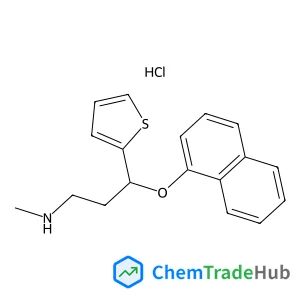
N-Methyl-3-(1-naphthyloxy)-3-(2-thienyl)-1-propanamine hydrochloride (1:1)
CAS号:
1188266-11-6
分子式:
C18H20ClNOS
S. Mordechai, E. Shufan, B. S. Porat Katz, A. Salman
Alzheimer's disease (AD) is the most common cause of dementia, particularly in the elderly. The disease is characterized by cognitive decline that typically starts with insidious memory loss and progresses relentlessly to produce global impairment of all higher cortical functions. Due to better living conditions and health facilities in developed countries, which result in higher overall life spans, these countries report upward trends of AD among their populations. There are, however, no specific diagnostic tests for AD and clinical diagnosis is especially difficult in the earliest stages of the disease. Early diagnosis of AD is frequently subjective and is determined by physicians (generally neurologists, geriatricians, and psychiatrists) depending on their experience. Diagnosing AD requires both medical history and mental status testing. Having trouble with memory does not mean you have AD. AD has no current cure, but treatments for symptoms are available and research continues. In this study, we investigated the potential of infrared microscopy to differentiate between AD patients and controls, using Fourier transform infrared (FTIR) spectroscopy of isolated blood components. FTIR is known as a quick, safe, and minimally invasive method to investigate biological samples. For this goal, we measured infrared spectra from white blood cells (WBCs) and plasma taken from AD patients and controls, with the consent of the patients or their guardians. Applying multivariate analysis, principal component analysis (PCA) followed by linear discriminant analysis (LDA), it was possible to differentiate among the different types of mild, moderate, and severe AD, and the controls, with 85% accuracy when using the WBC spectra and about 77% when using the plasma spectra. When only the moderate and severe stages were included, an 83% accuracy was obtained using the WBC spectra and about 89% when using the plasma spectra.
Ying Hua, Pascale Changenet-Barret, Thomas Gustavsson, Dimitra Markovitsi
DOI: 10.1039/C3CP00060E
Nina O. C. Winter, Nora K. Graf, Samuel Leutwyler, Christof Hättig
DOI: 10.1039/C2CP42694C
Christoph Kölbl, Beate Stempfle
DOI: 10.1039/C3CP44693J
Yilun Liu
DOI: 10.1039/C3CP43854F
Luis Gómez-Hortigüela, Furio Corà, C. Richard A. Catlow
DOI: 10.1039/C3CP51079D
ZhenHua Zeng, Mårten E. Björketun, Sune Ebbesen, Mogens B. Mogensen, Jan Rossmeisl
DOI: 10.1039/C3CP51099A
Paul E. Crider, Matthias Vonderach, Patrick Weis
DOI: 10.1039/C2CP43808A
Yi Lin Yang, Yu-Chieh Ho, Yuri A. Dyakov, Wen-Hsin Hsu, Yi-Lun Sun, Wan-Chen Tsai, Wei-Ping Hu
DOI: 10.1039/C3CP44674C
Ping Wu, Pan Du, Hui Zhang, Chenxin Cai
DOI: 10.1039/C3CP50900A
M. Sadeghi
DOI: 10.1039/C3CP44563A
(5-氨基吡唑-3-基)乙酸是一种无色至白色固体,分子量为174.15 g/mol。它在水中具有较好的溶解性,在有机溶剂中的溶解度较低。该化合物具有较好的反应活...
3-氟-4,5-二氯苯胺受到多项法规指南的约束,包括但不限于GHS(全球化学品统一分类和标签制度)的危险分类标准、欧盟的REACH法规(注册、评估、授权和限制)...
这是一种有机化合物,化学名为(R)-(+)-2,2',6,6'-四甲氧基-4,4'-联(二(3,5-二甲苯基基)膦基)-3,3'-二联吡啶,CAS号为44290...
1-氨基-2-氰基萘在医药、聚合物、传感器和半导体等行业中有应用。在医药领域,它可用作中间体合成某些药物。在聚合物行业,它可以用于制备具有特定性能的聚合物。此外...
处理含1-溴-4-(异丙氧基甲基)苯的废料时,首先应确保废液收集在防渗漏的容器中,避免泄露。然后,可以考虑采用化学降解法或物理吸附法进行处理。在特定条件下,可通...
6-氯-8-三氟甲基-2,3-二氢-4H-色喃-4-酮主要用于有机合成中的中间体,也可作为研究试剂使用。
7-乙氧基-2-萘酚通常通过N-乙氧基化反应合成,首先将2-萘酚与乙醇钠在乙醇中反应生成7-乙氧基-2-萘酚钠盐,再通过酸化进一步得到7-乙氧基-2-萘酚。该合...
该化合物需遵循一系列的法规指南,包括但不限于GHS全球统一分类和标签制度,其分类可能包括易燃液体和可能危害水生环境。在欧洲,还需遵循REACH法规,确保物质和混...
4-甲氧基苄基叠氮甲酸酯是一种无色液体,具有一定的挥发性。其分子量为198.16,熔点为-69°C,沸点为105°C。该化合物在水中溶解度较低,在有机溶剂如乙醇...
含有4-氯-2-氟嘧啶的废料应按照危险废物处理。首先,应收集并分类这些废料,避免与其他废物混合。然后,可以采用焚烧处理或者交由专业机构进行处置。在处理过程中,需...

Analyst publishes analytical and bioanalytical research that reports premier fundamental discoveries and inventions, and the applications of those discoveries, unconfined by traditional discipline barriers.
![1-(1-Benzyl-1,2,3,6-tetrahydropyridin-4-yl)-1H-benzo[d]imidazol-2(3H)-one structure](https://cnstatic.chemtradehub.com/structs/603/60373-71-9-7dfb.webp "1-(1-Benzyl-1,2,3,6-tetrahydropyridin-4-yl)-1H-benzo[d]imidazol-2(3H)-one structure")
![(2R,6S)-6-[(Benzyloxy)methyl]-4-{[(2-methyl-2-propanyl)oxy]carbonyl}-2-morpholinecarboxylic acid structure](https://cnstatic.chemtradehub.com/structs/109/1093085-91-6-3382.webp "(2R,6S)-6-[(Benzyloxy)methyl]-4-{[(2-methyl-2-propanyl)oxy]carbonyl}-2-morpholinecarboxylic acid structure")