











![[4-Amino-2-(methylsulfanyl)-5-pyrimidinyl]methanol structure](https://cnstatic.chemtradehub.com/structs/588/588-36-3-fc73.webp "[4-Amino-2-(methylsulfanyl)-5-pyrimidinyl]methanol structure")
Fullerenol C60(OH)16 prevents amyloid fibrillization of Aβ40 – in vitro and in silico approach
文献信息
发布日期
2016-06-20
DOI
10.1039/C6CP00901H
影响因子
3.676
作者
Maria-Magdalena Mocanu, Diana Fedunova, Mai Suan Li
查看原文
摘要
The generation of Aβ amyloid aggregates in the form of senile plaques in the brain is one of the pathological hallmarks of Alzheimer's disease (AD). There is no cure for AD and one of the recent treatment strategies is focused on the inhibition of amyloid fibrillization of Aβ peptide. Fullerene C60 has been proposed as a candidate for destroying Aβ aggregates but it is not soluble in water and its toxicity to cells remains largely ambiguous. To overcome these drawbacks, we synthesized and studied the effect of water-soluble fullerenol C60(OH)16 (fullerene C60 carrying 16 hydroxyl groups) on the amyloid fibrillization of Aβ40 peptide in vitro. Using a Thioflavin T fluorescent assay and atomic force microscopy it was found that C60(OH)16 effectively reduces the formation of amyloid fibrils. The IC50 value is in the low range (μg ml−1) suggesting that fullerenol interferes with Aβ40 aggregation at stoichiometric concentrations. The in silico calculations supported the experimental data. It was revealed that fullerenol tightly binds to monomer Aβ40 and polar, negatively charged amino acids play a key role. Electrostatic interactions dominantly contribute to the binding propensity via interaction of the oxygen atoms from the COO− groups of side chains of polar, negatively charged amino acids with the OH groups of fullerenol. This stabilizes contact with either the D23 or K28 of the salt bridge. Due to the lack of a well-defined binding pocket fullerenol is also inclined to locate near the central hydrophobic region of Aβ40 and can bind to the hydrophobic C-terminal of the peptide. Upon fullerenol binding the salt bridge becomes flexible, inhibiting Aβ aggregation. In order to assess the toxicity of fullerenol, we found that exposure of neuroblastoma SH-SY5Y cells to fullerenol caused no significant changes in viability after 24 h of treatment. These results suggest that fullerenol C60(OH)16 represents a promising candidate as a therapeutic for Alzheimer's disease.
相关文献
Role of the organic linker in the early stages of the templated synthesis of PMOs
Ryusuke Futamura, Miguel Jorge, José R. B. Gomes
2013-03-06
Communication
DOI: 10.1039/C3CP50193K
Co–Ni layered double hydroxides for water oxidation in neutral electrolyte
Ye Zhang, Bai Cui, Chunsong Zhao, Hong Lin
2013-03-18
Paper
DOI: 10.1039/C3CP50202C
Investigation on the electronic structure of BN nanosheets synthesized via carbon-substitution reaction: the arrangement of B, N, C and O atoms
Lijia Liu, Tsun-Kong Sham, Weiqiang Han
2013-03-18
Paper
DOI: 10.1039/C3CP50498K
In situ fluorescence and electrochemical monitoring of a photosynthetic microbial fuel cell
Alister E. Inglesby, Kamran Yunus, Adrian C. Fisher
2013-04-02
Paper
DOI: 10.1039/C3CP51076J
Complementary mechanistic properties of Fe- and Mn-doped aluminophosphates in the catalytic aerobic oxidation of hydrocarbons
Luis Gómez-Hortigüela, Furio Corà, C. Richard A. Catlow
2013-03-14
Paper
DOI: 10.1039/C3CP51079D
On the role of singlet versus triplet excited states in the uncaging of ortho-nitrobenzyl caged compounds
Jan-Michael Mewes, Andreas Dreuw
2013-03-01
Paper
DOI: 10.1039/C3CP44338H
Ligand strain and conformations in a family of Fe(ii) spin crossover hexadentate complexes involving the 2-pyridylmethyl-amino moiety: DFT modelling
Galina S. Matouzenko, Serguei A. Borshch, Volker Schünemann, Juliusz A. Wolny
2013-03-22
Paper
DOI: 10.1039/C3CP44570D
Adsorption of diferrocenylacetylene on Au(111) studied by scanning tunneling microscopy
Rebecca C. Quardokus, Natalie A. Wasio, Ryan P. Forrest, Craig S. Lent, Steven A. Corcelli, John A. Christie, Kenneth W. Henderson, S. Alex Kandel
2013-03-19
Paper
DOI: 10.1039/C3CP50225B
Staying hydrated: the molecular journey of gaseous sulfur dioxide to a water surface
Eric S. Shamay, Nicholas A. Valley, Frederick G. Moore, Geraldine L. Richmond
2013-03-18
Paper
DOI: 10.1039/C3CP50609F
您可能还喜欢
化合物问答
6-氯-2H-1,4-苯并噁嗪-3(4H)-酮(CAS号:7652-29-1)应用于哪些行业?
6-氯-2H-1,4-苯并噁嗪-3(4H)-酮主要应用于医药、农药和聚合物等领域。在医药领域,该化合物可用于合成抗菌药物;在农药领域,可用作杀虫剂的中间体;在聚...
7652-29-16-Chloro-2H-1,4-benz...
化合物问答
活性氧化铝(CAS号:1302-74-5)应用于哪些行业?
活性氧化铝广泛应用于医药、聚合物、传感器、半导体和催化等领域。在医药行业,活性氧化铝用作吸附剂和干燥剂,有助于去除杂质和水分。在聚合物行业,它用作增白剂和抗结块...
1302-74-5aluminum;trihydrate
化合物问答
什么是硅胶(CAS号:112926-00-8)?
硅胶(Silica gel, pptd.,cryst.-free)是一种无定形、多孔的硅酸盐材料,主要成分为二氧化硅(SiO₂)。其结构由硅氧四面体构成,通过酸...
112926-00-8Silica gel, pptd.,cr...
化合物问答
二乙基甲基一氢硅烷(CAS号:760-32-7)的主要用途是什么?
二乙基甲基一氢硅烷主要用于有机合成、表面处理以及作为溶剂。它还被用作合成其他硅烷化合物的原料,以及在涂料、粘合剂和密封剂中的应用。
760-32-7Diethyl(methyl)silan...
化合物问答
在合成中是否有N-花生四烯酰基甘氨酸(CAS号:179113-91-8)的替代品?
在合成过程中,可以考虑使用类似结构的化合物作为替代品,例如N-亚油酰基甘氨酸或N-花生二烯酰基甘氨酸。这些替代品在结构上有类似的双键位置,但可能具有不同的物理化...
179113-91-8Glycine, N-[(5Z,8Z,1...
化合物问答
在合成中是否有1-(4-甲氧基苯基)丙烷-1,2-二酮(CAS号:10557-27-4)的替代品?
在合成过程中,可以考虑使用类似结构的化合物作为替代品,例如1-(3-甲氧基苯基)丙烷-1,2-二酮或1-(4-羟基苯基)丙烷-1,2-二酮。这些替代品具有相似的...
10557-27-41-(4-Methoxyphenyl)p...
化合物问答
N-(4-氨基-1-苄基-3-羟基-5-苯基戊基)-3-甲基-2-(2-氧代四氢嘧啶-1-基)-丁酰胺 5-氧代吡咯烷-2-甲酸(CAS号:192726-06-0)通常如何合成?
该化合物通常通过一系列复杂的有机合成步骤获得。首先,通过芳香族化合物的羟基化反应获得羟基化产物,然后通过酰化反应形成酰胺中间体,最后通过环化反应得到目标产物。常...
192726-06-05-Oxo-L-proline - (2...
化合物问答
(S)-2-氨基-3-喹啉-2-丙酸(CAS号:161513-46-8)的市场或研究趋势如何?
该化合物作为生物活性化合物,尤其是在药物化学领域表现出色。近年来,随着对新型抗炎、抗病毒和抗癌药物的研究增加,其市场和研究趋势持续增长。此外,其在神经科学领域的...
161513-46-8(S)-2-Amino-3-quinol...
化合物问答
核黄素磷酸钠(CAS号:130-40-5)安全吗?
核黄素磷酸钠在常规使用条件下安全,但高剂量可能引起刺激性反应。操作时需佩戴防护手套和护目镜,避免吸入粉尘。若接触皮肤或眼睛,应立即用大量清水冲洗。急救时需根据接...
130-40-5Sodium 1-deoxy-1-(7,...
化合物问答
盐酸丙胺卡因杂质A(EP) 标准品(CAS号:19281-31-3)通常如何合成?
盐酸丙胺卡因杂质A(EP) 标准品可通过重氮化反应和随后的酰胺化反应合成。首先,利用氯化反应将苯环上的氢原子转化为氯原子,然后通过芳香族重氮化反应引入氨基,最后...
19281-31-32-Chloro-N-(2-methyl...
来源期刊
Physical Chemistry Chemical Physics

CiteScore:
5.5
自引率:
10.3%
年发文量:
3036
Physical Chemistry Chemical Physics (PCCP) is an international journal co-owned by 19 physical chemistry and physics societies from around the world. This journal publishes original, cutting-edge research in physical chemistry, chemical physics and biophysical chemistry. To be suitable for publication in PCCP, articles must include significant innovation and/or insight into physical chemistry; this is the most important criterion that reviewers and Editors will judge against when evaluating submissions. The journal has a broad scope and welcomes contributions spanning experiment, theory, computation and data science. Topical coverage includes spectroscopy, dynamics, kinetics, statistical mechanics, thermodynamics, electrochemistry, catalysis, surface science, quantum mechanics, quantum computing and machine learning. Interdisciplinary research areas such as polymers and soft matter, materials, nanoscience, energy, surfaces/interfaces, and biophysical chemistry are welcomed if they demonstrate significant innovation and/or insight into physical chemistry. Joined experimental/theoretical studies are particularly appreciated when complementary and based on up-to-date approaches.
推荐化合物

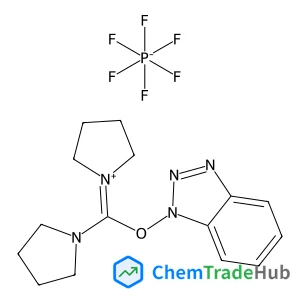
(1H-Benzotriazol-1-yloxy)(di-1-pyrrolidinyl)methylium hexafluorophosphate
CAS号:
105379-24-6
分子式:
C15H21F6N5OP
推荐供应商




免责声明
本页面提供的学术期刊信息仅供参考和研究使用。我们与任何期刊出版商均无关联,也不处理投稿事宜。如有投稿相关咨询,请直接联系相关期刊出版商。
如发现页面信息有误,请发送邮件至 support@chemtradehub.com 联系我们。我们将及时核实并处理您的问题。