







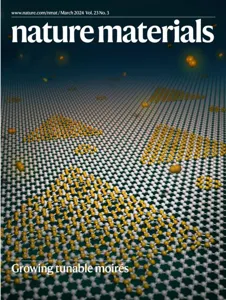
Defect induced tunable near infrared emission of Er–CeO2 by heterovalent co-dopants
文献信息
发布日期
2016-06-03
DOI
10.1039/C6CP02754G
影响因子
3.676
作者
Mihaela Florea, Daniel Avram, Bogdan Cojocaru, Ion Tiseanu, Vasile Parvulescu, Carmen Tiseanu
查看原文
摘要
We investigate the effects of heterovalent co-dopants on the structural and emission properties of 1% Er–CeO2 nanoparticles. The CeO2 oxide host was selected on the basis of its fairly well-understood defect chemistry in either a pure or doped state. As a luminescent activator, Er is acknowledged as an interesting element due to its rich luminescence and excitation properties spanning the visible to near-infrared range. The optically inactive trivalent La and monovalent Li metal ions with a concentration of up to 20% were chosen to presumably generate a variable amount of defects in the Er–CeO2 lattice. It was found that La and Li co-dopants induced distinct changes related to the size, lattice constant, bandgap energy, lattice and surface defects of Er–CeO2. As a result of these changes, a strong modulation of the luminescence intensity and shape was measured using a suite of excitation conditions (charge-transfer absorption band of CeO2, direct/up-conversion into Er absorptions and X-ray excitation modes). The use of Eu as a luminescent probe offered additional information concerning the effects of La/Li co-doping on the local structure surrounding the luminescent activator. Remarkably high percentages of 90 and 98% of the total emission of Er measured between 500 and 1100 nm are measured in the near-infrared region at 980 nm under X-ray and up-conversion excitation at ∼1500 nm, respectively. The optical properties suggest that Li, Er co-doped CeO2 has good potential for therapy and biological imaging.
相关文献
Solubilities in aqueous nitrate solutions that appear to reverse the law of mass action
2021-09-23
Perspective
DOI: 10.1039/D1CP03124D
Structural and electronic analysis of the octarepeat region of prion protein with four Cu2+ by polarizable MD and QM/MM simulations
Jorge Nochebuena, Liliana Quintanar, Alberto Vela, G. Andrés Cisneros
2021-09-13
Paper
DOI: 10.1039/D1CP03187B
Molecular magnetism in nanodomains of isoreticular MIL-88(Fe)-MOFs
Sheeba Dawood, Surabhi Shaji, Gayani Pathiraja, Yirong Mo, Hemali Rathnayake
2021-09-09
Paper
DOI: 10.1039/D1CP03122H
Evaluating the nature of the vertical excited states of fused-ring electron acceptors using TD-DFT and density-based charge transfer
Amjad Ali, Muhammad Imran Rafiq, Baojing Zhou, Weihua Tang
2021-06-28
Paper
DOI: 10.1039/D1CP01917A
Regularized dynamical decoupling noise spectroscopy – a decoherence descriptor for radicals in glassy matrices
Janne Soetbeer, Luis Fábregas Ibáñez, Zachariah Berkson, Yevhen Polyhach, Gunnar Jeschke
2021-09-23
Paper
DOI: 10.1039/D1CP03103A
Thermodynamic and structural features of chlorodifluoromethane (a sI–sII dual hydrate former) + external guest (N2 or CH4) hydrates and their significance for greenhouse gas separation
Junghoon Mok, Junkyu Lim, Wonjung Choi, Soyeong Yun, Joonseop Lee, Gyeol Ko, Yongwon Seo
2021-07-13
Paper
DOI: 10.1039/D1CP02327F
A double bilayer to study the nonequilibrium environmental response of GIRK2 in complex states
Anhui Wang, Chenyi Liao, Guohui Li
2021-07-01
Paper
DOI: 10.1039/D1CP01785C
Thermally regenerative electrochemically cycled flow batteries with pH neutral electrolytes for harvesting low-grade heat
Xin Qian, Jungwoo Shin, Yaodong Tu, James Han Zhang, Gang Chen
2021-09-15
Paper
DOI: 10.1039/D1CP01988K
Self-folding and self-scrolling mechanisms of edge-deformed graphene sheets: a molecular dynamics study
Marcelo Lopes Pereira Junior, Luiz Antonio Ribeiro Junior
2021-06-23
Paper
DOI: 10.1039/D1CP02117F
Inspecting the structural characteristics of chiral drug penicillamine under different pH conditions using Raman optical activity spectroscopy and DFT calculations
Yu-Ting Guo, Yuan-Hui Xiao, Ji-Guang Zhang, Si-Da Bian, Jian-Zhang Zhou, De-Yin Wu, Zhong-Qun Tian
2021-09-05
Paper
DOI: 10.1039/D1CP02219A
您可能还喜欢
化合物问答
奥美沙坦酯杂质4(CAS号:95579-71-8)的主要用途是什么?
奥美沙坦酯杂质4在药物工业中并无特定用途,主要作为生产和质量控制中的监控指标,以确保产品质量和符合相关规范。它具有一定的化学活性,因此在生产过程中需要严格控制其...
95579-71-84-Chloro-4-methyl-5-...
化合物问答
如何储存C3bot (154-182)(CAS号:1246280-79-4)?
C3bot (154-182)应储存在干燥、阴凉、通风良好的环境中,避免阳光直射。具体储存条件需要参考其相关安全数据表(SDS)中的储存信息。建议使用密闭容器存...
1246280-79-4C3bot (154-182)
化合物问答
在合成中是否有4-吡唑甲酸乙酯(CAS号:37622-90-5)的替代品?
在合成过程中,可以考虑使用类似结构的化合物作为替代品,例如4-吡唑甲酸甲酯或其他吡唑类化合物。这些替代品在性质上相似,可以用于相似的合成反应中,但需根据具体应用...
37622-90-5Ethyl 1H-pyrazole-4-...
化合物问答
(2-溴乙基)三甲基硅烷(CAS号:18156-67-7)的主要用途是什么?
(2-溴乙基)三甲基硅烷主要用作有机合成中的溴代试剂,特别是在硅化学领域中,用于制备硅烷衍生物和硅基功能材料。它也用于表面改性、催化剂合成、医药中间体合成以及分...
18156-67-7(2-Bromoethyl)(trime...
化合物问答
如何处理含有2-(4-broMophenyl)-1,1,1-trifluoropropan-2-ol(CAS号:122243-28-1)的废料?
含该化合物的废料需按照危险废物管理规定进行分类和处理。首先,应尽量减少废料的产生,通过改进生产工艺实现废物最小化。对于不可避免的废料,建议采用安全的收集方法,避...
122243-28-12-(4-bromophenyl)-1,...
化合物问答
什么是1,1,1-三氟-6-苯基-5-(e)-己烯-2,4-二酮(CAS号:18931-64-1)?
1,1,1-三氟-6-苯基-5-(e)-己烯-2,4-二酮是一种有机化合物,化学式为C14H8F3O2。它是一种具有特定立体结构的芳香族化合物,属于酮类。
18931-64-1(5E)-1,1,1-Trifluoro...
化合物问答
2-(2-甲基哌啶-1-基)-2-氧代-乙酸(CAS号:77654-61-6)的主要用途是什么?
2-(2-甲基哌啶-1-基)-2-氧代-乙酸主要用于药物合成、有机合成及作为化学试剂。它在医药领域有一定的应用,可用于合成某些药物中间体。此外,它还用于实验室研...
77654-61-6(2-Methyl-1-piperidi...
化合物问答
如何储存(R)-1-(3-Chlorophenyl)-2,2,2-trifluoroethanamine(CAS号:1213627-66-7)?
应将(R)-1-(3-氯苯基)-2,2,2-三氟乙胺储存在阴凉、干燥、通风良好的地方,远离火源和热源。应使用密封的容器储存,并避免光照。储存温度应控制在室温范围...
1213627-66-7(1R)-1-(3-Chlorophen...
化合物问答
N-亚硝基-N,N-二壬基胺(CAS号:84424-96-4)的市场或研究趋势如何?
N-亚硝基-N,N-二壬基胺目前主要应用于有机合成和药物化学领域。市场趋势显示,随着有机合成技术的进步,该化合物在新药研发中的应用将更加广泛。新兴研究领域包括其...
84424-96-4N-Nitroso-N-nonyl-1-...
化合物问答
5-Chloro-2-methoxy-3-(2,2,2-trifluoroethoxy)pyridine(CAS号:1280786-68-6)的市场或研究趋势如何?
该化合物在医药、农药等领域有潜在应用价值,但市场需求较小。目前研究趋势主要集中在探索其在特定领域的应用潜力,如作为药物合成中的中间体。随着研究的深入,预计未来市...
1280786-68-65-Chloro-2-methoxy-3...
来源期刊
Physical Chemistry Chemical Physics

CiteScore:
5.5
自引率:
10.3%
年发文量:
3036
Physical Chemistry Chemical Physics (PCCP) is an international journal co-owned by 19 physical chemistry and physics societies from around the world. This journal publishes original, cutting-edge research in physical chemistry, chemical physics and biophysical chemistry. To be suitable for publication in PCCP, articles must include significant innovation and/or insight into physical chemistry; this is the most important criterion that reviewers and Editors will judge against when evaluating submissions. The journal has a broad scope and welcomes contributions spanning experiment, theory, computation and data science. Topical coverage includes spectroscopy, dynamics, kinetics, statistical mechanics, thermodynamics, electrochemistry, catalysis, surface science, quantum mechanics, quantum computing and machine learning. Interdisciplinary research areas such as polymers and soft matter, materials, nanoscience, energy, surfaces/interfaces, and biophysical chemistry are welcomed if they demonstrate significant innovation and/or insight into physical chemistry. Joined experimental/theoretical studies are particularly appreciated when complementary and based on up-to-date approaches.
推荐化合物
![9-Ethyl-3-{(E)-[ethyl(2-methylphenyl)hydrazono]methyl}-9H-carbazole structure](https://cnstatic.chemtradehub.com/structs/127/1274948-12-7-301f.webp "9-Ethyl-3-{(E)-[ethyl(2-methylphenyl)hydrazono]methyl}-9H-carbazole structure")

推荐供应商





免责声明
本页面提供的学术期刊信息仅供参考和研究使用。我们与任何期刊出版商均无关联,也不处理投稿事宜。如有投稿相关咨询,请直接联系相关期刊出版商。
如发现页面信息有误,请发送邮件至 support@chemtradehub.com 联系我们。我们将及时核实并处理您的问题。