







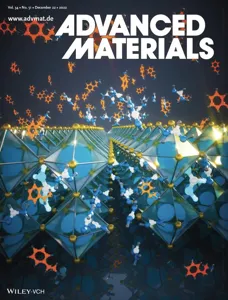
Near infrared electroluminescence of ZnMgO/InN core–shell nanorod heterostructures grown on Si substrate
文献信息
发布日期
2016-06-07
DOI
10.1039/C6CP03199D
影响因子
3.676
作者
Guoguang Wu, Weitao Zheng, Fubin Gao, Hang Yang, Yang Zhao, Jingzhi Yin, Wei Zheng, Wancheng Li, Baolin Zhang, Guotong Du
查看原文
摘要
This paper presents a systematic investigation of a ZnMgO/InN core–shell nanorods heterojunction device on a p-Si substrate. Here we demonstrated the heteroepitaxial growth of the well-aligned ZnMgO/InN core–shell nanorods structure, which enabled an increased heterojunction area to improve the carrier injection efficiency of nanodevices by plasma-assisted molecular beam epitaxy combined with metal–organic chemical vapor deposition. In situ X-ray photoelectron spectroscopy measurements were performed on the ZnMgO nanorods, the interface of ZnMgO/InN and the InN core–shell nanorods to fully understand the structure and working mechanism of the heterojunction device. The current transport mechanism has been discussed in terms of the characteristics of current–voltage and the energy band diagram of the n-InN/ZnMgO/p-Si heterojunction. At a low forward voltage, the current transport followed the dependence of I ∼ V1.47, which was attributed to the deep-level assisted tunneling. When the forward voltage was larger than 10 V, the current followed the relation of I ∼ V2 because of the radiative recombination process. In accordance with the above conclusion, the near-infrared electroluminescence of the diode could be observed after the forward bias voltage up to 11.6 V at room temperature. In addition, the size quantization effect and the intrinsic electron accumulation of the InN core–shell nanorods were investigated to explain the blueshift and broadened bandwidth. Furthermore, the light output power of about 0.6 microwatt at a fixed wavelength of 1500 nm indicated that our study will further provide a useful route for realizing the near-infrared electroluminescence of InN on Si substrate.
相关文献
Non-toxic catalysts for ring-opening polymerizations of biodegradable polymers at room temperature for biohybrid materials
2013-12-05
Paper
DOI: 10.1039/C3GC42044B
Palladium-catalyzed synthesis of benzoxazoles by the cleavage reaction of carbon–carbon triple bonds with o-aminophenol
Ying Liang, Heng-Shan Wang, Ying-Ming Pan
2014-01-17
Communication
DOI: 10.1039/C3GC42499E
Solvents for sustainable chemical processes
Evan A. Davey, Esteban E. Ureña-Benavides
2013-12-20
Critical Review
DOI: 10.1039/C3GC42302F
Solvent-free γ-valerolactone hydrogenation to 2-methyltetrahydrofuran catalysed by Ru/C: a reaction network analysis
Mohammad G. Al-Shaal, Adam Dzierbinski, Regina Palkovits
2013-12-12
Paper
DOI: 10.1039/C3GC41803K
Glycerol based solvents: synthesis, properties and applications
José I. García, Héctor García-Marín, Elísabet Pires
2013-12-05
Critical Review
DOI: 10.1039/C3GC41857J
Heterogeneous ditopic ZnFe2O4 catalyzed synthesis of 4H-pyrans: further conversion to 1,4-DHPs and report of functional group interconversion from amide to ester
Paramita Das, Arghya Dutta, Asim Bhaumik, Chhanda Mukhopadhyay
2013-11-27
Paper
DOI: 10.1039/C3GC42095G
Precipitation of chitosan from ionic liquid solution by the compressed CO2 anti-solvent method
Xiaofu Sun, Zhimin Xue, Tiancheng Mu
2014-01-10
Communication
DOI: 10.1039/C3GC42166J
Studies on staged precipitation of cellulose from an ionic liquid by compressed carbon dioxide
Xiaofu Sun, Yanling Chi, Tiancheng Mu
2014-02-24
Paper
DOI: 10.1039/C4GC00085D
Regioselective synthesis of renewable bisphenols from 2,3-pentanedione and their application as plasticizers
Wouter Schutyser, Steven-Friso Koelewijn, Michiel Dusselier, Joice Thomas, Feng Yu, Maria Josefina Carbone, Mario Smet, Peter Van Puyvelde, Wim Dehaen, Bert F. Sels
2014-02-24
Paper
DOI: 10.1039/C4GC00250D
您可能还喜欢
化合物问答
如何储存8-溴-4-羟基-6-(三氟甲氧基)喹啉-3-羧酸乙酯(CAS号:1072944-81-0)?
8-溴-4-羟基-6-(三氟甲氧基)喹啉-3-羧酸乙酯应储存在阴凉、干燥的地方,避免光照和高温。建议使用密封容器进行储存,以防止水分和空气的影响。
1072944-81-0Ethyl 8-bromo-4-hydr...
化合物问答
2,2-二(2-呋喃基)丙烷(CAS号:17920-88-6)的市场或研究趋势如何?
2,2-二(2-呋喃基)丙烷的研究趋势主要集中在新型材料的开发和应用,如高分子材料、有机光电材料等。市场趋势方面,随着环保要求的提高和新材料的应用,该化合物的需...
17920-88-62,2'-(2,2-Propanediy...
化合物问答
如何处理含有螺[呋喃并[3,4-b]吡啶-5(7H),4'-哌啶]-7-酮盐酸盐(CAS号:475152-31-9)的废料?
对于含有螺[呋喃并[3,4-b]吡啶-5(7H),4'-哌啶]-7-酮盐酸盐的废料,应首先进行分类和分离,以减少危险物质的数量。随后,可以考虑通过化学氧化、生物...
475152-31-97H-Spiro[furo[3,4-b]...
化合物问答
Cinnamyl 3-aminobut-2-enoate(CAS号:113898-97-8)安全吗?
Cinnamyl 3-氨基丁-2-烯酸在接触皮肤和眼睛时可能会引起刺激。应避免吸入其粉尘和烟雾。操作时应穿戴适当的个人防护装备,如手套、护目镜和实验室外套。
113898-97-8Cinnamyl 3-aminobut-...
化合物问答
反式-2-十二碳烯二酸(CAS号:6402-36-4)的市场或研究趋势如何?
反式-2-十二碳烯二酸在医药、材料科学等领域有一定的应用,但其市场相对较小。近年来,由于环保意识的提升,对环境友好型化学品的需求增加,研究倾向于开发更绿色的合成...
6402-36-4Traumatic Acid
化合物问答
什么是(9ci)-1H-苯并咪唑-5-乙酸(CAS号:473895-86-2)?
(9ci)-1H-苯并咪唑-5-乙酸是一种含氮杂环化合物,其化学结构为1H-苯并咪唑-5-乙酸。该化合物具有特定的分子式C8H7NO2,属于有机酸类化合物。
473895-86-21H-Benzimidazol-5-yl...
化合物问答
酞菁蓝(CAS号:147-14-8)的主要用途是什么?
酞菁蓝主要用作颜料和染料,广泛应用于塑料、油墨、涂料、纺织品及橡胶工业中。它也用于光敏材料,如太阳能电池和光刻胶。在医疗领域,酞菁蓝因其光敏特性被用于某些光动力...
147-14-8Copper(2+) phthalocy...
化合物问答
5-甲基-1,2,3,4-四氢异喹啉(CAS号:123593-99-7)安全吗?
5-甲基-1,2,3,4-四氢异喹啉在使用和储存时需要谨慎处理。它具有一定的毒性,应避免吸入其蒸气或直接接触皮肤和眼睛。操作此化合物时,建议佩戴防护眼镜、实验服...
123593-99-75-Methyl-1,2,3,4-tet...
化合物问答
如何处理含有3',4',5'-三甲氧基苯乙酮(CAS号:1136-86-3)的废料?
含有3',4',5'-三甲氧基苯乙酮的废液应首先确保其是否为危险废物,根据当地法规确定处理方法。通常,这类有机废液可以采用中和反应降低其pH值,然后通过蒸馏或萃...
1136-86-31-(3,4,5-Trimethoxyp...
化合物问答
如何储存KI-7(CAS号:1489263-00-4)?
KI-7应储存在通风良好的干燥环境中,避免光照和高温。建议使用密封容器储存,并保持在阴凉处。储存温度应控制在室温范围内,一般建议不超过25°C。避免与氧化剂接触...
1489263-00-42-(1-Benzyl-1H-indol...
来源期刊
Physical Chemistry Chemical Physics

CiteScore:
5.5
自引率:
10.3%
年发文量:
3036
Physical Chemistry Chemical Physics (PCCP) is an international journal co-owned by 19 physical chemistry and physics societies from around the world. This journal publishes original, cutting-edge research in physical chemistry, chemical physics and biophysical chemistry. To be suitable for publication in PCCP, articles must include significant innovation and/or insight into physical chemistry; this is the most important criterion that reviewers and Editors will judge against when evaluating submissions. The journal has a broad scope and welcomes contributions spanning experiment, theory, computation and data science. Topical coverage includes spectroscopy, dynamics, kinetics, statistical mechanics, thermodynamics, electrochemistry, catalysis, surface science, quantum mechanics, quantum computing and machine learning. Interdisciplinary research areas such as polymers and soft matter, materials, nanoscience, energy, surfaces/interfaces, and biophysical chemistry are welcomed if they demonstrate significant innovation and/or insight into physical chemistry. Joined experimental/theoretical studies are particularly appreciated when complementary and based on up-to-date approaches.
推荐化合物
![Methyl 3-({2'-[(E)-(hydroxyhydrazono)methyl]-4-biphenylyl}methyl)-2-oxo-2,3-dihydro-1H-benzimidazole-4-carboxylate structure](https://cnstatic.chemtradehub.com/structs/149/1499167-72-4-034a.webp "Methyl 3-({2'-[(E)-(hydroxyhydrazono)methyl]-4-biphenylyl}methyl)-2-oxo-2,3-dihydro-1H-benzimidazole-4-carboxylate structure")

![[3-(2,6-Dichlorophenyl)-5-isopropyl-1,2-oxazol-4-yl]methanol structure](https://cnstatic.chemtradehub.com/structs/278/278597-30-1-5c79.webp "[3-(2,6-Dichlorophenyl)-5-isopropyl-1,2-oxazol-4-yl]methanol structure")
推荐供应商




免责声明
本页面提供的学术期刊信息仅供参考和研究使用。我们与任何期刊出版商均无关联,也不处理投稿事宜。如有投稿相关咨询,请直接联系相关期刊出版商。
如发现页面信息有误,请发送邮件至 support@chemtradehub.com 联系我们。我们将及时核实并处理您的问题。