











Molecular mechanisms responsible for hydrate anti-agglomerant performance
文献信息
发布日期
2016-07-07
DOI
10.1039/C6CP03296F
影响因子
3.676
作者
Anh Phan, Tai Bui, Erick Acosta, Pushkala Krishnamurthy, Alberto Striolo
查看原文
摘要
Steered and equilibrium molecular dynamics simulations were employed to study the coalescence of a sI hydrate particle and a water droplet within a hydrocarbon mixture. The size of both the hydrate particle and the water droplet is comparable to that of the aqueous core in reverse micelles. The simulations were repeated in the presence of various quaternary ammonium chloride surfactants. We investigated the effects due to different groups on the quaternary head group (e.g. methyl vs. butyl groups), as well as different hydrophobic tail lengths (e.g. n-hexadecyl vs. n-dodecyl tails) on the surfactants' ability to prevent coalescence. Visual inspection of sequences of simulation snapshots indicates that when the water droplet is not covered by surfactants it is more likely to approach the hydrate particle, penetrate the protective surfactant film, reach the hydrate surface, and coalesce with the hydrate than when surfactants are present on both surfaces. Force–distance profiles obtained from steered molecular dynamics simulations and free energy profiles obtained from umbrella sampling suggest that surfactants with butyl tripods on the quaternary head group and hydrophobic tails with size similar to the solvent molecules can act as effective anti-agglomerants. These results qualitatively agree with macroscopic experimental observations. The simulation results provide additional insights, which could be useful in flow assurance applications: the butyl tripod provides adhesion between surfactants and hydrates; when the length of the surfactant tail is compatible with that of the hydrocarbon in the liquid phase a protective film can form on the hydrate; however, once a molecularly thin chain of water molecules forms through the anti-agglomerant film, connecting the water droplet and the hydrate, water flows to the hydrate and coalescence is inevitable.
相关文献
pH-Responsive mechanised nanoparticles gated by semirotaxanes
Niveen M. Khashab, Matthew E. Belowich, Ali Trabolsi, Douglas C. Friedman, Cory Valente, Yuen Lau, Hussam A. Khatib, Jeffrey I. Zink, J. Fraser Stoddart
2009-08-18
Communication
DOI: 10.1039/B910431C
Convenient modular method for affinity labeling (MoAL method) based on a catalytic amidation
Shuichi Nakanishi, Jin Nishida, Hiroyuki Tanaka, Daiki Morisaki, Hiroshi Nomoto
2009-08-19
Communication
DOI: 10.1039/B912908A
Ferrocenes with two carbohydrate appendages at the upper and lower rings are useful for investigating carbohydrate–carbohydrate interactions
2009-07-30
Communication
DOI: 10.1039/B910534D
A method for covering a substrate with highly-oriented single crystalline hexagonal zinc structures under ambient pressure and room temperature
Seungho Cho, Hye-Jin Kim, Kun-Hong Lee
2009-08-21
Communication
DOI: 10.1039/B911773C
Discrimination of cryptochirality in chiral isotactic polystyrene by asymmetric autocatalysis
Christiane Hohberger, Yuko Araki, Kunihiko Hatase, Klaus Beckerle, Jun Okuda
2009-08-21
Communication
DOI: 10.1039/B912813A
Hierarchical γ-Al2O3 monoliths with highly ordered 2D hexagonal mesopores in macroporous walls
Le-Le Li, Wen-Tao Duan, Quan Yuan, Zhen-Xing Li, Hao-Hong Duan, Chun-Hua Yan
2009-09-10
Communication
DOI: 10.1039/B912495K
Multiple conformational changes of β-tetraphenyl meso-hexakis(pentafluorophenyl) substituted [26] and [28]hexaphyrins(1.1.1.1.1.1)
Taro Koide, Katsuyuki Youfu, Shohei Saito, Atsuhiro Osuka
2009-08-21
Communication
DOI: 10.1039/B910167E
A highly efficient methodology of asymmetric epoxidation based on a novel chiral sulfur ylide‡
Francisco Sarabia, Samy Chammaa, Miguel García-Castro, Francisca Martín-Gálvez
2009-08-07
Communication
DOI: 10.1039/B912070J
Inclusion of C60 into the hexagonal columnar space formed by intra- and intermolecular CH⋯π interactions
Junji Kobayashi, Yuya Domoto, Takayuki Kawashima
2009-09-17
Communication
DOI: 10.1039/B909881J
您可能还喜欢
化合物问答
什么是2,6-二溴-4,8-双[(2-乙基己基)氧基]苯并[1,2-b:4,5-b']二噻吩(CAS号:1226782-13-3)?
2,6-二溴-4,8-双[(2-乙基己基)氧基]苯并[1,2-b:4,5-b']二噻吩是一种有机化合物,分子式为C23H32Br2O2S2。该化合物具有芳香性和...
1226782-13-32,6-Dibromo-4,8-bis[...
化合物问答
木聚硫钠(CAS号:37319-17-8)的物理化学性质是什么?
木聚硫钠通常为无色或白色结晶性粉末,具有吸湿性。其分子量约为121.11 g/mol。木聚硫钠易溶于水,不溶于醇类和其他非极性溶剂。在酸性或碱性溶液中,木聚硫钠...
37319-17-8Pentosan
化合物问答
2-甲氧基-4-(三氟甲基)苄溴, JRD(CAS号:886500-59-0)适用哪些法规指南?
该化合物在合成、储存和运输过程中需遵循《全球化学品统一分类和标签制度》(GHS)的健康、环境和物理危险分类。在欧洲还需符合《化学品注册、评估、授权和限制》(RE...
886500-59-02-Methoxy-4-(trifluo...
化合物问答
1,4-Diazoniabicyclo[2.2.2]octane-1,4-disulfinate(CAS号:119752-83-9)的主要用途是什么?
1,4-二氮杂双环[2.2.2]辛烷-1,4-二硫酸二酯主要用于有机合成中的保护基团,特别是在保护胺基和硫醇基方面具有广泛应用。此外,它还用于一些特殊化学反应的...
119752-83-91,4-Diazabicyclo[2.2...
化合物问答
如何处理含有4-(Bromomethyl)-2-fluorobenzenesulphonamide(CAS号:1645275-47-3)的废料?
含有4-(Bromomethyl)-2-fluorobenzenesulphonamide的废液应首先进行中和处理,以降低pH值,避免对环境造成腐蚀性影响。随后...
1645275-47-34-(Bromomethyl)-2-fl...
化合物问答
Loureiriol(CAS号:479195-44-3)的物理化学性质是什么?
Loureiriol是一种天然化合物,其分子式为C15H22O4。Loureiriol为无色结晶性粉末,具有较高的熔点和良好的热稳定性。其相对分子质量为262....
479195-44-3Loureiriol
化合物问答
在合成中是否有3-氨基苯甲酰苯胺(CAS号:14315-16-3)的替代品?
在合成过程中,可以考虑使用类似结构的化合物作为3-氨基苯甲酰苯胺的替代品,例如N-苯基-3-氰基苯胺或N-苯基-3-硝基苯胺等,这些化合物具有相似的化学性质,可...
14315-16-33-Amino-N-phenylbenz...
化合物问答
4-异氰酰苯基硼酸频哪醇酯(CAS号:380430-64-8)的市场或研究趋势如何?
4-异氰酰苯基硼酸频哪醇酯主要应用于有机合成、药物化学和材料科学领域。随着绿色化学的发展,该化合物因其高效的官能团转化能力和环境友好性而受到越来越多的关注。近年...
380430-64-82-(4-Isocyanatopheny...
化合物问答
如何储存3β-乙酰氧基-7,25-甘遂二烯-24(R)-醇(CAS号:1352001-09-2)?
3β-乙酰氧基-7,25-甘遂二烯-24(R)-醇应储存在阴凉、干燥、通风良好的地方,避免直接光照。储存容器应密封,防止空气中的水分和氧气影响化合物的稳定性。建...
1352001-09-23β-acetoxy-eupha- 7,...
化合物问答
如何储存4-氟-2-甲基-1H-吲哚(CAS号:1260383-51-4)?
应将4-氟-2-甲基-1H-吲哚存放在阴凉、干燥、通风良好的地方,避免直接暴露在光照下。容器应密封,避免与空气中的水蒸气接触。建议在避光、温度不超过25℃的环境...
1260383-51-44-Fluoro-2-methyl-1H...
来源期刊
Physical Chemistry Chemical Physics

CiteScore:
5.5
自引率:
10.3%
年发文量:
3036
Physical Chemistry Chemical Physics (PCCP) is an international journal co-owned by 19 physical chemistry and physics societies from around the world. This journal publishes original, cutting-edge research in physical chemistry, chemical physics and biophysical chemistry. To be suitable for publication in PCCP, articles must include significant innovation and/or insight into physical chemistry; this is the most important criterion that reviewers and Editors will judge against when evaluating submissions. The journal has a broad scope and welcomes contributions spanning experiment, theory, computation and data science. Topical coverage includes spectroscopy, dynamics, kinetics, statistical mechanics, thermodynamics, electrochemistry, catalysis, surface science, quantum mechanics, quantum computing and machine learning. Interdisciplinary research areas such as polymers and soft matter, materials, nanoscience, energy, surfaces/interfaces, and biophysical chemistry are welcomed if they demonstrate significant innovation and/or insight into physical chemistry. Joined experimental/theoretical studies are particularly appreciated when complementary and based on up-to-date approaches.
推荐化合物
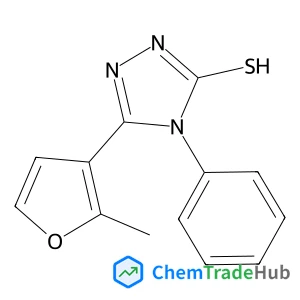
5-(2-Methyl-3-furyl)-4-phenyl-2,4-dihydro-3H-1,2,4-triazole-3-thione
CAS号:
346464-59-3
分子式:
C13H11N3OS
![6,6-Dimethylbicyclo[3.1.1]hept-2-ene-2-carbaldehyde structure](https://cnstatic.chemtradehub.com/structs/564/564-94-3-e746.webp "6,6-Dimethylbicyclo[3.1.1]hept-2-ene-2-carbaldehyde structure")
![6-(Benzyloxy)-8-(2-bromoacetyl)-2H-benzo[b][1,4]oxazin-3(4H)-one structure](https://cnstatic.chemtradehub.com/structs/926/926319-53-1-2287.webp "6-(Benzyloxy)-8-(2-bromoacetyl)-2H-benzo[b][1,4]oxazin-3(4H)-one structure")
推荐供应商


免责声明
本页面提供的学术期刊信息仅供参考和研究使用。我们与任何期刊出版商均无关联,也不处理投稿事宜。如有投稿相关咨询,请直接联系相关期刊出版商。
如发现页面信息有误,请发送邮件至 support@chemtradehub.com 联系我们。我们将及时核实并处理您的问题。