








![(1R,5R)-3-{[(2-Methyl-2-propanyl)oxy]carbonyl}-3-azabicyclo[3.1.0]hexane-1-carboxylic acid structure](https://cnstatic.chemtradehub.com/structs/116/1165450-63-4-bfe1.webp "(1R,5R)-3-{[(2-Methyl-2-propanyl)oxy]carbonyl}-3-azabicyclo[3.1.0]hexane-1-carboxylic acid structure")
The effect of water on discharge product growth and chemistry in Li–O2 batteries
文献信息
发布日期
2016-08-12
DOI
10.1039/C6CP03695C
影响因子
3.676
作者
David G. Kwabi, Thomas P. Batcho, Shuting Feng, Carl V. Thompson
查看原文
摘要
Understanding what controls Li–O2 battery discharge product chemistry and morphology is key to enabling its practical deployment as a low-cost, high-specific-energy energy conversion technology. Several studies have recently shown that the addition of substantial quantities (hundreds to thousands ppm) of water and weak acids to dimethoxyethane (DME)-based electrolytes can significantly increase Li–O2 battery discharge capacity, without substantially changing the discharge product chemistry, which remains Li2O2. The exact mechanisms behind these device-level improvements, however, are not yet understood. In this study, we show that the presence of water in a DME-based electrolyte decreases the rate of Li2O2 nucleation on the electrode surface during Li–O2 battery discharge, using potentiostatic electrochemical measurements, and direct, ex situ observations of Li2O2 particles. We also show that adding water to an acetonitrile (MeCN)-based electrolyte results in LiOH upon discharge, as opposed to only Li2O2. Using first principles calculations, we propose that this change in discharge product chemistry is attributable to increased proton availability, as shown by a lower pKa for water in MeCN than in DME. This study combines kinetic and morphological analyses with first principles calculations, and elucidates relationships among electrolyte composition, discharge product chemistry and growth mechanisms for the rational design of efficient metal–air batteries.
相关文献
Catalytic membrane-installed microchannel reactors for one-second allylic arylation
Yoichi M. A. Yamada, Kaoru Torii
2009-08-18
Communication
DOI: 10.1039/B912696A
High-mobility anthracene-based X-shaped conjugated molecules for thin film transistors
Ki Hwa Jung, Suk Young Bae, Kyung Hwan Kim, Min Ju Cho, Kwangyeol Lee, Zee Hwan Kim, Dong Hoon Choi, Dong Hoon Lee, Dae Sung Chung, Chan Eon Park
2009-07-28
Communication
DOI: 10.1039/B911780F
The effect of DNA aptamer configuration on the sensitivity of detection thrombin at surface by acoustic method
Tibor Hianik, Igor Grman, Ivana Karpisova
2009-09-08
Communication
DOI: 10.1039/B910981A
Copper-catalyzed enantioselectivecarbenoidinsertion into S–H bonds‡
Yong-Zhen Zhang, Shou-Fei Zhu, Yan Cai, Hong-Xiang Mao, Qi-Lin Zhou
2009-08-11
Communication
DOI: 10.1039/B911670B
Simple mixed Fe–Zn catalysts for the Suzuki couplings of tetraarylborates with benzyl halides and 2-halopyridines
Robin B. Bedford, Mark A. Hall, George R. Hodges, Michael Huwe, Mark C. Wilkinson
2009-09-28
Communication
DOI: 10.1039/B915945B
Polythiophene derivatives by step-growth polymerizationvia photoinduced electron transfer reactions
Binnur Aydogan, Ali Senol Gundogan, Turan Ozturk, Yusuf Yagci
2009-09-07
Communication
DOI: 10.1039/B914953H
Observation of reaction intermediates and kinetic mistakes in a remarkably slow self-assembly reaction
Virginia M. Cangelosi, Timothy G. Carter, Lev N. Zakharov, Darren W. Johnson
2009-08-20
Communication
DOI: 10.1039/B914750K
Hierarchical γ-Al2O3 monoliths with highly ordered 2D hexagonal mesopores in macroporous walls
Le-Le Li, Wen-Tao Duan, Quan Yuan, Zhen-Xing Li, Hao-Hong Duan, Chun-Hua Yan
2009-09-10
Communication
DOI: 10.1039/B912495K
Discrimination of cryptochirality in chiral isotactic polystyrene by asymmetric autocatalysis
Christiane Hohberger, Yuko Araki, Kunihiko Hatase, Klaus Beckerle, Jun Okuda
2009-08-21
Communication
DOI: 10.1039/B912813A
您可能还喜欢
化合物问答
什么是2,6-二溴-4,8-双[(2-乙基己基)氧基]苯并[1,2-b:4,5-b']二噻吩(CAS号:1226782-13-3)?
2,6-二溴-4,8-双[(2-乙基己基)氧基]苯并[1,2-b:4,5-b']二噻吩是一种有机化合物,分子式为C23H32Br2O2S2。该化合物具有芳香性和...
1226782-13-32,6-Dibromo-4,8-bis[...
化合物问答
木聚硫钠(CAS号:37319-17-8)的物理化学性质是什么?
木聚硫钠通常为无色或白色结晶性粉末,具有吸湿性。其分子量约为121.11 g/mol。木聚硫钠易溶于水,不溶于醇类和其他非极性溶剂。在酸性或碱性溶液中,木聚硫钠...
37319-17-8Pentosan
化合物问答
2-甲氧基-4-(三氟甲基)苄溴, JRD(CAS号:886500-59-0)适用哪些法规指南?
该化合物在合成、储存和运输过程中需遵循《全球化学品统一分类和标签制度》(GHS)的健康、环境和物理危险分类。在欧洲还需符合《化学品注册、评估、授权和限制》(RE...
886500-59-02-Methoxy-4-(trifluo...
化合物问答
1,4-Diazoniabicyclo[2.2.2]octane-1,4-disulfinate(CAS号:119752-83-9)的主要用途是什么?
1,4-二氮杂双环[2.2.2]辛烷-1,4-二硫酸二酯主要用于有机合成中的保护基团,特别是在保护胺基和硫醇基方面具有广泛应用。此外,它还用于一些特殊化学反应的...
119752-83-91,4-Diazabicyclo[2.2...
化合物问答
如何处理含有4-(Bromomethyl)-2-fluorobenzenesulphonamide(CAS号:1645275-47-3)的废料?
含有4-(Bromomethyl)-2-fluorobenzenesulphonamide的废液应首先进行中和处理,以降低pH值,避免对环境造成腐蚀性影响。随后...
1645275-47-34-(Bromomethyl)-2-fl...
化合物问答
Loureiriol(CAS号:479195-44-3)的物理化学性质是什么?
Loureiriol是一种天然化合物,其分子式为C15H22O4。Loureiriol为无色结晶性粉末,具有较高的熔点和良好的热稳定性。其相对分子质量为262....
479195-44-3Loureiriol
化合物问答
在合成中是否有3-氨基苯甲酰苯胺(CAS号:14315-16-3)的替代品?
在合成过程中,可以考虑使用类似结构的化合物作为3-氨基苯甲酰苯胺的替代品,例如N-苯基-3-氰基苯胺或N-苯基-3-硝基苯胺等,这些化合物具有相似的化学性质,可...
14315-16-33-Amino-N-phenylbenz...
化合物问答
4-异氰酰苯基硼酸频哪醇酯(CAS号:380430-64-8)的市场或研究趋势如何?
4-异氰酰苯基硼酸频哪醇酯主要应用于有机合成、药物化学和材料科学领域。随着绿色化学的发展,该化合物因其高效的官能团转化能力和环境友好性而受到越来越多的关注。近年...
380430-64-82-(4-Isocyanatopheny...
化合物问答
如何储存3β-乙酰氧基-7,25-甘遂二烯-24(R)-醇(CAS号:1352001-09-2)?
3β-乙酰氧基-7,25-甘遂二烯-24(R)-醇应储存在阴凉、干燥、通风良好的地方,避免直接光照。储存容器应密封,防止空气中的水分和氧气影响化合物的稳定性。建...
1352001-09-23β-acetoxy-eupha- 7,...
化合物问答
如何储存4-氟-2-甲基-1H-吲哚(CAS号:1260383-51-4)?
应将4-氟-2-甲基-1H-吲哚存放在阴凉、干燥、通风良好的地方,避免直接暴露在光照下。容器应密封,避免与空气中的水蒸气接触。建议在避光、温度不超过25℃的环境...
1260383-51-44-Fluoro-2-methyl-1H...
来源期刊
Physical Chemistry Chemical Physics

CiteScore:
5.5
自引率:
10.3%
年发文量:
3036
Physical Chemistry Chemical Physics (PCCP) is an international journal co-owned by 19 physical chemistry and physics societies from around the world. This journal publishes original, cutting-edge research in physical chemistry, chemical physics and biophysical chemistry. To be suitable for publication in PCCP, articles must include significant innovation and/or insight into physical chemistry; this is the most important criterion that reviewers and Editors will judge against when evaluating submissions. The journal has a broad scope and welcomes contributions spanning experiment, theory, computation and data science. Topical coverage includes spectroscopy, dynamics, kinetics, statistical mechanics, thermodynamics, electrochemistry, catalysis, surface science, quantum mechanics, quantum computing and machine learning. Interdisciplinary research areas such as polymers and soft matter, materials, nanoscience, energy, surfaces/interfaces, and biophysical chemistry are welcomed if they demonstrate significant innovation and/or insight into physical chemistry. Joined experimental/theoretical studies are particularly appreciated when complementary and based on up-to-date approaches.
推荐化合物
![6-(Benzyloxy)-8-(2-bromoacetyl)-2H-benzo[b][1,4]oxazin-3(4H)-one structure](https://cnstatic.chemtradehub.com/structs/926/926319-53-1-2287.webp "6-(Benzyloxy)-8-(2-bromoacetyl)-2H-benzo[b][1,4]oxazin-3(4H)-one structure")
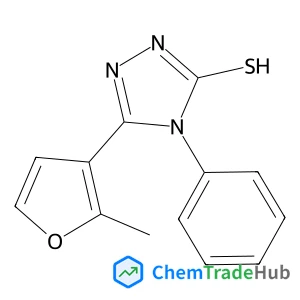
5-(2-Methyl-3-furyl)-4-phenyl-2,4-dihydro-3H-1,2,4-triazole-3-thione
CAS号:
346464-59-3
分子式:
C13H11N3OS
推荐供应商





免责声明
本页面提供的学术期刊信息仅供参考和研究使用。我们与任何期刊出版商均无关联,也不处理投稿事宜。如有投稿相关咨询,请直接联系相关期刊出版商。
如发现页面信息有误,请发送邮件至 support@chemtradehub.com 联系我们。我们将及时核实并处理您的问题。