





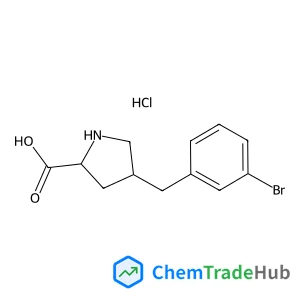
(2S,4R)-4-(3-Bromobenzyl)pyrrolidine-2-carboxylic acid hydrochloride
CAS号:
1049734-10-2
分子式:
C12H15BrClNO2
Ángel Martín Pendás, José Manuel Guevara-Vela, Daniel Menéndez Crespo, Aurora Costales, Evelio Francisco
While the modern theory of the insulating state shows that the conducting or insulating properties of a system can be extracted solely from the ground state properties via the so-called localization tensor (LT), no chemical reading of this important quantity has ever been offered. Here, a remarkable link between the LT and the bond orders as described by the delocalization indices (DIs) of chemical bonding theory is reported. This is achieved through a real space partition of the LT into intra- and interatomic contributions. We show that the convergence or divergence of the LT in the thermodynamic limit, which signals the insulating or conducting nature of an extended system, respectively, can be nailed down to DIs. This allows for the exploitation of traditional chemical intuition to identify essential and spectator atomic groups in determining electrical conductivity. The thermodynamic limit of the LT is controlled by the spatial decay rate of the interatomic DIs, exponential in insulators and power-law in conductors. Computational data of a few selected toy systems corroborate our results.
Ryoya Kobayashi, Toshihiro Takashima, Satoshi Tanigawa, Shugo Takeuchi, Bunsho Ohtani
DOI: 10.1039/C6CP02903E
Claire Roiland, Gaelle Trippé-Allard, Khaoula Jemli, Bruno Alonso, Jean-Claude Ameline, Régis Gautier, Thierry Bataille, Laurent Le Pollès, Emmanuelle Deleporte, Jacky Even, Claudine Katan
DOI: 10.1039/C6CP02947G
Y. F. Huang, D. Gan, J. Y. Xu, H. Li, G. Wang
DOI: 10.1039/C6CP04686J
Michael Staniforth, Lewis A. Baker, Natércia D. N. Rodrigues, Neil C. Cole-Filipiak, Wen-Dong Quan, Vasilios G. Stavros
DOI: 10.1039/C6CP05205C
Xiaofang Li, Changqian Wang, Bo Li, Yu Shao, Danzhen Li
DOI: 10.1039/C6CP04929J
G. Buntinx, O. Devos, N. Jaïdane, S. Delbaere, A. K. Tiwari, J. Dubois, M. Takeshita, Y. Wada, S. Aloïse
DOI: 10.1039/C6CP03471C
Chuanxiang Cao, Zhang Chen, Jianjun Liu
DOI: 10.1039/C6CP05143J
Hao Su, Xiang Sheng, Yongjun Liu
DOI: 10.1039/C6CP04918D
B. X. Wang, T. F. Liu, Y. B. Zhou, X. Chen, X. B. Yuan, Y. Y. Yang, W. P. Liu, J. M. Wang, H. W. Han, Y. W. Tang
DOI: 10.1039/C6CP04793A
3-表南美楝属二醇是一种具有特定立体化学结构的化合物,其分子式为C31H52O2,属于甾醇类化合物。它具有光学活性,是一种复杂的有机分子,主要存在于一些植物中。
3-羧基-5-碘苯甲酸甲酯主要应用于医药行业,作为合成某些药物中间体的重要原料。此外,它还可能用于聚合物的改性、传感器的制备以及半导体材料的制备等领域。
3-Bromoindolin-2-one是一种含有溴代基团的吲哚酮衍生物,分子式为C9H7BrNO。它是一种无色固体,具有一定的挥发性,熔点为158-159°C...
对于含有该化合物的废液,应先进行中和处理,然后根据其毒性和活性选择合适的处置方法。可以考虑焚烧处理或由专业的化学品废物处理公司进行无害化处理。处理过程中需注意环...
ANGIOTENSIN 1/2 + A (2 - 8)是一种蛋白质类化合物,具有典型的蛋白质性质。它的分子量约为5900 Da。该化合物在水中具有一定的溶解性,...
应将该化合物存放在阴凉干燥、通风良好的地方,避免阳光直射。建议将化合物密封保存在避光的、干燥的容器中,远离火源和高温环境。
苏丹红IV氘代物 标准品是一种含有氘代标记的苏丹红IV化合物,是一种用于化合物分析、结构确证以及代谢研究的标准物质。
该化合物需要遵循《全球化学品统一分类和标签制度》(GHS)中的分类和标签要求,具体分类需依据其毒性和物理化学性质。此外,还需要符合《欧盟化学品注册、评估、授权和...
2-氨基-2-(2-吡啶)乙酸乙酯应储存于阴凉、干燥、通风良好的环境中,避免高温和光照。应使用密封容器储存,并远离易燃物、氧化剂和其他危险化学品。
3-羟基-4-甲氧基吡啶-2-羧酸主要用于合成其他有机化合物,如药物合成、农药合成和染料合成等。此外,它还可用作中间体和试剂,在化学研究领域也有一定的应用。

Physical Chemistry Chemical Physics (PCCP) is an international journal co-owned by 19 physical chemistry and physics societies from around the world. This journal publishes original, cutting-edge research in physical chemistry, chemical physics and biophysical chemistry. To be suitable for publication in PCCP, articles must include significant innovation and/or insight into physical chemistry; this is the most important criterion that reviewers and Editors will judge against when evaluating submissions. The journal has a broad scope and welcomes contributions spanning experiment, theory, computation and data science. Topical coverage includes spectroscopy, dynamics, kinetics, statistical mechanics, thermodynamics, electrochemistry, catalysis, surface science, quantum mechanics, quantum computing and machine learning. Interdisciplinary research areas such as polymers and soft matter, materials, nanoscience, energy, surfaces/interfaces, and biophysical chemistry are welcomed if they demonstrate significant innovation and/or insight into physical chemistry. Joined experimental/theoretical studies are particularly appreciated when complementary and based on up-to-date approaches.
![Heptadecanoic Acid 3-[2-[4-(6-Fluoro-1,2-benzisoxazol-3-yl)-1-piperidinyl]ethyl]-6,7,8,9-tetrahydro-2-methyl-4-oxo-4H-pyrido[1,2-a]pyrimidin-9-yl Ester structure](https://cnstatic.chemtradehub.com/structs/140/1404053-62-8-9da4.webp "Heptadecanoic Acid 3-[2-[4-(6-Fluoro-1,2-benzisoxazol-3-yl)-1-piperidinyl]ethyl]-6,7,8,9-tetrahydro-2-methyl-4-oxo-4H-pyrido[1,2-a]pyrimidin-9-yl Ester structure")






