




Synergetic enhancement of antitumor efficacy with charge-reversal and reduction-sensitive polymer micelles
文献信息
发布日期
2016-07-14
DOI
10.1039/C6PY00874G
影响因子
5.582
作者
Shi-Xi Li, Lei Liu, Liu-Jie Zhang, Bo Wu, Cai-Xia Wang, Wei Zhou, Ren-Xi Zhuo, Shi-Wen Huang
查看原文
摘要
The important characteristics of a nanoparticle-based anticancer drug delivery system at least include high stability in blood, highly efficient tumor cellular uptake and stimuli-responsive release of the anticancer drug inside the tumor cells. We here report a nanomicellar drug delivery system via self-assembly of PLA-SS-PAEMA/DMMA, an amphiphilic block copolymer composed of a poly(lactide) block and a poly(PAEMA/DMMA) block with disulfide linkage. Doxorubicin (DOX) was loaded into the micelles with a high drug-loading efficiency (10.6%, LE) and entrapment efficiency (59.5%, EE). In a neutral environment, PLA-SS-PAEMA/DMMA micelles are negatively charged, which ensures low adsorption of protein in the blood and excellent hemocompatibility. The surface charges of the micelles convert to positive under slightly acidic conditions at the tumor site, which improves the uptake of the micelles by the tumor cells. Once the drug-loaded micelles enter into the tumor cells, rapid release of DOX is triggered by reductive agents inside the tumor cells, such as GSH. In comparison to single responsive DOX-loaded PLA-CC-PAEMA/DMMA micelles and DOX-loaded PLA-SS-PAEMA/SA micelles, DOX-loaded PLA-SS-PAEMA/DMMA micelles showed higher cytotoxicity against HeLa cells due to the combinational effect of charge-reversal on cellular uptake and reduction-sensitivity on intracellular DOX release. The synergetic enhancement of antitumor efficacy by charge-reversal and reduction-sensitivity in DOX-loaded PLA-SS-PAEMA/DMMA micelles was further revealed by CLSM and flow cytometry analysis.
期刊推荐
相关文献
Dual pH-responsive micelles with both charge-conversional property and hydrophobic–hydrophilic transition for effective cellular uptake and intracellular drug release
Shuai Li, Zhouxiang Zhao, Chunmei Ding, Jianshu Li
2016-02-18
Paper
DOI: 10.1039/C6PY00177G
Poly(thiolactone) homo- and copolymers from maleimide thiolactone: synthesis and functionalization
Pieter Espeel, Filip E. Du Prez
2015-04-30
Paper
DOI: 10.1039/C5PY00329F
Thermo- and pH-sensitive shape memory polyurethane containing carboxyl groups
Qiuju Song, Shaobing Zhou, Keqing Zhao, Biqing Wang, Ping Hu
2016-01-25
Paper
DOI: 10.1039/C5PY02010G
Phenylmaleimide-containing PET-based copolyester: cross-linking from 2π + π cycloaddition toward flame retardance and anti-dripping
Xue Dong, Li Chen, Rong-Tao Duan, Yu-Zhong Wang
2016-03-14
Paper
DOI: 10.1039/C6PY00183A
Interpenetrating poly(urethane-urea)–polydimethylsiloxane networks designed as active elements in electromechanical transducers
C. Tugui, S. Vlad, M. Iacob, C. D. Varganici, L. Pricop, M. Cazacu
2016-03-16
Paper
DOI: 10.1039/C6PY00157B
Facile anionic synthesis of a well-controlled thermally cross-linkable block copolymer for polymer-based resistive memory device applications
Jingon Jang, Younggul Song, Myung-Jin Kim, Takhee Lee, Jae-Suk Lee
2015-05-01
Paper
DOI: 10.1039/C5PY00381D
Synthesis of polysarcosine from air and moisture stable N-phenoxycarbonyl-N-methylglycine assisted by tertiary amine base
Afroditi Doriti, Sarah M. Brosnan, Steffen M. Weidner, Helmut Schlaad
2016-04-08
Communication
DOI: 10.1039/C6PY00221H
Synthesis of a new poly([R]-3-hydroxybutyrate) RAFT agent
Lu Jiang, Sing Shy Liow
2016-01-04
Communication
DOI: 10.1039/C5PY01812A
A study on tunable AIE (AIEE) of boron ketoiminate-based conjugated polymers for live cell imaging
Chunhui Dai, Dongliang Yang, Xiao Fu, Qingmin Chen, Chengjian Zhu, Yixiang Cheng, Lianhui Wang
2015-06-05
Paper
DOI: 10.1039/C5PY00733J
Preservation of main-chain conjugation through BODIPY-containing alternating polymers from electronic interactions with side-chain substituents by cardo boron structures
Honami Yamane, Shunichiro Ito, Kazuo Tanaka, Yoshiki Chujo
2016-04-01
Paper
DOI: 10.1039/C6PY00377J
您可能还喜欢
化合物问答
如何储存1,2-环己二酮环乙缩醛(CAS号:4746-96-7)?
1,2-环己二酮环乙缩醛应储存在阴凉、干燥、通风良好的地方,避免阳光直射。建议使用密封容器保存,并保持环境温度在室温范围内,远离火源和热源。
4746-96-71,4-Dioxaspiro[4.5]d...
化合物问答
Ecopladib(CAS号:381683-92-7)的市场或研究趋势如何?
Ecopladib作为一种新型的药物,主要应用于治疗高胆固醇等疾病。目前,市场和研究趋势显示,Ecopladib因其独特的药理作用而受到关注。随着对心血管疾病治...
381683-92-7Ecopladib
化合物问答
2,3-Dimethyl-3H-imidazo[4,5-c]pyridine(CAS号:52538-09-7)通常如何合成?
2,3-二甲基-3H-咪唑[4,5-c]吡啶通常通过咪唑和2,3-二甲基吡啶的缩合反应合成。具体来说,将咪唑和2,3-二甲基吡啶在适当的溶剂中进行加热或加压反应...
52538-09-72,3-Dimethyl-3H-imid...
化合物问答
2,3,4,5-tetrahydro-1H-3-苯并氮杂环;盐酸盐(CAS号:17379-01-0)的市场或研究趋势如何?
该化合物在药物化学和有机合成中有一定的应用。近年来,随着对新型药物化合物的需求增加,该化合物的研究趋势主要集中在探索其生物活性,尤其是其在神经系统疾病治疗中的潜...
17379-01-02,3,4,5-Tetrahydro-1...
68-90-6(2-Ethyl-1-benzofura...
化合物问答
如何储存盐酸甘氨酸丁酯(CAS号:13048-99-2)?
盐酸甘氨酸丁酯应储存在阴凉、干燥、通风良好的地方,避免阳光直射和高温环境,温度应控制在25℃以下。储存容器应密封,避免与空气中的水分和酸性物质接触,以防发生水解...
13048-99-2Butyl glycinate hydr...
化合物问答
什么是2-Iodo-N,N-dimethylbenzamide(CAS号:54616-46-5)?
2-碘-N,N-二甲基苯胺是一种有机化合物,化学名为2-Iodo-N,N-dimethylbenzamide。其分子式为C<sub>9</sub>H<sub>1...
54616-46-52-Iodo-N,N-dimethylb...
16817-90-6N-Cyclohexylglycinam...
化合物问答
5-溴-2-(4H-1,2,4-三唑-4-基)吡啶(CAS号:959240-99-4)的市场或研究趋势如何?
随着医药、农药和新材料领域的发展,该化合物作为关键中间体的应用日益增多。特别是在药物合成中,由于其独特的化学性质,可以用于合成多种药物分子。未来的研究趋势可能集...
959240-99-45-Bromo-2-(4H-1,2,4-...
化合物问答
2,4-二溴-6-三氟甲基嘧啶(CAS号:785778-00-9)通常如何合成?
2,4-二溴-6-三氟甲基嘧啶通常通过溴化反应合成。首先,将6-三氟甲基嘧啶与溴化剂(如液溴)在适当的溶剂(如二氯甲烷、四氢呋喃)中反应,加入适当的催化剂(如四...
785778-00-92,4-Dibromo-6-(trifl...
来源期刊
Polymer Chemistry

CiteScore:
8.6
自引率:
7.3%
年发文量:
457
Polymer Chemistry welcomes submissions in all areas of polymer science that have a strong focus on macromolecular chemistry. Manuscripts may cover a broad range of fields, yet no direct application focus is required.
推荐化合物
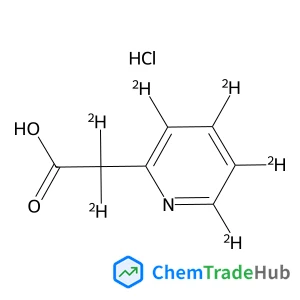
2,2-dideuterio-2-(3,4,5,6-tetradeuterio-2-pyridyl)acetic acid;hydrochloride
CAS号:
1329799-67-8
分子式:
C7H2ClD6NO2
推荐供应商





免责声明
本页面提供的学术期刊信息仅供参考和研究使用。我们与任何期刊出版商均无关联,也不处理投稿事宜。如有投稿相关咨询,请直接联系相关期刊出版商。
如发现页面信息有误,请发送邮件至 support@chemtradehub.com 联系我们。我们将及时核实并处理您的问题。