











![1-[4-(4-Methyl-1H-imidazol-1-yl)phenyl]ethanone structure](https://cnstatic.chemtradehub.com/structs/142/142161-53-3-7f55.webp "1-[4-(4-Methyl-1H-imidazol-1-yl)phenyl]ethanone structure")
Temperature and pH dual-responsive poly(vinyl lactam) copolymers functionalized with amine side groups via RAFT polymerization
文献信息
发布日期
2016-07-13
DOI
10.1039/C6PY00885B
影响因子
5.582
作者
查看原文
摘要
A series of well-defined statistical copolymers based on cyclic N-vinyl lactams (N-vinylcaprolactam, N-vinylpiperidine and N-vinylpyrrolidone) and N-vinylformamide (VFA) were successfully synthesized via RAFT polymerization. The less-polar solvents (anisole and 1,4-dioxane) were more favorable over the highly-polar solvents (DMSO and DMF) while 2-(ethoxycarbonothioylthio)propanoate was more suitable than dithiobenzoate derivatives as the chain transfer agent (CTA) for copolymerization. The optimal polymerization conditions were explored with methyl 2-(ethoxycarbonothioylthio)propanoate as the CTA and anisole as the solvent. The narrow dispersity (Đ) of the copolymers, linear relationship between conversion and molecular weight, and symmetrical unimodal GPC traces confirmed the controlled character of the polymerization process. The polymerization process was progressively disfavored by the enhanced steric hindrance from the enlarged lactam ring while the VFA composition could be well controlled up to as high as 50% by continuously feeding VFA with a syringe pump. The lower critical solution temperatures (LCSTs) of the thermo-responsive copolymers poly(N-vinylcaprolactam-co-N-vinylformamide) and poly(N-vinylpiperidine-co-N-vinylformamide) in aqueous solutions reflected by the appearance of the cloud points can be tunable by the molecular weights and compositions of the copolymers. Primary amine functionalized temperature/pH dual responsive reactive copolymers were obtained by the controlled hydrolysis of the VFA components under alkaline conditions. The influence of the lactam ring on the hydrolysis rates was investigated. The LCSTs of the hydrolyzed copolymers can be elegantly adjusted by the hydrolysis degree. Amine-enriched nanogels were prepared in W/O emulsions utilizing the coupling between the reactive amine side-groups of polymer chains and diacrylate functionalities of a poly(ethylene glycol) cross-linker via Michael addition reaction, which displayed temperature and pH double responsiveness. The nanogels were labelled with fluorescein isothiocyanate (FITC) through conjugation with the residual primary amine groups on the surface. This facile chemistry has opened up routes to synthesize water-soluble reactive stimuli-responsive copolymers with well-defined architectures for design of functional macromolecular materials.
相关文献
DNA detection by SERS: hybridisation parameters and the potential for asymmetric PCR
Daniel Macdonald, Ewen Smith, Karen Faulds, Duncan Graham
2020-01-13
Paper
DOI: 10.1039/C9AN01732A
SERS detection of polycyclic aromatic hydrocarbons using a bare gold nanoparticles coupled film system
Kai Hu, Da-Wei Li, Yi-Tao Long
2016-04-26
Paper
DOI: 10.1039/C6AN00319B
A paper-based colorimetric assay system for sensitive cysteine detection using a fluorescent probe
Xiaoya Ma
2020-01-15
Paper
DOI: 10.1039/C9AN02271F
Early apoptosis real-time detection by label-free SERS based on externalized phosphatidylserine
Haibo Zhou, Qiqin Wang, Jinyong Wang, Yang Huang, Huihui Wu, Jingyi Jian, Danting Yang, Ning Huang, Christoph Haisch, Zhengjin Jiang
2016-05-03
Paper
DOI: 10.1039/C6AN00606J
Development of a rechargeable optical hydrogen peroxide sensor – sensor design and biological application
Klaus Koren, Peter Ø. Jensen
2016-05-12
Paper
DOI: 10.1039/C6AN00864J
Photoelectrochemical detection of metal ions
Wei-Wei Zhao, Jing-Juan Xu, Hong-Yuan Chen
2016-06-03
Critical Review
DOI: 10.1039/C6AN01123C
An inner filter effect based sensing system for the determination of caffeine in beverage samples
Natalia González, Sara P. Lantmann Corral, Graciela Zanini, Carolina C. Acebal
2020-01-03
Paper
DOI: 10.1039/C9AN02483B
A high-sensitive sensor with HEPES-enhanced electrochemiluminescence of benzo[3]uril for Fe3+ and its application in human serum
Yao Lei, Fei Qiu, Jian-Mei Yang, Mao Liu, Qing-Mei Ge, Hang Cong, Zhu Tao
2019-12-27
Paper
DOI: 10.1039/C9AN02156F
Correction: Total viable bacterial count using a real time all-fibre spectroscopic system
2016-07-07
Correction
DOI: 10.1039/C6AN90038K
您可能还喜欢
化合物问答
什么是2,6-二溴-4,8-双[(2-乙基己基)氧基]苯并[1,2-b:4,5-b']二噻吩(CAS号:1226782-13-3)?
2,6-二溴-4,8-双[(2-乙基己基)氧基]苯并[1,2-b:4,5-b']二噻吩是一种有机化合物,分子式为C23H32Br2O2S2。该化合物具有芳香性和...
1226782-13-32,6-Dibromo-4,8-bis[...
化合物问答
木聚硫钠(CAS号:37319-17-8)的物理化学性质是什么?
木聚硫钠通常为无色或白色结晶性粉末,具有吸湿性。其分子量约为121.11 g/mol。木聚硫钠易溶于水,不溶于醇类和其他非极性溶剂。在酸性或碱性溶液中,木聚硫钠...
37319-17-8Pentosan
化合物问答
2-甲氧基-4-(三氟甲基)苄溴, JRD(CAS号:886500-59-0)适用哪些法规指南?
该化合物在合成、储存和运输过程中需遵循《全球化学品统一分类和标签制度》(GHS)的健康、环境和物理危险分类。在欧洲还需符合《化学品注册、评估、授权和限制》(RE...
886500-59-02-Methoxy-4-(trifluo...
化合物问答
1,4-Diazoniabicyclo[2.2.2]octane-1,4-disulfinate(CAS号:119752-83-9)的主要用途是什么?
1,4-二氮杂双环[2.2.2]辛烷-1,4-二硫酸二酯主要用于有机合成中的保护基团,特别是在保护胺基和硫醇基方面具有广泛应用。此外,它还用于一些特殊化学反应的...
119752-83-91,4-Diazabicyclo[2.2...
化合物问答
如何处理含有4-(Bromomethyl)-2-fluorobenzenesulphonamide(CAS号:1645275-47-3)的废料?
含有4-(Bromomethyl)-2-fluorobenzenesulphonamide的废液应首先进行中和处理,以降低pH值,避免对环境造成腐蚀性影响。随后...
1645275-47-34-(Bromomethyl)-2-fl...
化合物问答
Loureiriol(CAS号:479195-44-3)的物理化学性质是什么?
Loureiriol是一种天然化合物,其分子式为C15H22O4。Loureiriol为无色结晶性粉末,具有较高的熔点和良好的热稳定性。其相对分子质量为262....
479195-44-3Loureiriol
化合物问答
在合成中是否有3-氨基苯甲酰苯胺(CAS号:14315-16-3)的替代品?
在合成过程中,可以考虑使用类似结构的化合物作为3-氨基苯甲酰苯胺的替代品,例如N-苯基-3-氰基苯胺或N-苯基-3-硝基苯胺等,这些化合物具有相似的化学性质,可...
14315-16-33-Amino-N-phenylbenz...
化合物问答
4-异氰酰苯基硼酸频哪醇酯(CAS号:380430-64-8)的市场或研究趋势如何?
4-异氰酰苯基硼酸频哪醇酯主要应用于有机合成、药物化学和材料科学领域。随着绿色化学的发展,该化合物因其高效的官能团转化能力和环境友好性而受到越来越多的关注。近年...
380430-64-82-(4-Isocyanatopheny...
化合物问答
如何储存3β-乙酰氧基-7,25-甘遂二烯-24(R)-醇(CAS号:1352001-09-2)?
3β-乙酰氧基-7,25-甘遂二烯-24(R)-醇应储存在阴凉、干燥、通风良好的地方,避免直接光照。储存容器应密封,防止空气中的水分和氧气影响化合物的稳定性。建...
1352001-09-23β-acetoxy-eupha- 7,...
化合物问答
如何储存4-氟-2-甲基-1H-吲哚(CAS号:1260383-51-4)?
应将4-氟-2-甲基-1H-吲哚存放在阴凉、干燥、通风良好的地方,避免直接暴露在光照下。容器应密封,避免与空气中的水蒸气接触。建议在避光、温度不超过25℃的环境...
1260383-51-44-Fluoro-2-methyl-1H...
来源期刊
Polymer Chemistry

CiteScore:
8.6
自引率:
7.3%
年发文量:
457
Polymer Chemistry welcomes submissions in all areas of polymer science that have a strong focus on macromolecular chemistry. Manuscripts may cover a broad range of fields, yet no direct application focus is required.
推荐化合物
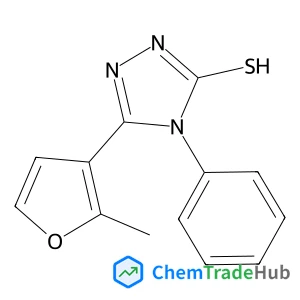
5-(2-Methyl-3-furyl)-4-phenyl-2,4-dihydro-3H-1,2,4-triazole-3-thione
CAS号:
346464-59-3
分子式:
C13H11N3OS
![8-Bromo-6-fluoro[1,2,4]triazolo[1,5-a]pyridin-2-amine structure](https://cnstatic.chemtradehub.com/structs/125/1257705-51-3-9f4a.webp "8-Bromo-6-fluoro[1,2,4]triazolo[1,5-a]pyridin-2-amine structure")
![Ethyl 4-[8-chloro(5,5,6,6,7-~2~H_5_)-5,6-dihydro-11H-benzo[5,6]cyclohepta[1,2-b]pyridin-11-ylidene]-1-piperidinecarboxylate structure](https://cnstatic.chemtradehub.com/structs/102/1020719-57-6-37e2.webp "Ethyl 4-[8-chloro(5,5,6,6,7-~2~H_5_)-5,6-dihydro-11H-benzo[5,6]cyclohepta[1,2-b]pyridin-11-ylidene]-1-piperidinecarboxylate structure")
推荐供应商






免责声明
本页面提供的学术期刊信息仅供参考和研究使用。我们与任何期刊出版商均无关联,也不处理投稿事宜。如有投稿相关咨询,请直接联系相关期刊出版商。
如发现页面信息有误,请发送邮件至 support@chemtradehub.com 联系我们。我们将及时核实并处理您的问题。