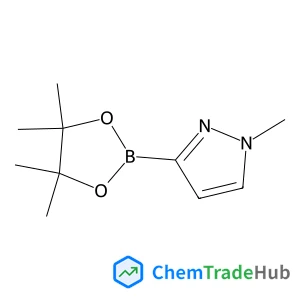
1-Methyl-3-(4,4,5,5-tetramethyl-1,3,2-dioxaborolan-2-yl)-1H-pyrazole
CAS号:
1020174-04-2
分子式:
C10H17BN2O2
Shixian Lv, Yuchen Wu, Jingqi Dang, Zhaohui Tang, Ziyuan Song, Sheng Ma, Xiao Wang, Xuesi Chen, Lichen Yin
The production of poly-[(N-2-hydroxyethyl)-aspartamide] (PHEA)-based materials is hampered by the unsatisfactory synthesis and low reactivity in terms of post-modification. Herein, we report the controlled synthesis of PHEA-based polymers, unraveled the hydrogen bonding in PHEA, developed effective approaches to enhance the reactivity of PHEA by improving the temperature, and further demonstrated the desired aqueous solubility as well as the lyophilization stability of PHEA-based amphiphiles. This study will provide insights into the design of useful and functionalized polypeptide-based biomaterials.
Paulo R. Bueno, David A. Miranda
DOI: 10.1039/C6CP02504H
Xiaojun Wu, Jinlong Yang
DOI: 10.1039/C6CP07402B
Hao Jin, Jianwei Li, Ying Dai, Yadong Wei
DOI: 10.1039/C6CP08158D
A. R. Alian, S. A. Meguid
DOI: 10.1039/C6CP07464B
Alexandra R. McIsaac, David A. Mazziotti
DOI: 10.1039/C6CP07563K
Yuanjun Lu, Bryan E. G. Lucier, Yue Zhang, Anmin Zheng, Yining Huang
DOI: 10.1039/C7CP00199A
Michelle C. Fairhurst, Michael J. Ezell, Carla Kidd, Pascale S. J. Lakey, Manabu Shiraiwa, Barbara J. Finlayson-Pitts
DOI: 10.1039/C6CP08663B
Minoru Otani
DOI: 10.1039/C6CP08466D
6-氯-2H-1,4-苯并噁嗪-3(4H)-酮主要应用于医药、农药和聚合物等领域。在医药领域,该化合物可用于合成抗菌药物;在农药领域,可用作杀虫剂的中间体;在聚...
活性氧化铝广泛应用于医药、聚合物、传感器、半导体和催化等领域。在医药行业,活性氧化铝用作吸附剂和干燥剂,有助于去除杂质和水分。在聚合物行业,它用作增白剂和抗结块...
硅胶(Silica gel, pptd.,cryst.-free)是一种无定形、多孔的硅酸盐材料,主要成分为二氧化硅(SiO₂)。其结构由硅氧四面体构成,通过酸...
二乙基甲基一氢硅烷主要用于有机合成、表面处理以及作为溶剂。它还被用作合成其他硅烷化合物的原料,以及在涂料、粘合剂和密封剂中的应用。
在合成过程中,可以考虑使用类似结构的化合物作为替代品,例如N-亚油酰基甘氨酸或N-花生二烯酰基甘氨酸。这些替代品在结构上有类似的双键位置,但可能具有不同的物理化...
在合成过程中,可以考虑使用类似结构的化合物作为替代品,例如1-(3-甲氧基苯基)丙烷-1,2-二酮或1-(4-羟基苯基)丙烷-1,2-二酮。这些替代品具有相似的...
该化合物通常通过一系列复杂的有机合成步骤获得。首先,通过芳香族化合物的羟基化反应获得羟基化产物,然后通过酰化反应形成酰胺中间体,最后通过环化反应得到目标产物。常...
该化合物作为生物活性化合物,尤其是在药物化学领域表现出色。近年来,随着对新型抗炎、抗病毒和抗癌药物的研究增加,其市场和研究趋势持续增长。此外,其在神经科学领域的...
核黄素磷酸钠在常规使用条件下安全,但高剂量可能引起刺激性反应。操作时需佩戴防护手套和护目镜,避免吸入粉尘。若接触皮肤或眼睛,应立即用大量清水冲洗。急救时需根据接...
盐酸丙胺卡因杂质A(EP) 标准品可通过重氮化反应和随后的酰胺化反应合成。首先,利用氯化反应将苯环上的氢原子转化为氯原子,然后通过芳香族重氮化反应引入氨基,最后...

Polymer Chemistry welcomes submissions in all areas of polymer science that have a strong focus on macromolecular chemistry. Manuscripts may cover a broad range of fields, yet no direct application focus is required.