


Theoretical perspectives on the structure, electronic, and optical properties of titanosilicates Li2M4[(TiO)Si4O12] (M = K+, Rb+)
文献信息
发布日期
2017-05-17
DOI
10.1039/C7CP01946G
影响因子
3.676
作者
Zuju Ma, Rongjian Sa, Yongfan Zhang, Kechen Wu
查看原文
摘要
It is still a challenge to design and synthesize high performance broader ultraviolet non-linear optical (NLO) materials. Two new transition-metal silicates have recently attracted a lot of attention due to their strong phase-matched second harmonic generation (SHG) responses (about 4.5 times higher than KDP). However, the electronic and optical properties underlying the high performance of these materials and consequently, the possibility of designing more efficient silicates for NLO applications are not presently clear. In this study, the geometrical structure and bonding character, electronic structure and optical properties of Li2M4[(TiO)Si4O12] (M = K+, Rb+) crystals have been systematically determined based on the density functional theory. Satisfactory agreement between the experimental and theoretical results indicates that the method and conditions used herein are favorable. A detailed analysis of the precise electronic structure and dipole moments of the two compounds suggests that it is the strong covalent character between Ti(Si) and O and the same orientation alignment of the dipole moment vector of the constituent asymmetric [TiO5]6− square pyramid anion units that result in the large SHG responses for the two compounds. In addition, the unavailable linear and non-linear optical experimental parameters, including dielectric function, optical absorption and birefringence, and all the components of the SHG coefficients are reported for the first time. This investigation unravels the structure–property relationships of titanosilicates and may be significant in terms of providing an efficient strategy towards designing more potential and competitive NLO materials.
期刊推荐

Colloid Journal

Electroanalysis
Critical Reviews in Solid State and Materials Sciences

Acta Metallurgica Sinica-English Letters

Cellulose
Bioorganic & Medicinal Chemistry Letters

Polycyclic Aromatic Compounds

Medicinal Chemistry Research

Journal of the Indian Institute of Science

Bioorganic & Medicinal Chemistry
相关文献
gem-Difluorovinylation of alkynyl bromoarenes via dual nickel-/palladium-catalyzed cross-electrophile coupling
Haotian Sun, Baojian Xiong, Yuan Yang, Jiangjun Liu, Xuemei Zhang, Zhong Lian
2021-11-23
Research Article
DOI: 10.1039/D1QO01406D
Photoredox-catalyzed 2,2,2-trifluoroethylation and 2,2-difluoroethylation of alkenes with concomitant introduction of a quinoxalin-2(1H)-one moiety
Xiu Yang, Wei-Dong Meng, Xiu-Hua Xu, Yangen Huang
2021-10-05
Research Article
DOI: 10.1039/D1QO01170G
Rhodium-catalyzed regioselective C8-H amination of quinoline N-oxides with trifluoroacetamide at room temperature
Chang You, Tingting Yuan, Yanzhen Huang, Chao Pi, Yangjie Wu, Xiuling Cui
2018-06-04
Paper
DOI: 10.1039/C8OB01108G
High pressure-assisted low-loading asymmetric organocatalytic conjugate addition of nitroalkanes to chalcones‡
Agnieszka Cholewiak, Kamil Adamczyk, Michał Kopyt, Adrian Kasztelan, Piotr Kwiatkowski
2018-05-22
Paper
DOI: 10.1039/C8OB00561C
Alkylsulfonium salts for the photochemical desulphurizative functionalization of heteroarenes
Xiaolong Zhu, Xuan Li, Enjie Zhu, Qirong Deng, Xiuyan Song, Jian Lv
2021-11-24
Research Article
DOI: 10.1039/D1QO01570B
A mild electroassisted synthesis of (hetero)arylphosphonates
Stéphane Sengmany, Anthony Ollivier, Erwan Le Gall, Eric Léonel
2018-06-01
Paper
DOI: 10.1039/C8OB00500A
Palladium-catalysed stereoselective [3 + 2] annulation of vinylethylene carbonates and tryptanthrin-based ketones
Qing-Zhu Li, Jun-Long Li, Bin Zhang, Zhen Dai, Ke Xie, Rong Zeng, Liang Zou, Xiang Zhang
2021-11-22
Research Article
DOI: 10.1039/D1QO01543E
Streamlined chemoenzymatic total synthesis of prioritized ganglioside cancer antigens
Hai Yu, Abhishek Santra, Yanhong Li, John B. McArthur, Tamashree Ghosh, Xiaoxiao Yang, Peng G. Wang, Xi Chen
2018-05-14
Communication
DOI: 10.1039/C8OB01087K
Synthesis of topologically constrained naphthalimide appended palladium(ii)–N-heterocyclic carbene complexes – insights into additive controlled product selectivity
Pradeep Kumar Reddy Panyam, Ramdas Sreedharan, Thirumanavelan Gandhi
2018-05-23
Paper
DOI: 10.1039/C8OB00616D
您可能还喜欢
化合物问答
如何处理含有8-氯咪唑并[1,2-A]吡嗪(CAS号:69214-33-1)的废料?
处理含有8-氯咪唑并[1,2-A]吡嗪的废料时,应首先将其收集并进行化学回收或降解。如果无法回收,需采用安全的化学处理方法,如中和、氧化还原或沉淀。处理过程中需...
69214-33-18-chloroimidazo[1,2-...
化合物问答
Calhex 231 hydrochloride(CAS号:2387505-78-2)适用哪些法规指南?
Calhex 231 hydrochloride 需要遵循《全球化学品统一分类和标签制度》(GHS)的分类和标签要求,以及欧盟的《化学品注册、评估、授权和限制条...
2387505-78-24-Chloro-N-[(1S,2S)-...
化合物问答
11-Beta,17-alpha,21-三羟基-5-beta-孕烯-3,20-二酮(CAS号:1482-50-4)的物理化学性质是什么?
11-Beta,17-alpha,21-三羟基-5-beta-孕烯-3,20-二酮是一种无色结晶性粉末,分子量为372.45 g/mol。该化合物在水中的溶解度...
1482-50-45β-Dihydrocortisol
化合物问答
处理5-异丙基-1,3,4-恶二唑-2-羧酸(CAS号:944907-13-5)时应注意哪些实验室安全事项?
处理5-异丙基-1,3,4-恶二唑-2-羧酸时应注意以下安全事项:穿戴适当的个人防护装备,包括实验室外套、手套和护目镜;操作应在通风橱中进行,以减少吸入或接触有...
944907-13-55-Isopropyl-1,3,4-ox...
化合物问答
benzyl 3-bromopropanoate(CAS号:90841-55-7)安全吗?
Benzyl 3-bromopropanoate属于有毒物质,吸入、摄入或皮肤接触均可能对人体造成伤害。操作时应佩戴防护眼镜、口罩和手套,避免吸入蒸汽和直接接触...
90841-55-7Benzyl 3-bromopropan...
化合物问答
什么是(R)-N-苄氧羰基-3,4-二氢-1H-异喹啉羧酸(CAS号:151004-88-5)?
(R)-N-苄氧羰基-3,4-二氢-1H-异喹啉羧酸是一种含有苄氧羰基和异喹啉环结构的化合物,分子式为C17H15NO3。它是一种有机化合物,具有一定的生物活性...
151004-88-5(1R)-2-[(Benzyloxy)c...
化合物问答
在合成中是否有1-苄基吡啶嗡-3-羧酸盐(CAS号:15990-43-9)的替代品?
可以考虑使用1-苄基吡啶-3-羧酸盐作为1-苄基吡啶嗡-3-羧酸盐的替代品。此外,还可以探索其他类似物,如1-苄基吡啶-3-氨基甲酸酯等。具体的替代品选择需根据...
15990-43-91-Benzyl-3-pyridiniu...
化合物问答
(2,6-二甲基吡啶-3-基)甲醇(CAS号:582303-10-4)安全吗?
(2,6-二甲基吡啶-3-基)甲醇在使用时需注意安全,应避免吸入其蒸汽,接触皮肤和眼睛。操作应在通风良好的环境中进行,佩戴适当的个人防护装备。
582303-10-4(2,6-Dimethyl-3-pyri...
化合物问答
5-溴-2-乙烯基吡啶(CAS号:226883-52-9)的物理化学性质是什么?
5-溴-2-乙烯基吡啶是一种有机化合物,外观为白色固体,具有良好的结晶性。分子量约为190.03 g/mol。它的溶解性在水中较差,但在有机溶剂如二氯甲烷、甲醇...
226883-52-95-Bromo-2-vinylpyrid...
化合物问答
2-羟基-3-硝基-5-甲基吡啶(CAS号:7464-14-4)应用于哪些行业?
2-羟基-3-硝基-5-甲基吡啶主要应用于医药、聚合物和半导体行业。在医药领域,它可以用作合成其他药物的中间体。在聚合物领域,它可以作为功能性单体参与聚合反应,...
7464-14-45-Methyl-3-nitro-2(1...
来源期刊
Physical Chemistry Chemical Physics

CiteScore:
5.5
自引率:
10.3%
年发文量:
3036
Physical Chemistry Chemical Physics (PCCP) is an international journal co-owned by 19 physical chemistry and physics societies from around the world. This journal publishes original, cutting-edge research in physical chemistry, chemical physics and biophysical chemistry. To be suitable for publication in PCCP, articles must include significant innovation and/or insight into physical chemistry; this is the most important criterion that reviewers and Editors will judge against when evaluating submissions. The journal has a broad scope and welcomes contributions spanning experiment, theory, computation and data science. Topical coverage includes spectroscopy, dynamics, kinetics, statistical mechanics, thermodynamics, electrochemistry, catalysis, surface science, quantum mechanics, quantum computing and machine learning. Interdisciplinary research areas such as polymers and soft matter, materials, nanoscience, energy, surfaces/interfaces, and biophysical chemistry are welcomed if they demonstrate significant innovation and/or insight into physical chemistry. Joined experimental/theoretical studies are particularly appreciated when complementary and based on up-to-date approaches.
推荐化合物
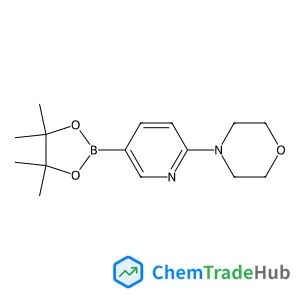
4-(5-(4,4,5,5-tetramethyl-1,3,2-dioxaborolan-2-yl)pyridin-2-yl)morpholine
CAS号:
485799-04-0
分子式:
C15H23BN2O3
推荐供应商



免责声明
本页面提供的学术期刊信息仅供参考和研究使用。我们与任何期刊出版商均无关联,也不处理投稿事宜。如有投稿相关咨询,请直接联系相关期刊出版商。
如发现页面信息有误,请发送邮件至 support@chemtradehub.com 联系我们。我们将及时核实并处理您的问题。