












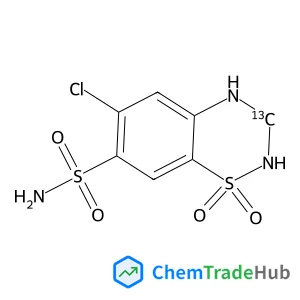
6-Chloro(3-~13~C)-3,4-dihydro-2H-1,2,4-benzothiadiazine-7-sulfonamide 1,1-dioxide
CAS号:
1190006-03-1
分子式:
C613CH8ClN3O4S2
Mhejabeen Sayed, Shruti Jha, Haridas Pal
The present study reports a contrasting interaction behaviour of a biologically important dye, acridine orange (AOH+), with a highly water soluble anionic host, based on a β-cyclodextrin (βCD) scaffold, i.e. sulfobutylether-β-cyclodextrin (SBEβCD), in comparison to native βCD. AOH+ shows striking modulation in its photophysical properties, representing sequential changes in the modes of interaction with increasing SBEβCD concentration. At lower SBEβCD concentrations, AOH+ preferentially binds in dimeric forms at the negatively charged SBEβCD portals, leading to strong fluorescence quenching. At higher SBEβCD concentrations, the dimeric dyes convert to monomeric forms and subsequently undergo both inclusion and exo complex formation with 1 : 1 stoichiometry, resulting in a large fluorescence enhancement. The intriguing observation of sequential fluorescence switch off and switch on for an AOH+–SBEβCD system is clearly facilitated by the presence of butylether chains with SO3− end groups at the portals of SBEβCD, providing an additional ion–ion interaction and much enhanced hydrophobic interaction for cationic AOH+ compared to the native βCD host. To the best of our knowledge, such fluorescence off/on switching through multistep host–guest binding has not been reported so far in the literature. The present study not only provides a detailed insight into the unique binding interactions of AOH+ with the SBEβCD host, but the findings of this study are also expected to be useful in designing supramolecular based drug formulations, drug delivery systems, sensors, and so on.
Laetitia Vlaminck, Maria M. Velencoso, Filip E. Du Prez, Frederik R. Wurm
DOI: 10.1039/C7PY00813A
Yang Zheng, Yucheng Huang, Zaid M. Abbas, Brian C. Benicewicz
DOI: 10.1039/C6PY01319H
Peng-Yun Li, Jia-Min Li, Lian-Wei Li, Xiao-Dong Ye, Wei-Dong He
DOI: 10.1039/C7PY00551B
Sang Thi Duong, Michiya Fujiki
DOI: 10.1039/C7PY00958E
Ryoto Tanaka, Kodai Watanabe, Takuya Yamamoto, Kenji Tajima, Takuya Isono, Toshifumi Satoh
DOI: 10.1039/C7PY00646B
Yueyue Gao, Yong Zhang, Zhitian Liu, Liancheng Zhao
DOI: 10.1039/C7PY00850C
Karol Erfurt, Anna Chrobok, Andrzej Zięba
DOI: 10.1039/C7PY01046J
1,2-环己二酮环乙缩醛应储存在阴凉、干燥、通风良好的地方,避免阳光直射。建议使用密封容器保存,并保持环境温度在室温范围内,远离火源和热源。
Ecopladib作为一种新型的药物,主要应用于治疗高胆固醇等疾病。目前,市场和研究趋势显示,Ecopladib因其独特的药理作用而受到关注。随着对心血管疾病治...
2,3-二甲基-3H-咪唑[4,5-c]吡啶通常通过咪唑和2,3-二甲基吡啶的缩合反应合成。具体来说,将咪唑和2,3-二甲基吡啶在适当的溶剂中进行加热或加压反应...
该化合物在药物化学和有机合成中有一定的应用。近年来,随着对新型药物化合物的需求增加,该化合物的研究趋势主要集中在探索其生物活性,尤其是其在神经系统疾病治疗中的潜...
盐酸甘氨酸丁酯应储存在阴凉、干燥、通风良好的地方,避免阳光直射和高温环境,温度应控制在25℃以下。储存容器应密封,避免与空气中的水分和酸性物质接触,以防发生水解...
2-碘-N,N-二甲基苯胺是一种有机化合物,化学名为2-Iodo-N,N-dimethylbenzamide。其分子式为C<sub>9</sub>H<sub>1...
随着医药、农药和新材料领域的发展,该化合物作为关键中间体的应用日益增多。特别是在药物合成中,由于其独特的化学性质,可以用于合成多种药物分子。未来的研究趋势可能集...
2,4-二溴-6-三氟甲基嘧啶通常通过溴化反应合成。首先,将6-三氟甲基嘧啶与溴化剂(如液溴)在适当的溶剂(如二氯甲烷、四氢呋喃)中反应,加入适当的催化剂(如四...

Physical Chemistry Chemical Physics (PCCP) is an international journal co-owned by 19 physical chemistry and physics societies from around the world. This journal publishes original, cutting-edge research in physical chemistry, chemical physics and biophysical chemistry. To be suitable for publication in PCCP, articles must include significant innovation and/or insight into physical chemistry; this is the most important criterion that reviewers and Editors will judge against when evaluating submissions. The journal has a broad scope and welcomes contributions spanning experiment, theory, computation and data science. Topical coverage includes spectroscopy, dynamics, kinetics, statistical mechanics, thermodynamics, electrochemistry, catalysis, surface science, quantum mechanics, quantum computing and machine learning. Interdisciplinary research areas such as polymers and soft matter, materials, nanoscience, energy, surfaces/interfaces, and biophysical chemistry are welcomed if they demonstrate significant innovation and/or insight into physical chemistry. Joined experimental/theoretical studies are particularly appreciated when complementary and based on up-to-date approaches.
![(2R,3S)-2-[4-(Cyclopentylamino)phenyl]-1-(2-fluoro-6-methylbenzoyl)-3-piperidinecarboxylic acid structure](https://cnstatic.chemtradehub.com/structs/134/1346623-11-7-b007.webp "(2R,3S)-2-[4-(Cyclopentylamino)phenyl]-1-(2-fluoro-6-methylbenzoyl)-3-piperidinecarboxylic acid structure")
![1-Ethyl-2-[5-(1-ethyl-2(1H)-quinolinylidene)-1,3-pentadien-1-yl]quinolinium iodide structure](https://cnstatic.chemtradehub.com/structs/141/14187-31-6-5fbb.webp "1-Ethyl-2-[5-(1-ethyl-2(1H)-quinolinylidene)-1,3-pentadien-1-yl]quinolinium iodide structure")




