









An investigation of the in-plane chemically ordered atomic laminates (Mo2/3Sc1/3)2AlC and (Mo2/3Y1/3)2AlC from first principles
文献信息
发布日期
2017-08-02
DOI
10.1039/C7CP03228E
影响因子
3.676
作者
A. Thore, J. Rosen
查看原文
摘要
We have calculated electronic, vibrational, and elastic properties of (Mo2/3Sc1/3)2AlC and (Mo2/3Y1/3)2AlC, two recently discovered nanolaminated materials in the family of so-called i-MAX phases. A comparison is made to the properties of the related hypothetical MAX phases Sc2AlC, Y2AlC, and Mo2AlC. From an analysis of the electronic band structures and projected crystal orbital Hamilton populations (pCOHP), we show that the i-MAX phases have more isotropic band structures than the MAX phases, but that their bonding characteristics are very similar, despite belonging to different space groups. However, the similar bonding notwithstanding, qualitative as well as significant quantitative differences are seen in the phonon density of states (PDOS). We also compare the Voigt–Reuss–Hill (VRH) bulk, shear, and Young's moduli. For (Mo2/3Sc1/3)2AlC, BVRH = 132 GPa, GVRH = 89 GPa, and EVRH = 218 GPa, all of which are higher values than for Sc2AlC, but lower than for Mo2AlC. For (Mo2/3Y1/3)2AlC, BVRH = 117 GPa, GVRH = 85 GPa, and EVRH = 205 GPa, which are higher than for Y2AlC, but lower than for Mo2AlC.
相关文献
Synthesis of molecularly imprinted polymers by photo-iniferter polymerization under visible light
Mariano J. Garcia-Soto, Karsten Haupt, Carlo Gonzato
2017-07-20
Paper
DOI: 10.1039/C7PY01113J
Poly(N-vinylimidazole)-l-poly(propylene glycol) amphiphilic conetworks and gels: molecularly forced blends of incompatible polymers with single glass transition temperatures of unusual dependence on the composition
Csaba Fodor, Tímea Stumphauser, Ralf Thomann, Yi Thomann, Béla Iván
2016-08-09
Paper
DOI: 10.1039/C6PY00848H
Thiophene-substituted phenothiazine-based photosensitisers for radical and cationic photopolymerization reactions under visible laser beams (405 and 455 nm)
Renquan Gu, Xiaoyu Ma, Yuming Zhao
2016-07-21
Paper
DOI: 10.1039/C6PY01095D
RAFT-mediated, visible light-initiated single unit monomer insertion and its application in the synthesis of sequence-defined polymers
Changkui Fu, Zixuan Huang, Craig J. Hawker, Graeme Moad, Jiangtao Xu, Cyrille Boyer
2017-06-26
Communication
DOI: 10.1039/C7PY00713B
Transition from smectic nanofibers to smectic vesicles in the self-assemblies of PEG-b-liquid crystal polycarbonates
Lu Zhou, Dapeng Zhang, Sabrina Hocine, Alessia Pilone, Sylvain Trépout, Sergio Marco, Christophe Thomas, Jia Guo
2017-07-26
Communication
DOI: 10.1039/C7PY01131H
Synthesis and functionalization of polymer networks via germane–ene chemistry
Ryan Guterman, Tristan D. Harrison, Paul J. Ragogna
2017-05-03
Paper
DOI: 10.1039/C7PY00438A
Photoresponsive liquid crystalline polymer single-chain nanoparticles
Weizheng Fan, Xia Tong, Guo Li, Yue Zhao
2017-05-09
Paper
DOI: 10.1039/C7PY00668C
您可能还喜欢
化合物问答
如何储存1,2-环己二酮环乙缩醛(CAS号:4746-96-7)?
1,2-环己二酮环乙缩醛应储存在阴凉、干燥、通风良好的地方,避免阳光直射。建议使用密封容器保存,并保持环境温度在室温范围内,远离火源和热源。
4746-96-71,4-Dioxaspiro[4.5]d...
化合物问答
Ecopladib(CAS号:381683-92-7)的市场或研究趋势如何?
Ecopladib作为一种新型的药物,主要应用于治疗高胆固醇等疾病。目前,市场和研究趋势显示,Ecopladib因其独特的药理作用而受到关注。随着对心血管疾病治...
381683-92-7Ecopladib
化合物问答
2,3-Dimethyl-3H-imidazo[4,5-c]pyridine(CAS号:52538-09-7)通常如何合成?
2,3-二甲基-3H-咪唑[4,5-c]吡啶通常通过咪唑和2,3-二甲基吡啶的缩合反应合成。具体来说,将咪唑和2,3-二甲基吡啶在适当的溶剂中进行加热或加压反应...
52538-09-72,3-Dimethyl-3H-imid...
化合物问答
2,3,4,5-tetrahydro-1H-3-苯并氮杂环;盐酸盐(CAS号:17379-01-0)的市场或研究趋势如何?
该化合物在药物化学和有机合成中有一定的应用。近年来,随着对新型药物化合物的需求增加,该化合物的研究趋势主要集中在探索其生物活性,尤其是其在神经系统疾病治疗中的潜...
17379-01-02,3,4,5-Tetrahydro-1...
68-90-6(2-Ethyl-1-benzofura...
化合物问答
如何储存盐酸甘氨酸丁酯(CAS号:13048-99-2)?
盐酸甘氨酸丁酯应储存在阴凉、干燥、通风良好的地方,避免阳光直射和高温环境,温度应控制在25℃以下。储存容器应密封,避免与空气中的水分和酸性物质接触,以防发生水解...
13048-99-2Butyl glycinate hydr...
化合物问答
什么是2-Iodo-N,N-dimethylbenzamide(CAS号:54616-46-5)?
2-碘-N,N-二甲基苯胺是一种有机化合物,化学名为2-Iodo-N,N-dimethylbenzamide。其分子式为C<sub>9</sub>H<sub>1...
54616-46-52-Iodo-N,N-dimethylb...
16817-90-6N-Cyclohexylglycinam...
化合物问答
5-溴-2-(4H-1,2,4-三唑-4-基)吡啶(CAS号:959240-99-4)的市场或研究趋势如何?
随着医药、农药和新材料领域的发展,该化合物作为关键中间体的应用日益增多。特别是在药物合成中,由于其独特的化学性质,可以用于合成多种药物分子。未来的研究趋势可能集...
959240-99-45-Bromo-2-(4H-1,2,4-...
化合物问答
2,4-二溴-6-三氟甲基嘧啶(CAS号:785778-00-9)通常如何合成?
2,4-二溴-6-三氟甲基嘧啶通常通过溴化反应合成。首先,将6-三氟甲基嘧啶与溴化剂(如液溴)在适当的溶剂(如二氯甲烷、四氢呋喃)中反应,加入适当的催化剂(如四...
785778-00-92,4-Dibromo-6-(trifl...
来源期刊
Physical Chemistry Chemical Physics

CiteScore:
5.5
自引率:
10.3%
年发文量:
3036
Physical Chemistry Chemical Physics (PCCP) is an international journal co-owned by 19 physical chemistry and physics societies from around the world. This journal publishes original, cutting-edge research in physical chemistry, chemical physics and biophysical chemistry. To be suitable for publication in PCCP, articles must include significant innovation and/or insight into physical chemistry; this is the most important criterion that reviewers and Editors will judge against when evaluating submissions. The journal has a broad scope and welcomes contributions spanning experiment, theory, computation and data science. Topical coverage includes spectroscopy, dynamics, kinetics, statistical mechanics, thermodynamics, electrochemistry, catalysis, surface science, quantum mechanics, quantum computing and machine learning. Interdisciplinary research areas such as polymers and soft matter, materials, nanoscience, energy, surfaces/interfaces, and biophysical chemistry are welcomed if they demonstrate significant innovation and/or insight into physical chemistry. Joined experimental/theoretical studies are particularly appreciated when complementary and based on up-to-date approaches.
推荐化合物
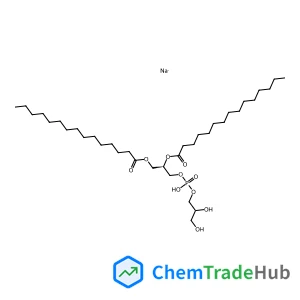
1,2-dipentadecanoyl-sn-glycero-3-phospho-(1'-rac-glycerol) (sodiuM salt)
CAS号:
322647-32-5
分子式:
C36H71NaO10P
![2,2,2-Trifluoro-N-[(1S)-1-phenylethyl]acetamide structure](https://cnstatic.chemtradehub.com/structs/399/39995-51-2-8484.webp "2,2,2-Trifluoro-N-[(1S)-1-phenylethyl]acetamide structure")
![1-Ethyl-2-[5-(1-ethyl-2(1H)-quinolinylidene)-1,3-pentadien-1-yl]quinolinium iodide structure](https://cnstatic.chemtradehub.com/structs/141/14187-31-6-5fbb.webp "1-Ethyl-2-[5-(1-ethyl-2(1H)-quinolinylidene)-1,3-pentadien-1-yl]quinolinium iodide structure")
推荐供应商





免责声明
本页面提供的学术期刊信息仅供参考和研究使用。我们与任何期刊出版商均无关联,也不处理投稿事宜。如有投稿相关咨询,请直接联系相关期刊出版商。
如发现页面信息有误,请发送邮件至 support@chemtradehub.com 联系我们。我们将及时核实并处理您的问题。