


Effects of TiCl4 treatment on the structural and electrochemical properties of a porous TiO2 layer in CH3NH3PbI3 perovskite solar cells
文献信息
发布日期
2017-09-18
DOI
10.1039/C7CP04132B
影响因子
3.676
作者
Hasyiya Karimah Adli, Takashi Harada, Shuji Nakanishi, Shigeru Ikeda
查看原文
摘要
The effects of surface treatment with TiCl4 on the structural and electrochemical properties of a porous titanium oxide (pTiO2) layer deposited on a fluorine-doped tin oxide (FTO)/glass substrate covered with a dense TiO2 layer (pTiO2/dTiO2/FTO/glass) were systematically investigated in order to obtain an optimum pTiO2 layer for use in CH3NH3PbI3 perovskite solar cells. As confirmed by thermal desorption spectroscopy (TDS) analyses, the amount of surface hydroxyl groups in pTiO2 varied when the pTiO2/dTiO2/FTO/glass sample was treated with solutions with different concentrations of TiCl4 (i.e., 20, 50, 80, and 100 mM). Photoelectrochemical (PEC) analyses of the pTiO2/dTiO2/FTO/glass samples after TiCl4 treatment showed significant increments of photocurrent densities compared to the pTiO2/dTiO2/FTO/glass sample without TiCl4 treatment regardless of the concentration of TiCl4 used in the solution. Electrochemical impedance spectroscopy (EIS) analyses of the TiCl4-treated pTiO2/dTiO2/FTO/glass samples also indicated a lower recombination probability with an increase in TiCl4 concentration. The results suggest that TiCl4 treatment resulted in passivation of defect sites on the surface of the TiO2 nanoparticles as well as improvement of the interconnectivity between the TiO2 nanoparticles in pTiO2. In contrast, the power conversion efficiencies (PCEs) and short circuit current densities of CH3NH3PbI3 perovskite solar cells based on these pTiO2/dTiO2/FTO/glass samples exhibited volcano-like patterns depending on the TiCl4 concentration used for the pTiO2 treatment: the highest PCE was obtained by using pTiO2/dTiO2/FTO/glass treated with 50 mM of TiCl4 solution. Structural analysis of the CH3NH3PbI3 perovskite part performed by X-ray diffraction (XRD) indicated that the formation of CH3NH3PbI3 perovskite was inhibited by the presence of surface hydroxyl groups in the pTiO2 film without TiCl4 treatment. TiCl4 treatment using TiCl4 solutions with concentrations up to 50 mM enhanced the formation of the CH3NH3PbI3 perovskite layer, whereas TiCl4 treatment using TiCl4 solutions with concentrations higher than 50 mM was detrimental due to the formation of nanoparticulate TiO2 aggregates that induce poor porosity and act as recombination sites.
期刊推荐

Russian Journal of Organic Chemistry
Nature Medicine
Drug Discovery Today

Crystallography Reports
Current Opinion in Colloid & Interface Science
Russian Chemical Bulletin
Russian Journal of General Chemistry

Journal of Natural Medicines

Journal of Peptide Science

Current Opinion in Solid State & Materials Science
相关文献
Strain-induced ferroelectricity and lattice coupling in BaSnO3 and SrSnO3
Yajun Zhang, Takahiro Shimada, Takayuki Kitamura
2017-09-07
Paper
DOI: 10.1039/C7CP03952B
Unveiling universal trends for the energy level alignment in organic/oxide interfaces
José I. Martínez, Fernando Flores, José Ortega, Sylvie Rangan, Charles M. Ruggieri, Robert A. Bartynski
2017-08-08
Perspective
DOI: 10.1039/C7CP03853D
Self-assembled mesoscopic surface domains of fluorocarbon–hydrocarbon diblocks can form at zero surface pressure: tilting of solid-like hydrocarbon moieties compensates for cross-section mismatch with fluorocarbon moieties
Christian Schwieger, Xianhe Liu, Marie Pierre Krafft
2017-05-30
Paper
DOI: 10.1039/C7CP02432K
Formation of titanium dioxide core–shell microcapsules through a binary-phase spray technique
Jonatan Bergek, Björn Elgh, Anders E. C. Palmqvist, Lars Nordstierna
2017-07-31
Paper
DOI: 10.1039/C7CP02571H
The emergent intramolecular hydrogen bonding effect on the electronic structures of organic electron acceptors
Takashi Takeda, Yasutaka Suzuki, Jun Kawamata, Shin-ichiro Noro, Takayoshi Nakamura, Tomoyuki Akutagawa
2017-08-07
Communication
DOI: 10.1039/C7CP04402J
Adsorption of molecular hydrogen on coronene with a new potential energy surface
Massimiliano Bartolomei, Ricardo Pérez de Tudela, Kilian Arteaga, Tomás González-Lezana, Marta I. Hernández, José Campos-Martínez, Pablo Villarreal, Javier Hernández-Rojas, José Bretón
2017-09-05
Paper
DOI: 10.1039/C7CP03819D
A lipophilic ionic liquid based on formamidinium cations and TFSI: the electric response and the effect of CO2 on the conductivity mechanism
Federico Bertasi, Guinevere A. Giffin, Keti Vezzù, Yaser Abu-Lebdeh, Michel Armand
2017-09-05
Paper
DOI: 10.1039/C7CP02304A
Nanodots of transition metal dichalcogenides embedded in MoS2 and MoSe2: first-principles calculations
Roberto Hiroki Miwa, Wanderlã L. Scopel, Everson S. Souza, José Eduardo Padilha, Adalberto Fazzio
2017-09-21
Paper
DOI: 10.1039/C7CP03761A
Ionic effects on the proton transfer mechanism in aqueous solutions
Joonyoung F. Joung, Sangin Kim, Sungnam Park
2017-08-25
Paper
DOI: 10.1039/C7CP04392A
您可能还喜欢
化合物问答
2-(甲基磺酰基)嘧啶-5-胺(CAS号:56621-92-2)适用哪些法规指南?
该化合物适用的法规指南包括GHS(全球化学品统一分类和标签制度)分类为特定目标器官毒性-单次接触类别3;根据欧盟REACH法规,该化合物需要进行注册和评估;在美...
56621-92-22-(Methylsulfonyl)py...
化合物问答
在合成中是否有4-(4-氯苯基)-1H-咪唑(CAS号:35512-29-9)的替代品?
在合成中,可以考虑使用一些类似的化合物作为4-(4-氯苯基)-1H-咪唑的替代品,如4-(4-溴苯基)-1H-咪唑或4-(4-甲氧基苯基)-1H-咪唑。这些化合...
35512-29-94-(4-Chlorophenyl)-1...
化合物问答
什么是N~2~-甲基丙氨酸酰胺(CAS号:32012-16-1)?
N~2~-甲基丙氨酸酰胺是一种有机化合物,其化学名为2-(Methylamino)propanamide。它是一种酰胺类化合物,分子式为C4H10N2O,相对分...
32012-16-12-(Methylamino)propa...
化合物问答
如何处理含有N-苄基-3-氨基氧杂环丁烷草酸盐(CAS号:1956341-96-0)的废料?
处理含有N-苄基-3-氨基氧杂环丁烷草酸盐(CAS号:1956341-96-0)的废料时,应首先确保遵循相关法规要求,如GHS和REACH等。通常,废液应先进行...
1956341-96-0N-Benzyloxetan-3-ami...
化合物问答
4-bromo-2-chloro-6-methylbenzoic acid(CAS号:877149-07-0)的物理化学性质是什么?
4-溴-2-氯-6-甲基苯甲酸是一种固体化合物,具有较高的熔点和较低的沸点。它的分子量为261.03 g/mol。该化合物在水中几乎不溶,在有机溶剂中溶解度适中...
877149-07-04-Bromo-2-chloro-6-m...
化合物问答
2-[(2,5-二氯-4-嘧啶)氨基]-N-甲基苯甲酰胺(CAS号:761440-08-8)通常如何合成?
该化合物通常通过缩合反应合成,典型的方法是将2,5-二氯嘧啶与N-甲基苯甲酰胺在碱性条件下进行偶联反应。常用的碱包括NaH、LDA等强碱。该合成路线具有较高的选...
761440-08-82-[(2,5-dichloropyri...
4752-10-71,4-Dichlorophthalaz...
化合物问答
在合成中是否有3,5-二溴-4-甲基苯胺(CAS号:13194-73-5)的替代品?
3,5-二溴-4-甲基苯胺在某些合成路线中可能没有直接替代品。然而,在某些应用场景下,可以考虑使用其他类似结构的化合物如3,5-二溴-4-硝基苯胺或3,5-二碘...
13194-73-53,5-Dibromo-4-methyl...
化合物问答
2-氯喹啉-4-羧酸甲酯(CAS号:62482-26-2)的主要用途是什么?
2-氯喹啉-4-羧酸甲酯主要用于有机合成和药物合成领域,作为中间体或原料。它在合成某些药物和染料时具有重要作用。此外,该化合物还可能用于某些特定的化学研究中。
62482-26-2Methyl 2-chloro-4-qu...
化合物问答
i>]吡啶(CAS号:474708-88-8)安全吗?
6-溴-8-氯咪唑[1,2-a]吡啶在操作过程中需要谨慎以确保安全。该化合物具有一定的毒性,吸入其蒸气或粉尘可能导致呼吸道刺激。处理时应佩戴适当的防护装备,如手...
474708-88-86-Bromo-8-chloroimid...
来源期刊
Physical Chemistry Chemical Physics

CiteScore:
5.5
自引率:
10.3%
年发文量:
3036
Physical Chemistry Chemical Physics (PCCP) is an international journal co-owned by 19 physical chemistry and physics societies from around the world. This journal publishes original, cutting-edge research in physical chemistry, chemical physics and biophysical chemistry. To be suitable for publication in PCCP, articles must include significant innovation and/or insight into physical chemistry; this is the most important criterion that reviewers and Editors will judge against when evaluating submissions. The journal has a broad scope and welcomes contributions spanning experiment, theory, computation and data science. Topical coverage includes spectroscopy, dynamics, kinetics, statistical mechanics, thermodynamics, electrochemistry, catalysis, surface science, quantum mechanics, quantum computing and machine learning. Interdisciplinary research areas such as polymers and soft matter, materials, nanoscience, energy, surfaces/interfaces, and biophysical chemistry are welcomed if they demonstrate significant innovation and/or insight into physical chemistry. Joined experimental/theoretical studies are particularly appreciated when complementary and based on up-to-date approaches.
推荐化合物
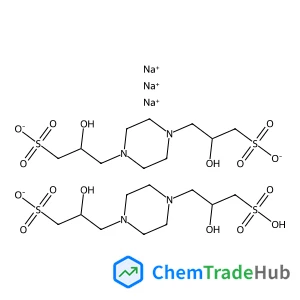
3,3'-(Piperazine-1,4-diyl)bis(2-hydroxypropane-1-sulfonic acid) Sodium Salt
CAS号:
108321-08-0
分子式:
C20H41N4Na3O16S4
推荐供应商






免责声明
本页面提供的学术期刊信息仅供参考和研究使用。我们与任何期刊出版商均无关联,也不处理投稿事宜。如有投稿相关咨询,请直接联系相关期刊出版商。
如发现页面信息有误,请发送邮件至 support@chemtradehub.com 联系我们。我们将及时核实并处理您的问题。