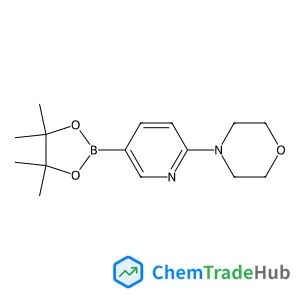
4-(5-(4,4,5,5-tetramethyl-1,3,2-dioxaborolan-2-yl)pyridin-2-yl)morpholine
CAS号:
485799-04-0
分子式:
C15H23BN2O3
Hanlin Gan, Liang Peng, Feng Long Gu
Density functional theory calculations are employed to study the mechanism of photoselective catalytic reduction of 4-bromobenzaldehyde (4-BBA) in acetonitrile and in ethanol solvents. A totally relaxed Ti3O9H6 cluster model is proposed to represent titanium dioxide (TiO2) surfaces. The reduction selectivity of an adsorbed 4-BBA molecule on Ti3O9H6 has been investigated. Owing to the difference in the proton and H atom donating capabilities between explicit CH3CN and C2H5OH solvent molecules, the photocatalytic reduction of 4-BBA is the debromination process in acetonitrile, whereas in ethanol it is the carbonyl reduction process. Therefore 4-BBA can be selectively reduced to benzaldehyde in acetonitrile and 4-bromobenzyl alcohol in ethanol, respectively. Our computational results have verified the reaction mechanism proposed by experiments and show that the debromination of 4-BBA would be efficient if both 4-BBA and Ti3O9H6 have an extra photoelectron. The Ti3O9H6 cluster, playing a role as a hydrogen source and a bridge to transfer photoelectrons from bulk TiO2, would have potential to be an ideal molecular model for understanding photocatalytic reactions on the TiO2 surface.

Electroanalysis

Acta Metallurgica Sinica-English Letters

Main Group Chemistry

Chinese Journal of Chemistry

Cellulose

Herald of the Russian Academy of Sciences

Journal of Asian Natural Products Research

Bioorganic & Medicinal Chemistry Letters

Critical Reviews in Solid State and Materials Sciences

Polycyclic Aromatic Compounds
Bas G. G. Lohmeijer, Daan Wouters, Zhihui Yin, Ulrich S. Schubert
DOI: 10.1039/B411777H
Randolf D. Köhn, Zhida Pan, Mary F. Mahon, Gabriele Kociok-Köhn
DOI: 10.1039/B302670A
Le-Ping Liu, Min Shi
DOI: 10.1039/B412823K
John J. Perry, Gregory J. McManus, Michael J. Zaworotko
DOI: 10.1039/B408973A
Max J. Cryle, Julia M. U. Stuthe, Paul R. Ortiz de Montellano, James J. De Voss
DOI: 10.1039/B315911F
Seong Jin Park, Dong Mok Shin, Shigeru Sakamoto, Kentaro Yamaguchi, Young Keun Chung, Myoung Soo Lah
DOI: 10.1039/B212855A
Jianzhong Yang, Andrew R. Barron
DOI: 10.1039/B411118D
Chengwei Gao, Xiaochun Tao, Yanlong Qian, Jiling Huang
DOI: 10.1039/B302890A
Tsutomu Konno, Jungha Chae, Tomoo Tanaka, Takashi Ishihara, Hiroki Yamanaka
DOI: 10.1039/B316065C
Liangti Qu, Gaoquan Shi
DOI: 10.1039/B412638F
处理含有8-氯咪唑并[1,2-A]吡嗪的废料时,应首先将其收集并进行化学回收或降解。如果无法回收,需采用安全的化学处理方法,如中和、氧化还原或沉淀。处理过程中需...
Calhex 231 hydrochloride 需要遵循《全球化学品统一分类和标签制度》(GHS)的分类和标签要求,以及欧盟的《化学品注册、评估、授权和限制条...
11-Beta,17-alpha,21-三羟基-5-beta-孕烯-3,20-二酮是一种无色结晶性粉末,分子量为372.45 g/mol。该化合物在水中的溶解度...
处理5-异丙基-1,3,4-恶二唑-2-羧酸时应注意以下安全事项:穿戴适当的个人防护装备,包括实验室外套、手套和护目镜;操作应在通风橱中进行,以减少吸入或接触有...
Benzyl 3-bromopropanoate属于有毒物质,吸入、摄入或皮肤接触均可能对人体造成伤害。操作时应佩戴防护眼镜、口罩和手套,避免吸入蒸汽和直接接触...
(R)-N-苄氧羰基-3,4-二氢-1H-异喹啉羧酸是一种含有苄氧羰基和异喹啉环结构的化合物,分子式为C17H15NO3。它是一种有机化合物,具有一定的生物活性...
可以考虑使用1-苄基吡啶-3-羧酸盐作为1-苄基吡啶嗡-3-羧酸盐的替代品。此外,还可以探索其他类似物,如1-苄基吡啶-3-氨基甲酸酯等。具体的替代品选择需根据...
(2,6-二甲基吡啶-3-基)甲醇在使用时需注意安全,应避免吸入其蒸汽,接触皮肤和眼睛。操作应在通风良好的环境中进行,佩戴适当的个人防护装备。
5-溴-2-乙烯基吡啶是一种有机化合物,外观为白色固体,具有良好的结晶性。分子量约为190.03 g/mol。它的溶解性在水中较差,但在有机溶剂如二氯甲烷、甲醇...
2-羟基-3-硝基-5-甲基吡啶主要应用于医药、聚合物和半导体行业。在医药领域,它可以用作合成其他药物的中间体。在聚合物领域,它可以作为功能性单体参与聚合反应,...

Physical Chemistry Chemical Physics (PCCP) is an international journal co-owned by 19 physical chemistry and physics societies from around the world. This journal publishes original, cutting-edge research in physical chemistry, chemical physics and biophysical chemistry. To be suitable for publication in PCCP, articles must include significant innovation and/or insight into physical chemistry; this is the most important criterion that reviewers and Editors will judge against when evaluating submissions. The journal has a broad scope and welcomes contributions spanning experiment, theory, computation and data science. Topical coverage includes spectroscopy, dynamics, kinetics, statistical mechanics, thermodynamics, electrochemistry, catalysis, surface science, quantum mechanics, quantum computing and machine learning. Interdisciplinary research areas such as polymers and soft matter, materials, nanoscience, energy, surfaces/interfaces, and biophysical chemistry are welcomed if they demonstrate significant innovation and/or insight into physical chemistry. Joined experimental/theoretical studies are particularly appreciated when complementary and based on up-to-date approaches.
![Ethyl 3-((6-(4,5-dihydro-1H-benzo[d]azepin-3(2H)-yl)-2-(pyridin-2-yl)pyrimidin-4-yl)amino)propanoate structure](https://cnstatic.chemtradehub.com/structs/137/1373423-53-0-496a.webp "Ethyl 3-((6-(4,5-dihydro-1H-benzo[d]azepin-3(2H)-yl)-2-(pyridin-2-yl)pyrimidin-4-yl)amino)propanoate structure")