





A study on the electronic and interfacial structures of monolayer ReS2–metal contacts
文献信息
发布日期
2017-09-14
DOI
10.1039/C7CP05386J
影响因子
3.676
作者
Guofeng Yang, Rui Sun, Pengfei Yan, Yanan Lu, Junjun Xue, Guoqing Chen
查看原文
摘要
In this paper, we perform a systematic and rigorous study to evaluate the Ohmic nature of the top-contact formed by the monolayer ReS2 (mReS2) and metals (gold, silver, platinum, nickel, titanium, and scandium) by means of first-principles density functional theory calculations. We investigate the potential barrier, charge transfer and atomic orbital overlap at the mReS2–metal interface in consideration of van der Waals forces to understand how efficiently carriers could be injected from the metal contact to the mReS2 channel. ReS2 is physisorbed on Au and Ag, which leads to little perturbation of its electronic structures and forms a larger Schottky contact and a higher tunnel barrier at the interface. ReS2 is chemisorbed on Ti and Sc, where the bonding strongly perturbs the electronic structures and is found to be purely Ohmic. The bonding of ReS2 on Pt and Ni lies between these two extreme cases, demonstrating an intermediate behavior. These findings not only provide an insight into the mReS2–metal interfaces but may also prove to be instrumental in the future design of ReS2-based devices with good performance.
相关文献
Photoinduced charge accumulation by metal ion-coupled electron transfer
Annabell G. Bonn, Oliver S. Wenger
2015-08-27
Paper
DOI: 10.1039/C5CP04718H
Important issues facing model-based approaches to tunneling transport in molecular junctions
2015-07-08
Paper
DOI: 10.1039/C5CP02595H
Molecular features contributing to the lower viscosity of phosphonium ionic liquids compared to their ammonium analogues
Laura Katharina Scarbath-Evers, Patricia A. Hunt, Barbara Kirchner, Douglas R. MacFarlane, Stefan Zahn
2015-07-09
Paper
DOI: 10.1039/C5CP00340G
Testing gold nanostructures fabricated by hole-mask colloidal lithography as potential substrates for SERS sensors: sensitivity, signal variability, and the aspect of adsorbate deposition
Vlastimil Peksa, Petra Lebrušková, Hana Šípová, Josef Štěpánek, Jiří Bok, Jiří Homola, Marek Procházka
2016-06-22
Paper
DOI: 10.1039/C6CP02752K
Element-selective resonant state in M-doped SnTe (M = Ga, In, and Tl)
X. J. Tan, G. Q. Liu, J. T. Xu, H. Z. Shao, J. Jiang, H. C. Jiang
2016-07-04
Paper
DOI: 10.1039/C6CP03688K
The role of the substrate structure in the on-surface synthesis of organometallic and covalent oligophenylene chains
Jingya Dai, Qitang Fan, Tao Wang, Julian Kuttner, Gerhard Hilt, J. Michael Gottfried, Junfa Zhu
2016-07-06
Paper
DOI: 10.1039/C6CP03551E
A computational study on the N-heterocyclic carbene-catalyzed Csp2–Csp3 bond activation/[4+2] cycloaddition cascade reaction of cyclobutenones with imines: a new application of the conservation principle of molecular orbital symmetry
Yang Wang, Bohua Wu, Haoyang Zhang, Donghui Wei, Mingsheng Tang
2016-07-04
Paper
DOI: 10.1039/C6CP03180C
The time scale of the quaternary structural changes in hemoglobin revealed using the transient grating technique
Jungkweon Choi
2015-08-14
Communication
DOI: 10.1039/C5CP03059E
Exploring electron pair behaviour in chemical bonds using the extracule density
Adam J. Proud, Dalton E. C. K. Mackenzie, Jason K. Pearson
2015-07-10
Paper
DOI: 10.1039/C5CP03280F
您可能还喜欢
化合物问答
2-(甲基磺酰基)嘧啶-5-胺(CAS号:56621-92-2)适用哪些法规指南?
该化合物适用的法规指南包括GHS(全球化学品统一分类和标签制度)分类为特定目标器官毒性-单次接触类别3;根据欧盟REACH法规,该化合物需要进行注册和评估;在美...
56621-92-22-(Methylsulfonyl)py...
化合物问答
在合成中是否有4-(4-氯苯基)-1H-咪唑(CAS号:35512-29-9)的替代品?
在合成中,可以考虑使用一些类似的化合物作为4-(4-氯苯基)-1H-咪唑的替代品,如4-(4-溴苯基)-1H-咪唑或4-(4-甲氧基苯基)-1H-咪唑。这些化合...
35512-29-94-(4-Chlorophenyl)-1...
化合物问答
什么是N~2~-甲基丙氨酸酰胺(CAS号:32012-16-1)?
N~2~-甲基丙氨酸酰胺是一种有机化合物,其化学名为2-(Methylamino)propanamide。它是一种酰胺类化合物,分子式为C4H10N2O,相对分...
32012-16-12-(Methylamino)propa...
化合物问答
如何处理含有N-苄基-3-氨基氧杂环丁烷草酸盐(CAS号:1956341-96-0)的废料?
处理含有N-苄基-3-氨基氧杂环丁烷草酸盐(CAS号:1956341-96-0)的废料时,应首先确保遵循相关法规要求,如GHS和REACH等。通常,废液应先进行...
1956341-96-0N-Benzyloxetan-3-ami...
化合物问答
4-bromo-2-chloro-6-methylbenzoic acid(CAS号:877149-07-0)的物理化学性质是什么?
4-溴-2-氯-6-甲基苯甲酸是一种固体化合物,具有较高的熔点和较低的沸点。它的分子量为261.03 g/mol。该化合物在水中几乎不溶,在有机溶剂中溶解度适中...
877149-07-04-Bromo-2-chloro-6-m...
化合物问答
2-[(2,5-二氯-4-嘧啶)氨基]-N-甲基苯甲酰胺(CAS号:761440-08-8)通常如何合成?
该化合物通常通过缩合反应合成,典型的方法是将2,5-二氯嘧啶与N-甲基苯甲酰胺在碱性条件下进行偶联反应。常用的碱包括NaH、LDA等强碱。该合成路线具有较高的选...
761440-08-82-[(2,5-dichloropyri...
4752-10-71,4-Dichlorophthalaz...
化合物问答
在合成中是否有3,5-二溴-4-甲基苯胺(CAS号:13194-73-5)的替代品?
3,5-二溴-4-甲基苯胺在某些合成路线中可能没有直接替代品。然而,在某些应用场景下,可以考虑使用其他类似结构的化合物如3,5-二溴-4-硝基苯胺或3,5-二碘...
13194-73-53,5-Dibromo-4-methyl...
化合物问答
2-氯喹啉-4-羧酸甲酯(CAS号:62482-26-2)的主要用途是什么?
2-氯喹啉-4-羧酸甲酯主要用于有机合成和药物合成领域,作为中间体或原料。它在合成某些药物和染料时具有重要作用。此外,该化合物还可能用于某些特定的化学研究中。
62482-26-2Methyl 2-chloro-4-qu...
化合物问答
i>]吡啶(CAS号:474708-88-8)安全吗?
6-溴-8-氯咪唑[1,2-a]吡啶在操作过程中需要谨慎以确保安全。该化合物具有一定的毒性,吸入其蒸气或粉尘可能导致呼吸道刺激。处理时应佩戴适当的防护装备,如手...
474708-88-86-Bromo-8-chloroimid...
来源期刊
Physical Chemistry Chemical Physics

CiteScore:
5.5
自引率:
10.3%
年发文量:
3036
Physical Chemistry Chemical Physics (PCCP) is an international journal co-owned by 19 physical chemistry and physics societies from around the world. This journal publishes original, cutting-edge research in physical chemistry, chemical physics and biophysical chemistry. To be suitable for publication in PCCP, articles must include significant innovation and/or insight into physical chemistry; this is the most important criterion that reviewers and Editors will judge against when evaluating submissions. The journal has a broad scope and welcomes contributions spanning experiment, theory, computation and data science. Topical coverage includes spectroscopy, dynamics, kinetics, statistical mechanics, thermodynamics, electrochemistry, catalysis, surface science, quantum mechanics, quantum computing and machine learning. Interdisciplinary research areas such as polymers and soft matter, materials, nanoscience, energy, surfaces/interfaces, and biophysical chemistry are welcomed if they demonstrate significant innovation and/or insight into physical chemistry. Joined experimental/theoretical studies are particularly appreciated when complementary and based on up-to-date approaches.
推荐化合物
![(3R)-3-(3-Fluorophenyl)-3-({[(2-methyl-2-propanyl)oxy]carbonyl}amino)propanoic acid structure](https://cnstatic.chemtradehub.com/structs/500/500789-04-8-20dd.webp "(3R)-3-(3-Fluorophenyl)-3-({[(2-methyl-2-propanyl)oxy]carbonyl}amino)propanoic acid structure")
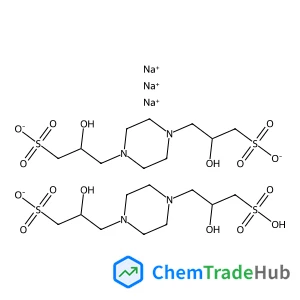
3,3'-(Piperazine-1,4-diyl)bis(2-hydroxypropane-1-sulfonic acid) Sodium Salt
CAS号:
108321-08-0
分子式:
C20H41N4Na3O16S4
推荐供应商



免责声明
本页面提供的学术期刊信息仅供参考和研究使用。我们与任何期刊出版商均无关联,也不处理投稿事宜。如有投稿相关咨询,请直接联系相关期刊出版商。
如发现页面信息有误,请发送邮件至 support@chemtradehub.com 联系我们。我们将及时核实并处理您的问题。