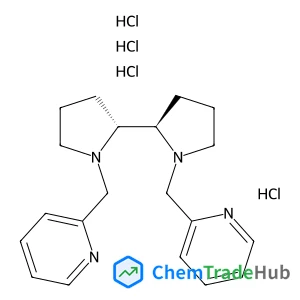
(2R,2'R)-1,1'-Bis(2-pyridinylmethyl)-2,2'-bipyrrolidine tetrahydrochloride
CAS号:
1228077-88-0
分子式:
C20H30Cl4N4
Margherita Barbero, Stefano Dughera
Diazonium salts, and precisely arenediazonium o-benzenedisulfonimides, have been used for the first time as efficient electrophilic partners in gold catalyzed Heck-coupling reactions. The synthetic protocol was general, easy and gave the target products in satisfactory yields. Mechanistic insights revealed the fundamental roles of the o-benzenedisulfonimide anion as an electron transfer agent thath promotes a radical pathway that does not require the presence of photocatalysts or external oxidants.
Russian Chemical Bulletin
Journal of Peptide Science
New Journal of Chemistry
Current Opinion in Solid State & Materials Science
Organic Process Research & Development

Acta Materialia
Russian Journal of Organic Chemistry
Nature Medicine
Journal of Saudi Chemical Society
Chemistry Education Research and Practice
Matthijs R. Panman, Pavol Bodis, Danny J. Shaw, Bert H. Bakker, Arthur C. Newton, Euan R. Kay, David A. Leigh, Wybren Jan Buma, Albert M. Brouwer, Sander Woutersen
DOI: 10.1039/C1CP22146A
Chad M. Huelsman, Phillip E. Savage
DOI: 10.1039/C2CP23910H
Bjørn Kvamme, Tatiana Kuznetsova, Pilvi-Helina Kivelæ
DOI: 10.1039/C2CP23810A
George Mitrikas
DOI: 10.1039/C2CP24057B
Tim S. Totton, Alston J. Misquitta, Markus Kraft
DOI: 10.1039/C2CP23008A
Akira Yamada, Ken Miyajima, Fumitaka Mafuné
DOI: 10.1039/C2CP24036J
Jens Petersen, Matthias Wohlgemuth, Bernhard Sellner, Roland Mitrić
DOI: 10.1039/C2CP24002E
Bin Zhang, Xudong Chen, Zhenguo Chi, Jin Yang, Jiemei Ou, Ming Qiu Zhang, Dehao Li, Dong Wang, Mingkai Liu, Juying Zhou
DOI: 10.1039/C2CP23953A
C. Callegari
DOI: 10.1039/C2CP22749E
随着环保要求的提高和安全意识的增强,该化合物的研究和应用趋势正逐渐转向更安全、更环境友好的替代品。市场关注点主要集中在开发新型合成方法和绿色化学路径,以减少有害...
处理含有2,9 - 二苯基 - 1,10 - 菲罗啉的废料时,应先将其收集在适当的容器中,避免与其他化学品混合。随后,可以通过水解或氧化等方法进行处理,直至达到...
处理(6-氯-吡嗪-3-基)-(4-乙基-哌嗪-1-基)-甲酮时,应穿戴适当的个人防护装备(PPE),包括手套、护目镜和实验室外套。在通风橱中操作以确保良好的通...
在处理(R)-2-氯-1-(2,4-二氯苯基)乙醇时,应佩戴防护眼镜、实验室外套和手套,确保通风橱开启以减少接触和吸入的风险。避免直接接触皮肤和眼睛。处理过程中...
可考虑使用类似结构的化合物作为替代品,如3-氯-6-(哌啶-1-基)吡嗪或3-氯-6-(2-氯哌啶-1-基)吡嗪,这些化合物在结构上与目标化合物相似,可能具有相...
该化合物可以通过乙酸乙酯与5-溴-1H-苯并三氮唑的反应合成,通常在无水条件下进行。合成过程中,需要使用适当的溶剂如乙酸乙酯,并在适当的温度下反应。该反应具有较...
一水硫酸镁是一种无机化合物,化学式为MgSO₄·H₂O,CAS号为14168-73-1。它由镁离子、硫酸根离子和一个结晶水分子组成,通常呈现为白色粉末或颗粒状固...
氘代-1,3-二氯-2-丙醇主要应用于医药和有机合成领域,作为研究化合物的氘代替代品,用于标记和追踪反应过程。此外,在聚合物和半导体生产中也有一定的应用潜力。
氰乙酸环己酯应储存在阴凉、干燥、通风良好的环境中,远离火源和热源,防止阳光直射。储存容器应密封良好,避免与空气接触,防止发生不必要的反应。
目前,2-碘-4-硝基苯胺在医药和农药领域有一定的研究和应用,尤其是在开发新型药物和农药产品方面。然而,由于其潜在的环境和健康风险,行业正趋向于寻找更为安全和环...

Organic & Biomolecular Chemistry (OBC) publishes original and high impact research and reviews in organic chemistry. We welcome research that shows new or significantly improved protocols or methodologies in total synthesis, synthetic methodology or physical and theoretical organic chemistry as well as research that shows a significant advance in the organic chemistry or molecular design aspects of chemical biology, catalysis, supramolecular and macromolecular chemistry, theoretical chemistry, mechanism-oriented physical organic chemistry, medicinal chemistry or natural products. Articles published in the journal should report new work which makes a highly-significant impact in the field. Routine and incremental work is generally not suitable for publication in the journal. More details about key areas of our scope are below. In all cases authors should include in their article clear rationale for why their research has been carried out.
![4-[(4-Bromophenyl)sulfonyl]thiomorpholine structure](https://cnstatic.chemtradehub.com/structs/223/223555-81-5-2d67.webp "4-[(4-Bromophenyl)sulfonyl]thiomorpholine structure")