



Oxygen tolerant photopolymerization for ultralow volumes
文献信息
发布日期
2017-02-16
DOI
10.1039/C7PY00007C
影响因子
5.582
作者
Robert Chapman
查看原文
摘要
A benchtop approach is developed for the synthesis of various polymeric architectures using an aqueous Reversible Addition–Fragmentation chain Transfer (RAFT) photopolymerization technique. Under visible green light irradiation (λ = 530 nm), eosin Y (EY) in the presence of ascorbic acid (AscA) as a reducing agent can initiate RAFT polymerization of a range of monomers (acrylamide, acrylate and methacrylate families) in water. More importantly, this process proceeds rapidly without the need for traditional deoxygenation and thus allows RAFT polymerizations to be performed in ultralow volumes (20 μL). This photopolymerization approach can be applied on a 96-well microtiter plate for the synthesis of a range of homopolymer and diblock copolymers. Furthermore, more complex polymeric architectures such as star polymers (arm first) and polymeric nanoparticles (via a polymerization-induced self-assembly (PISA) approach) were successfully synthesized in low volumes and without prior deoxygenation.
相关文献
O-Nitrobenzyl-alt-(phenylethynyl)benzene copolymer-based nanoaggregates with highly efficient two-photon-triggered degradable properties via a FRET process
Hui Zhao, Bing Hou, Yufu Tang, Wenbo Hu, Chao Yin, Yu Ji, Quli Fan
2016-04-07
Paper
DOI: 10.1039/C6PY00420B
Cyclic azobenzene-containing amphiphilic diblock copolymers: solution self-assembly and unusual photo-responsive behaviors
Beibei Chen, Zhao Wang, Jinjie Lu, Xian Yang, Yong Wang, Zhengbiao Zhang, Jian Zhu, Nianchen Zhou, Yiwen Li, Xiulin Zhu
2015-03-09
Communication
DOI: 10.1039/C5PY00246J
Synthesis of polymer-silica hybrid microparticles with defined geometry using surface initiated atom transfer radical polymerization
F. del Monte, D. P. Finn, W. Wang, A. Pandit
2015-03-09
Communication
DOI: 10.1039/C5PY00228A
Amidation of triglycerides by amino alcohols and their impact on plant oil-derived polymers
Liang Yuan, Zhongkai Wang, Nathan M. Trenor, Chuanbing Tang
2016-03-03
Paper
DOI: 10.1039/C6PY00048G
Photocontrollable induction of supramolecular chirality in achiral side chain Azo-containing polymers through preferential chiral solvation‡
Shunqin Jiang, Yin Zhao, Laibing Wang, Lu Yin, Zhengbiao Zhang, Jian Zhu, Wei Zhang, Xiulin Zhu
2015-04-23
Paper
DOI: 10.1039/C5PY00496A
Efficient multiblock star polymer synthesis from photo-induced copper-mediated polymerization with up to 21 arms
B. Wenn, Y.-M. Chuang, J. Gruber
2016-03-21
Paper
DOI: 10.1039/C6PY00175K
Phenylmaleimide-containing PET-based copolyester: cross-linking from 2π + π cycloaddition toward flame retardance and anti-dripping
Xue Dong, Li Chen, Rong-Tao Duan, Yu-Zhong Wang
2016-03-14
Paper
DOI: 10.1039/C6PY00183A
Synthesis and properties of stimuli-sensitive heterografted toothbrush-like terpolymers with a linear handle and two types of V-shaped grafts
Min Tong, Xiaonan An, Weidong Pan, Huanhuan Liu, Youliang Zhao
2016-02-26
Paper
DOI: 10.1039/C6PY00182C
Copolymerization of propylene with Si-containing α,ω-diolefins: how steric hindrance of diolefins affects long chain branch formation
Bin Wang, Yi-Ming Zhang, Zhe Ma, Li Pan, Shi-Jun Yu
2016-03-24
Paper
DOI: 10.1039/C6PY00333H
您可能还喜欢
化合物问答
如何储存1,2-环己二酮环乙缩醛(CAS号:4746-96-7)?
1,2-环己二酮环乙缩醛应储存在阴凉、干燥、通风良好的地方,避免阳光直射。建议使用密封容器保存,并保持环境温度在室温范围内,远离火源和热源。
4746-96-71,4-Dioxaspiro[4.5]d...
化合物问答
Ecopladib(CAS号:381683-92-7)的市场或研究趋势如何?
Ecopladib作为一种新型的药物,主要应用于治疗高胆固醇等疾病。目前,市场和研究趋势显示,Ecopladib因其独特的药理作用而受到关注。随着对心血管疾病治...
381683-92-7Ecopladib
化合物问答
2,3-Dimethyl-3H-imidazo[4,5-c]pyridine(CAS号:52538-09-7)通常如何合成?
2,3-二甲基-3H-咪唑[4,5-c]吡啶通常通过咪唑和2,3-二甲基吡啶的缩合反应合成。具体来说,将咪唑和2,3-二甲基吡啶在适当的溶剂中进行加热或加压反应...
52538-09-72,3-Dimethyl-3H-imid...
化合物问答
2,3,4,5-tetrahydro-1H-3-苯并氮杂环;盐酸盐(CAS号:17379-01-0)的市场或研究趋势如何?
该化合物在药物化学和有机合成中有一定的应用。近年来,随着对新型药物化合物的需求增加,该化合物的研究趋势主要集中在探索其生物活性,尤其是其在神经系统疾病治疗中的潜...
17379-01-02,3,4,5-Tetrahydro-1...
68-90-6(2-Ethyl-1-benzofura...
化合物问答
如何储存盐酸甘氨酸丁酯(CAS号:13048-99-2)?
盐酸甘氨酸丁酯应储存在阴凉、干燥、通风良好的地方,避免阳光直射和高温环境,温度应控制在25℃以下。储存容器应密封,避免与空气中的水分和酸性物质接触,以防发生水解...
13048-99-2Butyl glycinate hydr...
化合物问答
什么是2-Iodo-N,N-dimethylbenzamide(CAS号:54616-46-5)?
2-碘-N,N-二甲基苯胺是一种有机化合物,化学名为2-Iodo-N,N-dimethylbenzamide。其分子式为C<sub>9</sub>H<sub>1...
54616-46-52-Iodo-N,N-dimethylb...
16817-90-6N-Cyclohexylglycinam...
化合物问答
5-溴-2-(4H-1,2,4-三唑-4-基)吡啶(CAS号:959240-99-4)的市场或研究趋势如何?
随着医药、农药和新材料领域的发展,该化合物作为关键中间体的应用日益增多。特别是在药物合成中,由于其独特的化学性质,可以用于合成多种药物分子。未来的研究趋势可能集...
959240-99-45-Bromo-2-(4H-1,2,4-...
化合物问答
2,4-二溴-6-三氟甲基嘧啶(CAS号:785778-00-9)通常如何合成?
2,4-二溴-6-三氟甲基嘧啶通常通过溴化反应合成。首先,将6-三氟甲基嘧啶与溴化剂(如液溴)在适当的溶剂(如二氯甲烷、四氢呋喃)中反应,加入适当的催化剂(如四...
785778-00-92,4-Dibromo-6-(trifl...
来源期刊
Polymer Chemistry

CiteScore:
8.6
自引率:
7.3%
年发文量:
457
Polymer Chemistry welcomes submissions in all areas of polymer science that have a strong focus on macromolecular chemistry. Manuscripts may cover a broad range of fields, yet no direct application focus is required.
推荐化合物
phosphoryl}methyl 4-methylbenzenesulfonate structure](https://cnstatic.chemtradehub.com/structs/864/864068-45-1-ba7c.webp "{[3-(Hexadecyloxy)propoxy](hydroxy)phosphoryl}methyl 4-methylbenzenesulfonate structure")
![S-[2,3-Bis(palmitoyloxy)propyl]-N-[(9H-fluoren-9-ylmethoxy)(hydroxy)methylene]cysteine structure](https://cnstatic.chemtradehub.com/structs/210/210532-98-2-f6a7.webp "S-[2,3-Bis(palmitoyloxy)propyl]-N-[(9H-fluoren-9-ylmethoxy)(hydroxy)methylene]cysteine structure")
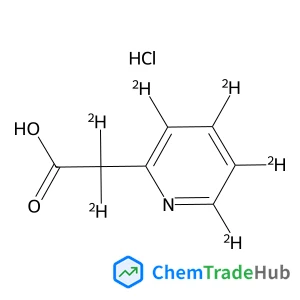
2,2-dideuterio-2-(3,4,5,6-tetradeuterio-2-pyridyl)acetic acid;hydrochloride
CAS号:
1329799-67-8
分子式:
C7H2ClD6NO2
推荐供应商





免责声明
本页面提供的学术期刊信息仅供参考和研究使用。我们与任何期刊出版商均无关联,也不处理投稿事宜。如有投稿相关咨询,请直接联系相关期刊出版商。
如发现页面信息有误,请发送邮件至 support@chemtradehub.com 联系我们。我们将及时核实并处理您的问题。