





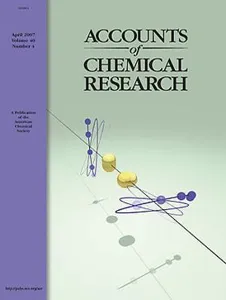


Photocontrollable induction of supramolecular chirality in achiral side chain Azo-containing polymers through preferential chiral solvation‡
文献信息
发布日期
2015-04-23
DOI
10.1039/C5PY00496A
影响因子
5.582
作者
Shunqin Jiang, Yin Zhao, Laibing Wang, Lu Yin, Zhengbiao Zhang, Jian Zhu, Wei Zhang, Xiulin Zhu
查看原文
摘要
Here we designed a trans–cis photoisomerizable achiral side chain azobenzene-containing polymer, poly(6-[4-(4-methoxyphenylazo) phenoxy] hexyl methacrylate) (PAzoMA), to investigate the possibility of transferring chirality of chiral solvent molecules to polymers. Preferred chirality in supramolecularly assembled trans-azobenzene units of PAzoMA is successfully induced by limonene chirality. This chiral solvation induced chirality arises from superstructural chirality of well-assembled achiral azobenzene units in polymer side chains. The intense bisignated circular dichroism (CD) signals in the UV-vis region disappeared when trans–cis photoisomerization of PAzoMA occurred with 365 nm light irradiation. The polymer aggregate solution shows the CD-silent state when the cis-PAzoMA solution is subjected to 436 nm light irradiation. The intense CD signals with a ∼40 nm red-shift were recovered by heating the polymer aggregate solution to 60 °C and keeping it at this temperature for 40 min, then cooling it down to room temperature. The successful construction of a reversible chiral–achiral switch based on an achiral azobenzene-containing side chain polymer will open a new approach for production of chiroptical materials.
相关文献
Visible-light photocatalytic preparation of alkenyl thioethers from 1,2,3-thiadiazoles and Hantzsch esters: synthetic and mechanistic investigations
Zhanqun Liang, Shaofang Zhou, Changlei Zhu, Xiaoguang Bao
2021-10-05
Research Article
DOI: 10.1039/D1QO01076J
Ru(ii)-Catalyzed C–H activation/annulation reactions of N-aryl-pyrazolidinones with sulfoxonium ylides: synthesis of cinnoline-fused pyrazolidinones
Hai-Shan Jin, Ya-Zhen Du, Qing-Yang Zhao, Li-Ming Zhao
2021-09-13
Research Article
DOI: 10.1039/D1QO01001H
Zinc–Brønsted acid mediated practical hydrotrifluoromethylation of alkenes with CF3Br
Deqian Peng, Wu Fan, Xueqi Zhao, Wei Chen, Yuan Wen, Li Zhang
2021-09-13
Research Article
DOI: 10.1039/D1QO01073E
Visible-light-promoted divergent functionalizations of methylenecyclopropanes
Baoxiang Zhu, Zhao Wang, Hui Xi, Zengqiang Feng, Binglei Wang, Wenyang Jiao, Zhongxian Li, Zechao Wang, Junliang Wu
2021-09-09
Research Article
DOI: 10.1039/D1QO01187A
Two catalytic protocols for Achmatowicz rearrangement using cyclic diacyl peroxides as oxidants
2018-07-17
Communication
DOI: 10.1039/C8OB01382A
Ru(ii)-Catalyzed C7-acyloxylation of indolines with carboxylic acids
Pinaki Bhusan De, Sonbidya Banerjee, Sourav Pradhan, Tharmalingam Punniyamurthy
2018-07-30
Paper
DOI: 10.1039/C8OB01603H
The radical acylarylation of N-arylacrylamides with aliphatic aldehydes using the photolysis of hypervalent iodine(iii) reagents
Ryu Sakamoto, Naomichi Hirama
2018-07-14
Communication
DOI: 10.1039/C8OB01420E
Copper-catalyzed [1,3]-alkoxy rearrangement for the selective synthesis of polycyclic ortho-aminoarenol derivatives
Itaru Nakamura, Satoru Nozawa, Yasuhiro Ishida, Ichiro Muranushi, Alexandra Mayerweg, Masahiro Terada
2021-09-18
Research Article
DOI: 10.1039/D1QO01189H
Brønsted acid-catalyzed dynamic kinetic resolution of in situ formed acyclic N,O-hemiaminals: cascade synthesis of chiral cyclic N,O-aminals
Xue-Jiao Lv, Yong-Chao Ming, Hui-Chun Wu
2021-09-16
Research Article
DOI: 10.1039/D1QO01135A
A Catellani and retro-Diels–Alder strategy to access 1-amino phenanthrenes via ortho- and interannular C–H activation of 2-iodobiphenyls
Mingjie Sun, Xinyang Chen, Zichao Feng, Guobo Deng, Yuan Yang, Yun Liang
2021-10-02
Research Article
DOI: 10.1039/D1QO01103K
您可能还喜欢
化合物问答
如何储存1,2-环己二酮环乙缩醛(CAS号:4746-96-7)?
1,2-环己二酮环乙缩醛应储存在阴凉、干燥、通风良好的地方,避免阳光直射。建议使用密封容器保存,并保持环境温度在室温范围内,远离火源和热源。
4746-96-71,4-Dioxaspiro[4.5]d...
化合物问答
Ecopladib(CAS号:381683-92-7)的市场或研究趋势如何?
Ecopladib作为一种新型的药物,主要应用于治疗高胆固醇等疾病。目前,市场和研究趋势显示,Ecopladib因其独特的药理作用而受到关注。随着对心血管疾病治...
381683-92-7Ecopladib
化合物问答
2,3-Dimethyl-3H-imidazo[4,5-c]pyridine(CAS号:52538-09-7)通常如何合成?
2,3-二甲基-3H-咪唑[4,5-c]吡啶通常通过咪唑和2,3-二甲基吡啶的缩合反应合成。具体来说,将咪唑和2,3-二甲基吡啶在适当的溶剂中进行加热或加压反应...
52538-09-72,3-Dimethyl-3H-imid...
化合物问答
2,3,4,5-tetrahydro-1H-3-苯并氮杂环;盐酸盐(CAS号:17379-01-0)的市场或研究趋势如何?
该化合物在药物化学和有机合成中有一定的应用。近年来,随着对新型药物化合物的需求增加,该化合物的研究趋势主要集中在探索其生物活性,尤其是其在神经系统疾病治疗中的潜...
17379-01-02,3,4,5-Tetrahydro-1...
68-90-6(2-Ethyl-1-benzofura...
化合物问答
如何储存盐酸甘氨酸丁酯(CAS号:13048-99-2)?
盐酸甘氨酸丁酯应储存在阴凉、干燥、通风良好的地方,避免阳光直射和高温环境,温度应控制在25℃以下。储存容器应密封,避免与空气中的水分和酸性物质接触,以防发生水解...
13048-99-2Butyl glycinate hydr...
化合物问答
什么是2-Iodo-N,N-dimethylbenzamide(CAS号:54616-46-5)?
2-碘-N,N-二甲基苯胺是一种有机化合物,化学名为2-Iodo-N,N-dimethylbenzamide。其分子式为C<sub>9</sub>H<sub>1...
54616-46-52-Iodo-N,N-dimethylb...
16817-90-6N-Cyclohexylglycinam...
化合物问答
5-溴-2-(4H-1,2,4-三唑-4-基)吡啶(CAS号:959240-99-4)的市场或研究趋势如何?
随着医药、农药和新材料领域的发展,该化合物作为关键中间体的应用日益增多。特别是在药物合成中,由于其独特的化学性质,可以用于合成多种药物分子。未来的研究趋势可能集...
959240-99-45-Bromo-2-(4H-1,2,4-...
化合物问答
2,4-二溴-6-三氟甲基嘧啶(CAS号:785778-00-9)通常如何合成?
2,4-二溴-6-三氟甲基嘧啶通常通过溴化反应合成。首先,将6-三氟甲基嘧啶与溴化剂(如液溴)在适当的溶剂(如二氯甲烷、四氢呋喃)中反应,加入适当的催化剂(如四...
785778-00-92,4-Dibromo-6-(trifl...
来源期刊
Polymer Chemistry

CiteScore:
8.6
自引率:
7.3%
年发文量:
457
Polymer Chemistry welcomes submissions in all areas of polymer science that have a strong focus on macromolecular chemistry. Manuscripts may cover a broad range of fields, yet no direct application focus is required.
推荐化合物
推荐供应商





免责声明
本页面提供的学术期刊信息仅供参考和研究使用。我们与任何期刊出版商均无关联,也不处理投稿事宜。如有投稿相关咨询,请直接联系相关期刊出版商。
如发现页面信息有误,请发送邮件至 support@chemtradehub.com 联系我们。我们将及时核实并处理您的问题。