



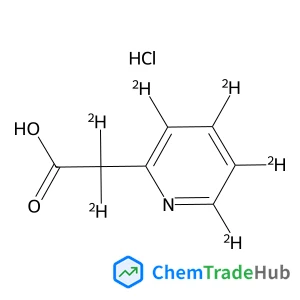
2,2-dideuterio-2-(3,4,5,6-tetradeuterio-2-pyridyl)acetic acid;hydrochloride
CAS号:
1329799-67-8
分子式:
C7H2ClD6NO2
M. Jane Strouse
There is considerable interest in the use of proteins as therapeutics and as chemical and biochemical reagents. However, many proteins are unstable and aggregate when exposed to stressors, including increased temperature, pH change, agitation, and desiccation. Polymers with side chain trehalose units were shown to be effective protein stabilizers, preventing aggregation and prolonging activity. Herein, we report the synthesis and characterization of four trehalose regioisomers containing a vinylbenzyl ether moiety at either the 2-O, 3-O, 4-O, or 6-O position. Computational analysis of these regioisomers suggested that they differ in their conformational flexibility, but all retained the native clam shell conformation of trehalose. Polymers were synthesized from the monomers separately via free radical polymerization and one polymer was prepared containing all of the regioisomers. The polymers were tested for their ability to stabilize insulin, and were found to prevent agitation-induced aggregation comparably. The results show that for insulin the effect of trehalose positional modification is minimal and suggest that the clam shell conformation itself may be more important than the polymer backbone attachment site for stabilization of proteins.
P. Horeglad, A. Litwińska, M. Dranka, G. Z. Żukowska, M. Michalak
DOI: 10.1039/C5PY02005K
Lu Jiang, Sing Shy Liow
DOI: 10.1039/C5PY01812A
Miao Yu, Xiaoyan Wang, Xiao Yang, Yang Zhao, Jia-Xing Jiang
DOI: 10.1039/C5PY00295H
Chen Zhang, Ji Zhang, Weixuan Zeng, Naihang Zheng, Wei Li, Wei Gao, Gui Yu, Chuluo Yang
DOI: 10.1039/C6PY00212A
Tian-You Zhou, Qiao-Yan Qi, Qiao-Ling Zhao, Jie Fu, Yi Liu, Zhi Ma, Xin Zhao
DOI: 10.1039/C5PY00072F
T. J. White
DOI: 10.1039/C5PY00640F
Jonghwa Jeong, Yun-Jung Lee, Bohyun Kim, Byoungjae Kim, Ki-Suck Jung, Hyun-jong Paik
DOI: 10.1039/C4PY01559B
Yevhen Karpov, Jatindranath Maiti, Roman Tkachov, Tetyana Beryozkina, Vasiliy Bakulev, Wei Liu, Hartmut Komber, Uwe Lappan, Mahmoud Al-Hussein, Manfred Stamm
DOI: 10.1039/C6PY00055J
1,2-环己二酮环乙缩醛应储存在阴凉、干燥、通风良好的地方,避免阳光直射。建议使用密封容器保存,并保持环境温度在室温范围内,远离火源和热源。
Ecopladib作为一种新型的药物,主要应用于治疗高胆固醇等疾病。目前,市场和研究趋势显示,Ecopladib因其独特的药理作用而受到关注。随着对心血管疾病治...
2,3-二甲基-3H-咪唑[4,5-c]吡啶通常通过咪唑和2,3-二甲基吡啶的缩合反应合成。具体来说,将咪唑和2,3-二甲基吡啶在适当的溶剂中进行加热或加压反应...
该化合物在药物化学和有机合成中有一定的应用。近年来,随着对新型药物化合物的需求增加,该化合物的研究趋势主要集中在探索其生物活性,尤其是其在神经系统疾病治疗中的潜...
盐酸甘氨酸丁酯应储存在阴凉、干燥、通风良好的地方,避免阳光直射和高温环境,温度应控制在25℃以下。储存容器应密封,避免与空气中的水分和酸性物质接触,以防发生水解...
2-碘-N,N-二甲基苯胺是一种有机化合物,化学名为2-Iodo-N,N-dimethylbenzamide。其分子式为C<sub>9</sub>H<sub>1...
随着医药、农药和新材料领域的发展,该化合物作为关键中间体的应用日益增多。特别是在药物合成中,由于其独特的化学性质,可以用于合成多种药物分子。未来的研究趋势可能集...
2,4-二溴-6-三氟甲基嘧啶通常通过溴化反应合成。首先,将6-三氟甲基嘧啶与溴化剂(如液溴)在适当的溶剂(如二氯甲烷、四氢呋喃)中反应,加入适当的催化剂(如四...

Polymer Chemistry welcomes submissions in all areas of polymer science that have a strong focus on macromolecular chemistry. Manuscripts may cover a broad range of fields, yet no direct application focus is required.