








Synthesis of platinum(ii) complex end functionalized star polymers: luminescence enhancements and unimolecular micelles in solvents of weakened quality
文献信息
发布日期
2017-07-13
DOI
10.1039/C7PY00993C
影响因子
5.582
作者
Fang Qu, Beihong Yang, Qun He, Weifeng Bu
查看原文
摘要
For the first time, two series of platinum(II) complex end functionalized star polymers have been designed and synthesized by the coordination reaction of K2PtCl4 with star polystyrene ligands ended with 2,6-bis(benzimidazol-2′-yl)pyridine. The resulting stars can self-assemble to generate spherical unimolecular micelles with a core of polystyrenes and a corona of planar platinum(II) complexes in the chloroform/methanol mixture solvent. The phosphorescence emissions of the star polymers show a stepwise increase in intensity in toluene/n-hexane or chloroform/n-hexane mixture solvents with increasing n-hexane content, where the solvent quality is gradually worsened for both the polystyrene and planar platinum(II) blocks. This class of aggregation-enhanced emissions is accordingly assigned to a triplet metal–metal-to-ligand charge-transfer excited state and has its origin in Pt⋯Pt and π–π stacking interactions that increasingly evoked between the planar platinum(II) blocks with weakening solvent quality. The star polymers terminated with high retention of luminescence metal complexes will represent a new class of functional polymer nanocomposites with well-defined topological architectures.
相关文献
Bright far-red/near-infrared fluorescent conjugated polymernanoparticles for targeted imaging of HER2-positive cancer cells
Jie Liu, Guangxue Feng, Dan Ding, Bin Liu
2013-05-29
Paper
DOI: 10.1039/C3PY00605K
Harnessing interrupted Fischer in continuous flow: sustainable synthesis of (spiro)indolenine and (spiro)indoline privileged scaffolds
Antonella Ilenia Alfano, Angela Zampella, Ettore Novellino, Margherita Brindisi, Heiko Lange
2020-09-14
Paper
DOI: 10.1039/D0RE00329H
Carbon material-supported Fe7C3@FeO nanoparticles: a highly efficient catalyst for carbon dioxide reduction with 1-butene
Bing Yan, Luyi Wang, Bolong Wang, Quanxin Chen, Chunjing Liu, Jian Li, Tao Jiang
2020-09-02
Paper
DOI: 10.1039/D0RE00249F
Organic synthesis via Kolbe and related non-Kolbe electrolysis: an enabling electro-strategy
Samina Aslam
2021-05-18
Minireview
DOI: 10.1039/D1RE00047K
Supramolecular guests in solvent driven block copolymerassembly: from internally structured nanoparticles to micelles
Daniel Klinger, Maxwell J. Robb, Jason M. Spruell, Nathaniel A. Lynd, Luke A. Connal
2013-07-05
Communication
DOI: 10.1039/C3PY00750B
Catalytic conversion of fructose into 5-HMF under eco-friendly-biphasic process
Panya Maneechakr, Surachai Karnjanakom
2020-09-12
Communication
DOI: 10.1039/D0RE00308E
Healable supramolecular polymers
Lewis R. Hart, Josephine L. Harries, Barnaby W. Greenland, Howard M. Colquhoun, Wayne Hayes
2013-02-06
Minireview
DOI: 10.1039/C3PY00081H
Tetrahydrofuran-based two-step solvent liquefaction process for production of lignocellulosic sugars
Arpa Ghosh, Martin R. Haverly, Jake K. Lindstrom, Patrick A. Johnston
2020-07-22
Paper
DOI: 10.1039/D0RE00192A
Cross-linkable aggregation induced emission dye based red fluorescent organic nanoparticles and their cell imaging applications
Xiqi Zhang, Meiying Liu, Bin Yang, Xiaoyong Zhang, Zhenguo Chi, Siwei Liu, Jiarui Xu, Yen Wei
2013-07-29
Communication
DOI: 10.1039/C3PY00860F
Predicting thermal excursions during in situ oxidative regeneration of packed bed catalytic fast pyrolysis catalyst
Bruce D. Adkins, Zach Mills, James Parks II, M. Brennan Pecha, Peter N. Ciesielski, Kristiina Iisa, Calvin Mukarakate, David J. Robichaud, Kristin Smith, Katherine Gaston, Michael B. Griffin, Joshua A. Schaidle
2021-03-26
Paper
DOI: 10.1039/D1RE00007A
您可能还喜欢
化合物问答
4-[4-三氟甲基苯基]恶唑(CAS号:1126636-40-5)通常如何合成?
4-[4-三氟甲基苯基]恶唑通常通过将4-三氟甲基苯酚与异硫氰酸苯酯在有机溶剂中进行酯化反应合成。该反应可在无水条件下,使用适当的催化剂,如四丁基氢氧化铵,以提...
1126636-40-54-(4-(Trifluoromethy...
59729-32-71-[3-(Dimethylamino)...
化合物问答
RockPhos Pd G3(CAS号:2009020-38-4)通常如何合成?
RockPhos Pd G3 通常通过钯催化偶联反应合成,使用配体 (2'-Amino-2-biphenylyl)(methanesulfonato-kappa...
2009020-38-4(2'-Amino-2-biphenyl...
化合物问答
1-哌啶甲酰胺(CAS号:2158-03-4)的市场或研究趋势如何?
1-哌啶甲酰胺作为有机合成中的重要中间体,其市场需求主要受医药、农药、染料等行业推动。近年来,随着新药开发和绿色化学的发展,该化合物的研究趋势集中在开发更高效、...
2158-03-41-Piperidinecarboxam...
化合物问答
2-(二苯基膦基)乙胺(CAS号:4848-43-5)适用哪些法规指南?
2-(二苯基膦基)乙胺适用于多种法规指南,包括但不限于《全球化学品统一分类和标签制度》(GHS),欧盟《化学品注册、评估、授权和限制》法规(REACH),以及美...
4848-43-52-(Diphenylphosphino...
化合物问答
如何储存间苯二甲酸二烯丙酯(CAS号:1087-21-4)?
间苯二甲酸二烯丙酯应储存在阴凉、干燥、通风良好的地方,远离火源和热源。储存容器应密封,避免光照和高温。储存温度应控制在25℃以下,相对湿度应低于80%。避免与其...
1087-21-4Diallyl isophthalate
化合物问答
什么是间甲苯异硫代异氰酸酯(CAS号:621-30-7)?
间甲苯异硫代异氰酸酯是一种有机化合物,分子式为C7H7NO2S,具有刺激性气味。它是一种重要的有机合成中间体,在合成其他化合物时广泛应用。
621-30-71-Isothiocyanato-3-m...
化合物问答
在合成中是否有N-Boc-D-苯丙氨醇(CAS号:106454-69-7)的替代品?
在合成中,可以考虑使用N-Cbz-D-苯丙氨醇或N-Fmoc-D-苯丙氨醇作为替代品。这些化合物同样具有保护氨基的功能,且在合成过程中表现出良好的反应性能。
106454-69-72-Methyl-2-propanyl ...
化合物问答
3-羟甲基-2-氧异丙基吡啶(CAS号:954240-50-7)的主要用途是什么?
3-羟甲基-2-氧异丙基吡啶主要用于有机合成领域,可以作为合成其他药物、农药或精细化学品的中间体。此外,它还可能在实验室研究中作为特定反应的前体或溶剂。
954240-50-7(2-Isopropoxy-3-pyri...
化合物问答
6-氨基-9-甲基嘌呤(CAS号:700-00-5)应用于哪些行业?
6-氨基-9-甲基嘌呤目前主要应用于医药行业,作为某些药物的中间体。此外,它还可能用于聚合物、传感器和半导体的某些领域,作为功能性单体或掺杂剂。
700-00-59-Methyl-9H-purin-6-...
来源期刊
Polymer Chemistry

CiteScore:
8.6
自引率:
7.3%
年发文量:
457
Polymer Chemistry welcomes submissions in all areas of polymer science that have a strong focus on macromolecular chemistry. Manuscripts may cover a broad range of fields, yet no direct application focus is required.
推荐化合物
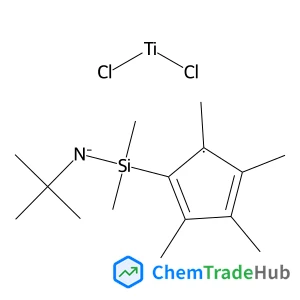
2,3,4,5-TETRAMETHYLCYCLOPENTADIENEDIMETHYLSILYL-TERT-BUTYLAMIDO TITANIUM DICHLORIDE
CAS号:
135072-61-6
分子式:
C15H27Cl2NSiTi-
![(S,S)-2-{1-Carboxy-2-[3-(3,5-dichloro-benzyl)-3H-imidazol-4-YL]-ethylamino}-4-methyl-pentanoic acid structure](https://cnstatic.chemtradehub.com/structs/305/305335-31-3-1724.webp "(S,S)-2-{1-Carboxy-2-[3-(3,5-dichloro-benzyl)-3H-imidazol-4-YL]-ethylamino}-4-methyl-pentanoic acid structure")
推荐供应商








免责声明
本页面提供的学术期刊信息仅供参考和研究使用。我们与任何期刊出版商均无关联,也不处理投稿事宜。如有投稿相关咨询,请直接联系相关期刊出版商。
如发现页面信息有误,请发送邮件至 support@chemtradehub.com 联系我们。我们将及时核实并处理您的问题。