




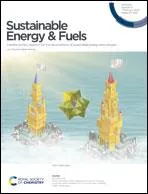
Proton transfer in microbial electrolysis cells
文献信息
发布日期
2017-02-15
DOI
10.1039/C7SE00034K
影响因子
6.367
作者
Alex J. Lewis
查看原文
摘要
Proton transfer and electron transfer are of prime importance in the development of microbial electrochemical cells. While electron transfer is primarily controlled by biology, proton transfer is controlled by process engineering and cell design. To develop commercially feasible technologies around the concept of a bioelectrochemical cell, real feedstocks have to be explored and associated limitations have to be identified. In this study, the proton transfer rate was quantified for a microbial electrolysis cell (MEC) and its dependence on process parameters was investigated using a proton balance model. The reaction system consisted of a biomass-derived pyrolytic aqueous stream as a substrate producing hydrogen in a flow-through MEC. The proton transfer rate increased with anode flow rate and organic loading rate up to a maximum of 0.36 ± 0.01 moles per m2 per h, equivalent to a hydrogen production rate of 9.08 L per L per day. Higher rates of hydrogen production, reaching 11.7 ± 0.2 L per L per day were achieved, when additional protons were provided via the cathode buffer. Electrochemical impedance spectroscopy shows that proton transfer was the dominant resistance in the production of hydrogen. The quantification of proton transfer rates for MECs with potential for biorefinery application and the demonstration of high hydrogen production rates approaching those required for commercial consideration indicate the strong potential of this technology for renewable hydrogen production. Understanding the transport phenomenon in bioelectrochemical cells is of great significance since these systems have potential for wide-ranging applications including energy production, bioremediation, chemical and nanomaterial synthesis, electro-fermentation, energy storage, desalination, and produced water treatment. Electron transfer in anode biofilms has been investigated extensively, but proton transfer studies are also important, since many cathodic half reactions require protons as the reactant. Determination of transport rates via proton balance was investigated in microbial electrolysis cells, which can be applied to other forms of microbial electrochemical systems. These systems have a unique niche in the development of future biorefineries as a means of recovering energy from waste streams with potential for water recycle, making them an integral part of the water–energy nexus focus area.
相关文献
Natural lignin nanoparticles: a promising nano-crosslinker for constructing fluorescent photoswitchable supramolecular hydrogels
Xue Liu, Shumin Dong, Zhijun Chen, Chao He, Yonghao Zheng
2020-01-28
Paper
DOI: 10.1039/C9PY01845J
Functionalization of triblock copolymer elastomers by cross-linking the end blocks via trans-N-alkylation-based exchangeable bonds
Mikihiro Hayashi
2020-02-20
Communication
DOI: 10.1039/C9PY01759C
An autonomously healable, highly stretchable and cyclically compressible, wearable hydrogel as a multimodal sensor
Jianfei Tie, Liduo Rong, Hongchen Liu
2019-12-24
Paper
DOI: 10.1039/C9PY01737B
Poly(diallyldimethylammonium) based poly(ionic liquid) di- and triblock copolymers by PISA as matrices for ionogel membranes
Jérémy Demarteau, Asier Fernandez de Añastro, Alexander S. Shaplov, David Mecerreyes
2019-12-10
Paper
DOI: 10.1039/C9PY01552C
Highly selective cis-1,4 copolymerization of dienes with polar 2-(3-methylidenepent-4-en-1-yl) pyridine: an approach for recyclable elastomers
Shiyu Long, Chunji Wu, Shihui Li, Changguang Yao, Hui Na, Dongtao Liu, Tao Tang
2020-01-14
Paper
DOI: 10.1039/C9PY01811E
Dynamic covalent bonds in self-healing, shape memory, and controllable stiffness hydrogels
M. Mario Perera, Neil Ayres
2020-02-03
Review Article
DOI: 10.1039/C9PY01694E
Ring opening copolymerization of ε-caprolactone and diselenic macrolide carbonate for well-defined poly(ester-co-carbonate): kinetic evaluation and ROS/GSH responsiveness
Jiahao Wang, Chuanhao Sun, Jieni Hu, Yanling Huang, Yunxiang Lu, Yan Zhang
2020-01-07
Paper
DOI: 10.1039/C9PY01788G
Synthesis and properties of poly(benzoxazole imide)s derived from two isomeric diamines containing a benzoxazole moiety
Yang Jiao, Guofei Chen, Nafeesa Mushtaq, Haijun Zhou, Xiaoqi Chen, Yantao Li, Xingzhong Fang
2020-01-31
Paper
DOI: 10.1039/C9PY01832H
Nitrilotriacetic acid-end-functionalized polycaprolactone as a template for polymer–protein nanocarriers
Leeja Jose, Aran Hwang, Chaeyeon Lee, KyuHwan Shim, Jae Kwang Song, Seong Soo A. An, Hyun-jong Paik
2020-01-10
Paper
DOI: 10.1039/C9PY01663E
您可能还喜欢
化合物问答
处理2-异丙基-5-羧基-1,3-二氧六环(CAS号:116193-72-7)时应注意哪些实验室安全事项?
处理2-异丙基-5-羧基-1,3-二氧六环时应注意以下安全事项:1. 戴上防护眼镜和手套,避免直接接触皮肤和眼睛。2. 在通风橱中操作,确保空气流通。3. 防止...
116193-72-72-Isopropyl-1,3-diox...
化合物问答
2-Hydroxy-N,N-dimethyl-2-phenylacetamide(CAS号:2019-71-8)的市场或研究趋势如何?
该化合物在制药和精细化工领域具有一定的应用,特别是在药物合成中作为中间体。随着环保意识的提高,市场对更安全、更环保的化学品的需求增加,因此该化合物的研究趋势倾向...
2019-71-82-Hydroxy-N,N-dimeth...
化合物问答
4-(1H-吡唑-3-基)哌啶(CAS号:278798-08-6)应用于哪些行业?
4-(1H-吡唑-3-基)哌啶在医药领域有潜在应用,可用于合成药物中间体。此外,在聚合物和传感器领域也有一定的应用前景,可以作为功能材料的一部分。
278798-08-64-(1H-Pyrazol-3-yl)p...
化合物问答
什么是三氯噻嗪(CAS号:133-67-5)?
三氯噻嗪是一种化学物质,其英文名称为6-Chloro-3-(dichloromethyl)-3,4-dihydro-2H-1,2,4-benzothiadiaz...
133-67-56-Chloro-3-(dichloro...
化合物问答
阿螺旋霉素(CAS号:467214-20-6)通常如何合成?
阿螺旋霉素的合成通常采用生物发酵技术,首先从特定的链霉菌提取前体物质,然后通过一系列化学修饰步骤,如酰胺化、环化等,最终得到阿螺旋霉素。常用的催化剂包括有机酸等...
467214-20-6Alvespimycin Hydroch...
化合物问答
什么是2-(二甲基氨基)-5-硝基苯甲酸(CAS号:4405-28-1)?
2-(二甲基氨基)-5-硝基苯甲酸是一种化学化合物,其分子式为C9H11N2O4。该化合物具有一定的生物活性和化学性质,常用于医药、农药及研究领域。
4405-28-12-(Dimethylamino)-5-...
化合物问答
1-苯基-1H-吡唑-4-甲酸甲酯(CAS号:7188-96-7)应用于哪些行业?
1-苯基-1H-吡唑-4-甲酸甲酯主要应用于医药行业,用作合成其他药物的中间体。此外,它还可能在聚合物、传感器等领域有应用。
7188-96-7Methyl 1-phenyl-1h-p...
化合物问答
1-(三异丙基甲硅烷基氧基)环丙烷羧酸甲酯(CAS号:83010-83-7)应用于哪些行业?
该化合物主要用于有机合成中间体领域,特别是在医药合成中作为关键中间体。它也可用于聚合物合成和传感器材料制备。由于其特殊的环丙烷结构和甲硅烷基氧基团,它在半导体材...
83010-83-77-Methoxy-8-nitroqui...
215319-47-4Balanophonin, (+)-
化合物问答
如何处理含有对甲苯氧基乙酸肼(CAS号:36304-39-9)的废料?
含有对甲苯氧基乙酸肼的废料应首先通过中和或沉淀等方法进行预处理,以降低其毒性。然后,可以采用焚烧或交由专业废物处理公司进行安全处置。根据当地法规和环境标准,务必...
36304-39-92-(4-Methylphenoxy)a...
来源期刊
推荐化合物
推荐供应商





免责声明
本页面提供的学术期刊信息仅供参考和研究使用。我们与任何期刊出版商均无关联,也不处理投稿事宜。如有投稿相关咨询,请直接联系相关期刊出版商。
如发现页面信息有误,请发送邮件至 support@chemtradehub.com 联系我们。我们将及时核实并处理您的问题。