










Gene expression data and FTIR spectra provide a similar phenotypic description of breast cancer cell lines in 2D and 3D cultures
文献信息
发布日期
2018-04-09
DOI
10.1039/C8AN00145F
影响因子
4.616
作者
Margarita Smolina, Erik Goormaghtigh
查看原文
摘要
Thirteen breast cancer cell lines were grown in traditional two-dimensional (2D) monolayer and three-dimensional (3D) laminin-rich extracellular matrix (lrECM) culture models. Microarray-based transcriptional profiling data were published for these cell lines under both culture conditions. Colonies embedded in Matrigel matrix were fixed in formalin, embedded in paraffin and cut into 4 μm thick sections. The sections were mounted onto infrared-transparent barium fluoride windows and deparaffinized for Fourier transform infrared (FTIR) imaging. Samples consisting of Matrigel-coated 2D-grown cells followed the same processing procedure, simplifying comparison with 3D-cultured cells as well as with routinely prepared formalin-fixed, paraffin-embedded tissue specimens. Gene expression was found to be dominated by the cell line genome. Cluster analysis first groups the same cell line samples, independent of whether cells have been grown in 2D or 3D cultures. FTIR spectroscopy first groups by culture conditions when considering the full spectrum length. The paper reports two important results. First, both gene expression level and FTIR spectroscopy are multivariate techniques that contain sufficient information to identify uniquely both any cell line (among thirteen breast cancer cell lines) and phenotype induced by growing the cells in 2D or 3D lrECM cultures. Second, we established the presence of a strong correlation between gene expression patterns and FTIR spectral data for the thirteen breast cancer cell lines grown in both 2D and 3D lrECM cultures. These results suggest that, although based on completely different principles, the two approaches describe similarly the patterns of variations in cells.
相关文献
Proton transfer in hydrogen-bonded pyridine/acid systems: the role of higher aggregation
Vytautas Balevicius, Ruta Bariseviciute, Kestutis Aidas, Ingrid Svoboda, Helmut Ehrenberg, Hartmut Fuess
2007-04-16
Paper
DOI: 10.1039/B701775H
Theoretical analysis of the potential distribution and transportation behavior of the ordered alkyl monolayer–silicon junction
Jianwei Zhao, Zhuangqun Huang, Xing Yin, Dongxu Wang, Kohei Uosaki
2006-11-14
Paper
DOI: 10.1039/B612818A
Semiconductor and ceramic nanoparticle films deposited by chemical bath deposition
2007-02-09
Invited Article
DOI: 10.1039/B616684A
A London-type formula for the dispersion interactions of endohedral A@B systems
Pekka Pyykkö, Cong Wang, Michal Straka, Juha Vaara
2007-05-22
Communication
DOI: 10.1039/B704695B
Effects of surface site distribution and dielectric discontinuity on the charging behavior of nanoparticles. A grand canonical Monte Carlo study
Marianne Seijo, Serge Ulrich, Montserrat Filella, Jacques Buffle, Serge Stoll
2006-11-14
Paper
DOI: 10.1039/B612118G
Direct observation of the solvent reorientation dynamics in the “twisted” intramolecular charge-transfer process of cyanophenyldisilane–water cluster by transient infrared spectroscopy‡
Haruki Ishikawa, Masuyuki Sugiyama, Wataru Setaka, Mitsuo Kira, Naohiko Mikami
2006-11-17
Paper
DOI: 10.1039/B612758D
Isothermal crystallization kinetics of in situ photo and thermo aged poly(ethylene oxide) using photoDSC
Frédéric Fraïsse, Jean-Marie Nedelec, Jean Pierre E. Grolier
2007-02-16
Paper
DOI: 10.1039/B618701C
您可能还喜欢
化合物问答
(5-氨基吡唑-3-基)乙酸(CAS号:174891-10-2)的物理化学性质是什么?
(5-氨基吡唑-3-基)乙酸是一种无色至白色固体,分子量为174.15 g/mol。它在水中具有较好的溶解性,在有机溶剂中的溶解度较低。该化合物具有较好的反应活...
174891-10-2(3-Amino-1H-pyrazol-...
化合物问答
3-氟-4,5-二氯苯胺(CAS号:35754-38-2)适用哪些法规指南?
3-氟-4,5-二氯苯胺受到多项法规指南的约束,包括但不限于GHS(全球化学品统一分类和标签制度)的危险分类标准、欧盟的REACH法规(注册、评估、授权和限制)...
35754-38-23,4-Dichloro-5-fluor...
化合物问答
什么是(R)-(+)-2,2',6,6'-四甲氧基-4,4'-联(二(3,5-二甲苯基基)膦基)-3,3'-二联吡啶(CAS号:442905-33-1)?
这是一种有机化合物,化学名为(R)-(+)-2,2',6,6'-四甲氧基-4,4'-联(二(3,5-二甲苯基基)膦基)-3,3'-二联吡啶,CAS号为44290...
442905-33-14,4'-Bis[bis(3,5-dim...
化合物问答
1-氨基-2-氰基萘(CAS号:3100-67-2)应用于哪些行业?
1-氨基-2-氰基萘在医药、聚合物、传感器和半导体等行业中有应用。在医药领域,它可用作中间体合成某些药物。在聚合物行业,它可以用于制备具有特定性能的聚合物。此外...
3100-67-21-Amino-2-naphthonit...
化合物问答
如何处理含有1-溴-4-(异丙氧基甲基)苯(CAS号:98446-84-5)的废料?
处理含1-溴-4-(异丙氧基甲基)苯的废料时,首先应确保废液收集在防渗漏的容器中,避免泄露。然后,可以考虑采用化学降解法或物理吸附法进行处理。在特定条件下,可通...
98446-84-51-Bromo-4-(isopropox...
化合物问答
6-Chloro-8-(trifluoromethyl)chroman-4-one(CAS号:1344889-75-3)的主要用途是什么?
6-氯-8-三氟甲基-2,3-二氢-4H-色喃-4-酮主要用于有机合成中的中间体,也可作为研究试剂使用。
1344889-75-36-Chloro-8-(trifluor...
化合物问答
7-乙氧基-2-萘酚(CAS号:57944-44-2)通常如何合成?
7-乙氧基-2-萘酚通常通过N-乙氧基化反应合成,首先将2-萘酚与乙醇钠在乙醇中反应生成7-乙氧基-2-萘酚钠盐,再通过酸化进一步得到7-乙氧基-2-萘酚。该合...
57944-44-27-Ethoxy-2-naphthol
化合物问答
4-(1,1-二氧硫代吗啉)丁醇(CAS号:59801-41-1)适用哪些法规指南?
该化合物需遵循一系列的法规指南,包括但不限于GHS全球统一分类和标签制度,其分类可能包括易燃液体和可能危害水生环境。在欧洲,还需遵循REACH法规,确保物质和混...
59801-41-14-(4-Hydroxybutyl)th...
化合物问答
4-甲氧基苄基叠氮甲酸酯(CAS号:25474-85-5)的物理化学性质是什么?
4-甲氧基苄基叠氮甲酸酯是一种无色液体,具有一定的挥发性。其分子量为198.16,熔点为-69°C,沸点为105°C。该化合物在水中溶解度较低,在有机溶剂如乙醇...
25474-85-54-Methoxybenzyl carb...
化合物问答
如何处理含有4-氯-2-氟嘧啶(CAS号:51422-00-5)的废料?
含有4-氯-2-氟嘧啶的废料应按照危险废物处理。首先,应收集并分类这些废料,避免与其他废物混合。然后,可以采用焚烧处理或者交由专业机构进行处置。在处理过程中,需...
51422-00-54-Chloro-2-fluoropyr...
来源期刊
Analyst

CiteScore:
7.8
自引率:
5.6%
年发文量:
653
Analyst publishes analytical and bioanalytical research that reports premier fundamental discoveries and inventions, and the applications of those discoveries, unconfined by traditional discipline barriers.
推荐化合物
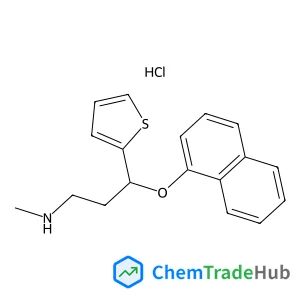
N-Methyl-3-(1-naphthyloxy)-3-(2-thienyl)-1-propanamine hydrochloride (1:1)
CAS号:
1188266-11-6
分子式:
C18H20ClNOS
![1-{3-[4-Amino-3-(4-phenoxyphenyl)-1H-pyrazolo[3,4-d]pyrimidin-1-yl]-1-piperidinyl}-2,3-dihydroxy-1-propanone structure](https://cnstatic.chemtradehub.com/structs/122/1226872-27-0-e037.webp "1-{3-[4-Amino-3-(4-phenoxyphenyl)-1H-pyrazolo[3,4-d]pyrimidin-1-yl]-1-piperidinyl}-2,3-dihydroxy-1-propanone structure")
推荐供应商





免责声明
本页面提供的学术期刊信息仅供参考和研究使用。我们与任何期刊出版商均无关联,也不处理投稿事宜。如有投稿相关咨询,请直接联系相关期刊出版商。
如发现页面信息有误,请发送邮件至 support@chemtradehub.com 联系我们。我们将及时核实并处理您的问题。