








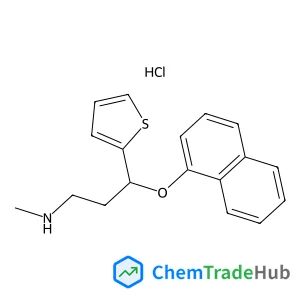
N-Methyl-3-(1-naphthyloxy)-3-(2-thienyl)-1-propanamine hydrochloride (1:1)
CAS号:
1188266-11-6
分子式:
C18H20ClNOS
Shanliang Song, Yuping Zhang, Yizhou Yang, Chuanxi Wang, Ying Zhou, Chuan Zhang, Yueqi Zhao, Minghui Yang, Quan Lin
A fast, sensitive, and convenient dual-emission water detector was robustly fabricated. This detector was prepared with blue fluorescent carbon dots (CDs) and red fluorescent Cu nanoclusters (NCs), and showed two well-resolved and intensity-comparable fluorescence peaks under a single excitation wavelength. Moreover, it showed strong red fluorescence in organic solvent due to the aggregation-induced emission enhancement (AIEE) properties of the Cu NCs, but the red fluorescence was gradually quenched with an increasing amount of water, whereas the blue fluorescence remained constant. The differences in response result in a continuous fluorescence color change from red to blue that can be clearly observed by the naked eye. Thus, as-prepared Cu NC-based dual-emission nanomaterials can be used for ratiometric fluorescence detection of trace amounts of water in organic solvents by taking advantage of the water sensitivity of their fluorescence intensity ratios (red/blue) and their low detect limits (<0.02% v/v). These studies demonstrate that a novel and sensitive dual-emission ratiometric water detector has been found, which shows promise for application in environmental monitoring, food inspection, and life science.
DOI: 10.1039/B700044H
Manuel J. Louwerse, Evert Jan Baerends
DOI: 10.1039/B613182D
Orlando J. Rojas, Cosima Stubenrauch
DOI: 10.1039/B610295F
Th. Emmler, I. Shenderovich, Y. Zeng, G. H. Findenegg, G. Buntkowsky
DOI: 10.1039/B617744A
Sumeet Mahajan, Mamdouh Abdelsalam, Yoshiro Suguwara, Suzanne Cintra, Andrea Russell, Jeremy Baumberg, Philip Bartlett
DOI: 10.1039/B611803H
Alexey Ponomaryov, Galina Gumenchuk, Elena Savchenko
DOI: 10.1039/B616441B
Sebastian Sinnecker, Marco Flores, Wolfgang Lubitz
DOI: 10.1039/B612568A
David Jewitt, Ralf I. Kaiser
DOI: 10.1039/B700814G
Alexander Kyrychenko, Randolph P. Thummel, Jacek Waluk, Bernhard Brutschy, Jerzy Herbich
DOI: 10.1039/B703908E
(5-氨基吡唑-3-基)乙酸是一种无色至白色固体,分子量为174.15 g/mol。它在水中具有较好的溶解性,在有机溶剂中的溶解度较低。该化合物具有较好的反应活...
3-氟-4,5-二氯苯胺受到多项法规指南的约束,包括但不限于GHS(全球化学品统一分类和标签制度)的危险分类标准、欧盟的REACH法规(注册、评估、授权和限制)...
这是一种有机化合物,化学名为(R)-(+)-2,2',6,6'-四甲氧基-4,4'-联(二(3,5-二甲苯基基)膦基)-3,3'-二联吡啶,CAS号为44290...
1-氨基-2-氰基萘在医药、聚合物、传感器和半导体等行业中有应用。在医药领域,它可用作中间体合成某些药物。在聚合物行业,它可以用于制备具有特定性能的聚合物。此外...
处理含1-溴-4-(异丙氧基甲基)苯的废料时,首先应确保废液收集在防渗漏的容器中,避免泄露。然后,可以考虑采用化学降解法或物理吸附法进行处理。在特定条件下,可通...
6-氯-8-三氟甲基-2,3-二氢-4H-色喃-4-酮主要用于有机合成中的中间体,也可作为研究试剂使用。
7-乙氧基-2-萘酚通常通过N-乙氧基化反应合成,首先将2-萘酚与乙醇钠在乙醇中反应生成7-乙氧基-2-萘酚钠盐,再通过酸化进一步得到7-乙氧基-2-萘酚。该合...
该化合物需遵循一系列的法规指南,包括但不限于GHS全球统一分类和标签制度,其分类可能包括易燃液体和可能危害水生环境。在欧洲,还需遵循REACH法规,确保物质和混...
4-甲氧基苄基叠氮甲酸酯是一种无色液体,具有一定的挥发性。其分子量为198.16,熔点为-69°C,沸点为105°C。该化合物在水中溶解度较低,在有机溶剂如乙醇...
含有4-氯-2-氟嘧啶的废料应按照危险废物处理。首先,应收集并分类这些废料,避免与其他废物混合。然后,可以采用焚烧处理或者交由专业机构进行处置。在处理过程中,需...

Analyst publishes analytical and bioanalytical research that reports premier fundamental discoveries and inventions, and the applications of those discoveries, unconfined by traditional discipline barriers.
![(2R,6S)-6-[(Benzyloxy)methyl]-4-{[(2-methyl-2-propanyl)oxy]carbonyl}-2-morpholinecarboxylic acid structure](https://cnstatic.chemtradehub.com/structs/109/1093085-91-6-3382.webp "(2R,6S)-6-[(Benzyloxy)methyl]-4-{[(2-methyl-2-propanyl)oxy]carbonyl}-2-morpholinecarboxylic acid structure")
![5'-Fluoro-[2,3'-biindolinylidene]-2',3-dione structure](https://cnstatic.chemtradehub.com/structs/251/251903-00-1-9cb1.webp "5'-Fluoro-[2,3'-biindolinylidene]-2',3-dione structure")
![1-(1-Benzyl-1,2,3,6-tetrahydropyridin-4-yl)-1H-benzo[d]imidazol-2(3H)-one structure](https://cnstatic.chemtradehub.com/structs/603/60373-71-9-7dfb.webp "1-(1-Benzyl-1,2,3,6-tetrahydropyridin-4-yl)-1H-benzo[d]imidazol-2(3H)-one structure")



