





Aptamer immobilization on amino-functionalized metal–organic frameworks: an ultrasensitive platform for the electrochemical diagnostic of Escherichia coli O157:H7
文献信息
发布日期
2018-06-05
DOI
10.1039/C8AN00725J
影响因子
4.616
作者
Saba Ranjbar
查看原文
摘要
Herein, we report the development of an electrochemical biosensor for Escherichia coli O157:H7 diagnostic based on amino-functionalized metal–organic frameworks (MOFs) as a new generation of organic–inorganic hybrid nanocomposites. The electrical and morphological properties of MOFs were enhanced by interweaving each isolated MOF crystal with polyaniline (PANI). Subsequent attachment of the amine-modified aptamer to the polyanilinated MOFs was accomplished using glutaraldehyde (GA) as a cross-linking agent. The prepared biocompatible platform was carefully characterized by means of field-emission scanning electron microscopy (FESEM), energy-dispersive spectroscopy (EDS), Fourier transform infrared spectroscopy (FT-IR), and X-ray powder diffraction (XRD) techniques. The biosensor fabrication and its electrochemical characterizations were monitored by cyclic voltammetry (CV) and electrochemical impedance spectroscopy (EIS) techniques. Differential pulse voltammetry (DPV) was applied to monitoring and quantitation of the interaction between the aptamer and E. coli O157:H7 using methylene blue (MB) as an electrochemical indicator. Changes in the reduction peak current of MB in the presence of E. coli O157:H7 was recorded as an analytical signal and indicated a relationship with the logarithm of the E. coli O157:H7 concentration in the range of 2.1 × 101 to 2.1 × 10⁷ CFU mL−1 with a LOQ of 21 CFU mL−1 and LOD of 2 CFU mL−1. The electrochemical aptasensor displayed good recovery values for the detection of E. coli O157:H7 in environmental real samples and also could act as a smart device to investigate the effects of antibacterial agents against E. coli O157:H7.
相关文献
Do defects in PAHs promote catalytic activity in space? Stone–Wales pyrene as a test case
Dario Campisi
2020-02-28
Paper
DOI: 10.1039/C9CP06523G
A phase-field model for the evaporation of thin film mixtures
Olivier J. J. Ronsin, DongJu Jang, Hans-Joachim Egelhaaf
2020-03-05
Paper
DOI: 10.1039/D0CP00214C
Shapes of epitaxial gold nanocrystals on SrTiO3 substrates
Peiyu Chen, Krishnan Murugappan, Martin R. Castell
2020-02-05
Paper
DOI: 10.1039/C9CP06801E
Statistical molecular fragmentation: which parameters influence the branching ratios?
Nguyen-Thi Van-Oanh
2019-11-27
Paper
DOI: 10.1039/C9CP05095G
Steady semiconducting properties of monolayer PtSe2 with non-metal atom and transition metal atom doping
Ranzhuo Huang, Tianxing Wang, Xianqi Dai, Shuyi Wei, Yaqiang Ma
2020-02-13
Paper
DOI: 10.1039/C9CP06249A
Large scale indium tin oxide (ITO) one dimensional gratings for ultrafast signal modulation in the visible spectral region
Michele Guizzardi, Silvio Bonfadini, Ilka Kriegel, Luigino Criante
2020-03-05
Paper
DOI: 10.1039/C9CP06839B
Identification of a receiver triplet state in the ultrafast intersystem crossing of carbonylpyrenes
Lekshmi R. S., Gayathri B. Kurup, Sivaranjana Reddy Vennapusa
2020-02-17
Paper
DOI: 10.1039/C9CP06857K
Real-time degradation dynamics of hydrated per- and polyfluoroalkyl substances (PFASs) in the presence of excess electrons
Sharma S. R. K. C. Yamijala, Ravindra Shinde, Bryan M. Wong
2020-01-22
Communication
DOI: 10.1039/C9CP06797C
Symmetry and 1H NMR chemical shifts of short hydrogen bonds: impact of electronic and nuclear quantum effects
Shengmin Zhou, Lu Wang
2020-01-08
Paper
DOI: 10.1039/C9CP06840F
您可能还喜欢
化合物问答
(5-氨基吡唑-3-基)乙酸(CAS号:174891-10-2)的物理化学性质是什么?
(5-氨基吡唑-3-基)乙酸是一种无色至白色固体,分子量为174.15 g/mol。它在水中具有较好的溶解性,在有机溶剂中的溶解度较低。该化合物具有较好的反应活...
174891-10-2(3-Amino-1H-pyrazol-...
化合物问答
3-氟-4,5-二氯苯胺(CAS号:35754-38-2)适用哪些法规指南?
3-氟-4,5-二氯苯胺受到多项法规指南的约束,包括但不限于GHS(全球化学品统一分类和标签制度)的危险分类标准、欧盟的REACH法规(注册、评估、授权和限制)...
35754-38-23,4-Dichloro-5-fluor...
化合物问答
什么是(R)-(+)-2,2',6,6'-四甲氧基-4,4'-联(二(3,5-二甲苯基基)膦基)-3,3'-二联吡啶(CAS号:442905-33-1)?
这是一种有机化合物,化学名为(R)-(+)-2,2',6,6'-四甲氧基-4,4'-联(二(3,5-二甲苯基基)膦基)-3,3'-二联吡啶,CAS号为44290...
442905-33-14,4'-Bis[bis(3,5-dim...
化合物问答
1-氨基-2-氰基萘(CAS号:3100-67-2)应用于哪些行业?
1-氨基-2-氰基萘在医药、聚合物、传感器和半导体等行业中有应用。在医药领域,它可用作中间体合成某些药物。在聚合物行业,它可以用于制备具有特定性能的聚合物。此外...
3100-67-21-Amino-2-naphthonit...
化合物问答
如何处理含有1-溴-4-(异丙氧基甲基)苯(CAS号:98446-84-5)的废料?
处理含1-溴-4-(异丙氧基甲基)苯的废料时,首先应确保废液收集在防渗漏的容器中,避免泄露。然后,可以考虑采用化学降解法或物理吸附法进行处理。在特定条件下,可通...
98446-84-51-Bromo-4-(isopropox...
化合物问答
6-Chloro-8-(trifluoromethyl)chroman-4-one(CAS号:1344889-75-3)的主要用途是什么?
6-氯-8-三氟甲基-2,3-二氢-4H-色喃-4-酮主要用于有机合成中的中间体,也可作为研究试剂使用。
1344889-75-36-Chloro-8-(trifluor...
化合物问答
7-乙氧基-2-萘酚(CAS号:57944-44-2)通常如何合成?
7-乙氧基-2-萘酚通常通过N-乙氧基化反应合成,首先将2-萘酚与乙醇钠在乙醇中反应生成7-乙氧基-2-萘酚钠盐,再通过酸化进一步得到7-乙氧基-2-萘酚。该合...
57944-44-27-Ethoxy-2-naphthol
化合物问答
4-(1,1-二氧硫代吗啉)丁醇(CAS号:59801-41-1)适用哪些法规指南?
该化合物需遵循一系列的法规指南,包括但不限于GHS全球统一分类和标签制度,其分类可能包括易燃液体和可能危害水生环境。在欧洲,还需遵循REACH法规,确保物质和混...
59801-41-14-(4-Hydroxybutyl)th...
化合物问答
4-甲氧基苄基叠氮甲酸酯(CAS号:25474-85-5)的物理化学性质是什么?
4-甲氧基苄基叠氮甲酸酯是一种无色液体,具有一定的挥发性。其分子量为198.16,熔点为-69°C,沸点为105°C。该化合物在水中溶解度较低,在有机溶剂如乙醇...
25474-85-54-Methoxybenzyl carb...
化合物问答
如何处理含有4-氯-2-氟嘧啶(CAS号:51422-00-5)的废料?
含有4-氯-2-氟嘧啶的废料应按照危险废物处理。首先,应收集并分类这些废料,避免与其他废物混合。然后,可以采用焚烧处理或者交由专业机构进行处置。在处理过程中,需...
51422-00-54-Chloro-2-fluoropyr...
来源期刊
Analyst

CiteScore:
7.8
自引率:
5.6%
年发文量:
653
Analyst publishes analytical and bioanalytical research that reports premier fundamental discoveries and inventions, and the applications of those discoveries, unconfined by traditional discipline barriers.
推荐化合物
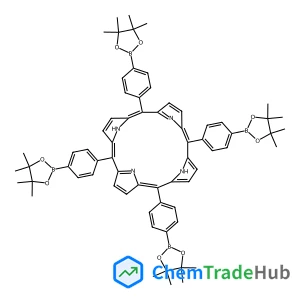
5,10,15,20-tetrakis(4-boronic acid pinacol ester phenyl) porphyrin
CAS号:
1332748-00-1
分子式:
C68H74B4N4O8
![6,7-Dihydro-5H-pyrrolo[1,2-a]imidazole-6-carboxylic acid structure](https://cnstatic.chemtradehub.com/structs/136/1369160-12-2-6524.webp "6,7-Dihydro-5H-pyrrolo[1,2-a]imidazole-6-carboxylic acid structure")
推荐供应商




免责声明
本页面提供的学术期刊信息仅供参考和研究使用。我们与任何期刊出版商均无关联,也不处理投稿事宜。如有投稿相关咨询,请直接联系相关期刊出版商。
如发现页面信息有误,请发送邮件至 support@chemtradehub.com 联系我们。我们将及时核实并处理您的问题。