




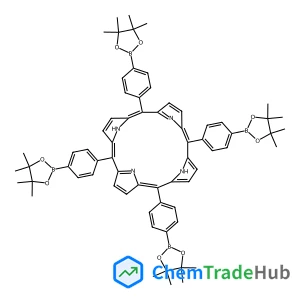
5,10,15,20-tetrakis(4-boronic acid pinacol ester phenyl) porphyrin
CAS号:
1332748-00-1
分子式:
C68H74B4N4O8
Ting-Jun Bi, Long-Kun Xu, Fan Wang, Xiang-Yuan Li
A self-consistent state specific (SS) method in the framework of TDDFT is presented to account for solvent effects on absorption and emission processes for molecules in solution. In these processes, the initial state is an equilibrium state, while the polarization of the solvent is in nonequilibrium with the electron density of the solute in the final state. Nonequilibrium solvation free energy is calculated based on a novel nonequilibrium solvation model with constrained equilibrium manipulation. The bulk solvent effects are considered using the polarizable continuum method (PCM), where the solvent–solute interaction is described with a reaction field. Molecular orbitals and orbital energies in the presence of the reaction field corresponding to the excited state are employed and the response of the solvent is not included in the TDDFT calculations. A self-consistent procedure is designed to obtain the excited state reaction field. The equations based on this new nonequilibrium solvation model in the framework of the self-consistent SS-PCM/TDDFT method for calculation of vertical absorption and emission energies are presented and implemented in the Q-Chem package. Vertical absorption and emission energies for several small molecules in solution using the newly developed code are calculated and compared with available experimental data and the results of other theoretical studies. Solvent shifts of absorption and emission energies are reasonably reproduced with this approach. The new model is a promising approach to study nonequilibrium absorption and emission processes in solution.
Eric R. Williams, Paige L. McMahon, Joseph E. Reynolds, III, Jonathan L. Snider, Vitalie Stavila, Mark D. Allendorf, Morgan Stefik
DOI: 10.1039/D1MA00146A
Rachel E. Sully, Hemda Garelick, Eriketi Z. Loizidou, Adrian G. Podoleanu, Vladimir Gubala
DOI: 10.1039/D1MA00135C
Paul N. Davey, Martyn J. Earle, Jennifer T. Hamill, Suhas P. Katdare, David W. Rooney, Kenneth R. Seddon
DOI: 10.1039/B915131A
Marija Petkovic, Jamie L. Ferguson, H. Q. Nimal Gunaratne, Rui Ferreira, Maria C. Leitão, Luís Paulo N. Rebelo
DOI: 10.1039/B922247B
Vivek Shukla, Ashish Bhatnagar, Satish K. Verma, Anant P. Pandey, Alok K. Vishwakarma, Pankaj Srivastava, T. P. Yadav, O. N. Srivastava
DOI: 10.1039/D1MA00012H
Qijun Meng, Hao Yang, Chang Liu, Yingzheng Li, Alexander Kravchenko, Xia Sheng, Lizhou Fan, Fusheng Li
DOI: 10.1039/D1MA00344E
Stefan Stürup, Lars Bendahl, Bente Gammelgaard
DOI: 10.1039/B514633J
Linmariya Devassy Koonathan, Suman Neogy, Anil K. Debnath, Soumyakanti Adhikari
DOI: 10.1039/D1MA00042J
Jutta Frank, Michael Krachler, William Shotyk
DOI: 10.1039/B514268G
Jason P. Hallett, Tom Welton
DOI: 10.1039/B918787A
8-溴-4-羟基-6-(三氟甲氧基)喹啉-3-羧酸乙酯应储存在阴凉、干燥的地方,避免光照和高温。建议使用密封容器进行储存,以防止水分和空气的影响。
2,2-二(2-呋喃基)丙烷的研究趋势主要集中在新型材料的开发和应用,如高分子材料、有机光电材料等。市场趋势方面,随着环保要求的提高和新材料的应用,该化合物的需...
对于含有螺[呋喃并[3,4-b]吡啶-5(7H),4'-哌啶]-7-酮盐酸盐的废料,应首先进行分类和分离,以减少危险物质的数量。随后,可以考虑通过化学氧化、生物...
Cinnamyl 3-氨基丁-2-烯酸在接触皮肤和眼睛时可能会引起刺激。应避免吸入其粉尘和烟雾。操作时应穿戴适当的个人防护装备,如手套、护目镜和实验室外套。
反式-2-十二碳烯二酸在医药、材料科学等领域有一定的应用,但其市场相对较小。近年来,由于环保意识的提升,对环境友好型化学品的需求增加,研究倾向于开发更绿色的合成...
(9ci)-1H-苯并咪唑-5-乙酸是一种含氮杂环化合物,其化学结构为1H-苯并咪唑-5-乙酸。该化合物具有特定的分子式C8H7NO2,属于有机酸类化合物。
酞菁蓝主要用作颜料和染料,广泛应用于塑料、油墨、涂料、纺织品及橡胶工业中。它也用于光敏材料,如太阳能电池和光刻胶。在医疗领域,酞菁蓝因其光敏特性被用于某些光动力...
5-甲基-1,2,3,4-四氢异喹啉在使用和储存时需要谨慎处理。它具有一定的毒性,应避免吸入其蒸气或直接接触皮肤和眼睛。操作此化合物时,建议佩戴防护眼镜、实验服...
含有3',4',5'-三甲氧基苯乙酮的废液应首先确保其是否为危险废物,根据当地法规确定处理方法。通常,这类有机废液可以采用中和反应降低其pH值,然后通过蒸馏或萃...
KI-7应储存在通风良好的干燥环境中,避免光照和高温。建议使用密封容器储存,并保持在阴凉处。储存温度应控制在室温范围内,一般建议不超过25°C。避免与氧化剂接触...

Physical Chemistry Chemical Physics (PCCP) is an international journal co-owned by 19 physical chemistry and physics societies from around the world. This journal publishes original, cutting-edge research in physical chemistry, chemical physics and biophysical chemistry. To be suitable for publication in PCCP, articles must include significant innovation and/or insight into physical chemistry; this is the most important criterion that reviewers and Editors will judge against when evaluating submissions. The journal has a broad scope and welcomes contributions spanning experiment, theory, computation and data science. Topical coverage includes spectroscopy, dynamics, kinetics, statistical mechanics, thermodynamics, electrochemistry, catalysis, surface science, quantum mechanics, quantum computing and machine learning. Interdisciplinary research areas such as polymers and soft matter, materials, nanoscience, energy, surfaces/interfaces, and biophysical chemistry are welcomed if they demonstrate significant innovation and/or insight into physical chemistry. Joined experimental/theoretical studies are particularly appreciated when complementary and based on up-to-date approaches.
![[3-(2,6-Dichlorophenyl)-5-isopropyl-1,2-oxazol-4-yl]methanol structure](https://cnstatic.chemtradehub.com/structs/278/278597-30-1-5c79.webp "[3-(2,6-Dichlorophenyl)-5-isopropyl-1,2-oxazol-4-yl]methanol structure")