

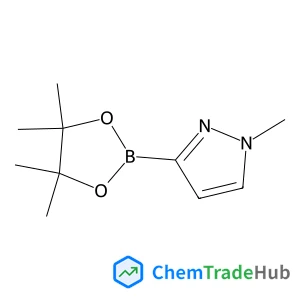
1-Methyl-3-(4,4,5,5-tetramethyl-1,3,2-dioxaborolan-2-yl)-1H-pyrazole
CAS号:
1020174-04-2
分子式:
C10H17BN2O2
Maria Eugenia Fortes Brollo, Patricia Hernández Flores, Lucía Gutiérrez, Christer Johansson, Domingo Francisco Barber, María del Puerto Morales
The aggregation processes of magnetic nanoparticles in biosystems are analysed by comparing the magnetic properties of three systems with different spatial distributions of the nanoparticles. The first one is iron oxide nanoparticles (NPs) of 14 nm synthesized by coprecipitation with two coatings, (3-aminopropyl)trimethoxysilane (APS) and dimercaptosuccinic acid (DMSA). The second one is liposomes with encapsulated nanoparticles, which have different configurations depending on the NP coating (NPs attached to the liposome surface or encapsulated in its aqueous volume). The last system consists of two cell lines (Pan02 and Jurkat) incubated with the NPs. Dynamic magnetic behaviour (AC) was analysed in liquid samples, maintaining their colloidal properties, while quasi-static (DC) magnetic measurements were performed on lyophilised samples. AC measurements provide a direct method for determining the effect of the environment on the magnetization relaxation of nanoparticles. Thus, the imaginary (χ′′) component shifts to lower frequencies as the aggregation state increases from free nanoparticles to those attached or embedded into liposomes in cell culture media and more pronounced when internalized by the cells. DC magnetization curves show no degradation of the NPs after interaction with biosystems in the analysed timescale. However, the blocking temperature is shifted to higher temperatures for the nanoparticles in contact with the cells, regardless of the location, the incubation time, the cell line and the nanoparticle coating, supporting AC susceptibility data. These results indicate that the simple fact of being in contact with the cells makes the nanoparticles aggregate in a non-controlled way, which is not the same kind of aggregation caused by the contact with the cell medium nor inside liposomes.
Sergiu Coseri, Gabriela Biliuta
DOI: 10.1039/C7PY01710C
Hideto Tsuji, Shotaro Sato, Noriaki Masaki, Yuki Arakawa
DOI: 10.1039/C7PY02024D
Haichang Zhang, Shuo Zhang, Yifan Mao, Kewei Liu, Yu-Ming Chen, Zhang Jiang, Joseph Strzalka, Wenjun Yang, Chien-Lung Wang, Yu Zhu
DOI: 10.1039/C7PY00616K
Victor R. De la Rosa, David Barker, Richard Hoogenboom
DOI: 10.1039/C7PY00919D
Maxime Colpaert, Sanjib Banerjee, Vincent Ladmiral, Taizo Ono, Bruno Améduri
DOI: 10.1039/C7PY02018J
Abhishek U. Shete
DOI: 10.1039/C7PY00623C
Bettina Olshausen, Kathryn E. Fairfull-Smith, Ute Schepers
DOI: 10.1039/C7PY01942D
Chao Yu, Pengfei Zhang, Fei Gao, Shaowen Zhang, Xiaofang Li
DOI: 10.1039/C7PY01915G
6-氯-2H-1,4-苯并噁嗪-3(4H)-酮主要应用于医药、农药和聚合物等领域。在医药领域,该化合物可用于合成抗菌药物;在农药领域,可用作杀虫剂的中间体;在聚...
活性氧化铝广泛应用于医药、聚合物、传感器、半导体和催化等领域。在医药行业,活性氧化铝用作吸附剂和干燥剂,有助于去除杂质和水分。在聚合物行业,它用作增白剂和抗结块...
硅胶(Silica gel, pptd.,cryst.-free)是一种无定形、多孔的硅酸盐材料,主要成分为二氧化硅(SiO₂)。其结构由硅氧四面体构成,通过酸...
二乙基甲基一氢硅烷主要用于有机合成、表面处理以及作为溶剂。它还被用作合成其他硅烷化合物的原料,以及在涂料、粘合剂和密封剂中的应用。
在合成过程中,可以考虑使用类似结构的化合物作为替代品,例如N-亚油酰基甘氨酸或N-花生二烯酰基甘氨酸。这些替代品在结构上有类似的双键位置,但可能具有不同的物理化...
在合成过程中,可以考虑使用类似结构的化合物作为替代品,例如1-(3-甲氧基苯基)丙烷-1,2-二酮或1-(4-羟基苯基)丙烷-1,2-二酮。这些替代品具有相似的...
该化合物通常通过一系列复杂的有机合成步骤获得。首先,通过芳香族化合物的羟基化反应获得羟基化产物,然后通过酰化反应形成酰胺中间体,最后通过环化反应得到目标产物。常...
该化合物作为生物活性化合物,尤其是在药物化学领域表现出色。近年来,随着对新型抗炎、抗病毒和抗癌药物的研究增加,其市场和研究趋势持续增长。此外,其在神经科学领域的...
核黄素磷酸钠在常规使用条件下安全,但高剂量可能引起刺激性反应。操作时需佩戴防护手套和护目镜,避免吸入粉尘。若接触皮肤或眼睛,应立即用大量清水冲洗。急救时需根据接...
盐酸丙胺卡因杂质A(EP) 标准品可通过重氮化反应和随后的酰胺化反应合成。首先,利用氯化反应将苯环上的氢原子转化为氯原子,然后通过芳香族重氮化反应引入氨基,最后...

Physical Chemistry Chemical Physics (PCCP) is an international journal co-owned by 19 physical chemistry and physics societies from around the world. This journal publishes original, cutting-edge research in physical chemistry, chemical physics and biophysical chemistry. To be suitable for publication in PCCP, articles must include significant innovation and/or insight into physical chemistry; this is the most important criterion that reviewers and Editors will judge against when evaluating submissions. The journal has a broad scope and welcomes contributions spanning experiment, theory, computation and data science. Topical coverage includes spectroscopy, dynamics, kinetics, statistical mechanics, thermodynamics, electrochemistry, catalysis, surface science, quantum mechanics, quantum computing and machine learning. Interdisciplinary research areas such as polymers and soft matter, materials, nanoscience, energy, surfaces/interfaces, and biophysical chemistry are welcomed if they demonstrate significant innovation and/or insight into physical chemistry. Joined experimental/theoretical studies are particularly appreciated when complementary and based on up-to-date approaches.
![[4-Amino-2-(methylsulfanyl)-5-pyrimidinyl]methanol structure](https://cnstatic.chemtradehub.com/structs/588/588-36-3-fc73.webp "[4-Amino-2-(methylsulfanyl)-5-pyrimidinyl]methanol structure")