






Computational studies of protein–protein dissociation by statistical potential and coarse-grained simulations: a case study on interactions between colicin E9 endonuclease and immunity proteins
文献信息
发布日期
2019-01-10
DOI
10.1039/C8CP05644G
影响因子
3.676
作者
Zhaoqian Su, Yinghao Wu
查看原文
摘要
Proteins carry out their diverse functions in cells by forming interactions with each other. The dynamics of these interactions are quantified by the measurement of association and dissociation rate constants. Relative to the efforts made to model the association of biomolecules, little has been studied to understand the principles of protein complex dissociation. Using the interaction between colicin E9 endonucleases and immunity proteins as a test system, here we develop a coarse-grained simulation method to explore the dissociation mechanisms of protein complexes. The interactions between proteins in the complex are described by the knowledge-based potential that was constructed by the statistics from available protein complexes in the structural database. Our study provides the supportive evidences to the dual recognition mechanism for the specificity of binding between E9 DNase and immunity proteins, in which the conserved residues of helix III of Im2 and Im9 proteins act as the anchor for binding, while the sequence variations in helix II make positive or negative contributions to specificity. Beyond that, we further suggest that this binding specificity is rooted in the process of complex dissociation instead of association. While we increased the flexibility of protein complexes, we further found that they are less prone to dissociation, suggesting that conformational fluctuations of protein complexes play important functional roles in regulating their binding and dissociation. Our studies therefore bring new insights to the molecule mechanisms of protein–protein interactions, while the method can serve as a new addition to a suite of existing computational tools for the simulations of protein complexes.
相关文献
Mass transfer considerations for monitoring catalytic solid–liquid interfaces under operating conditions
Laura Rodríguez-García, Roland Walker, Eyal Spier, Konrad Hungerbühler, Fabian Meemken
2017-12-18
Paper
DOI: 10.1039/C7RE00179G
Continuous microfluidic synthesis of colloidal ultrasmall gold nanoparticles: in situ study of the early reaction stages and application for catalysis
Ghazal Tofighi, Jan Pesek, Wu Wang, Ludger Schöttner, Günter Rinke, Roland Dittmeyer
2017-09-13
Paper
DOI: 10.1039/C7RE00114B
Merging of a chemical reaction with microbial metabolism via inverse phase transfer catalysis for efficient production of red Monascus pigments
Bin Gu, Haisheng Xie, Xuehong Zhang, Zhilong Wang
2019-06-07
Paper
DOI: 10.1039/C9RE00179D
Calcination kinetics of cement raw meals under various CO2 concentrations
Jose Ramon Fernandez, Sandra Turrado, Juan Carlos Abanades
2019-10-18
Paper
DOI: 10.1039/C9RE00361D
Continuous manufacturing of silver nanoparticles between 5 and 80 nm with rapid online optical size and shape evaluation
Bruno Pinho, Laura Torrente-Murciano
2019-12-06
Paper
DOI: 10.1039/C9RE00452A
Heterogeneous palladium-based catalyst promoted reduction of oximes to amines: using H2 at 1 atm in H2O under mild conditions
Yaxu Liu, Ziyi Quan, Shaopo He, Zexi Zhao, Jiang Wang
2019-03-22
Paper
DOI: 10.1039/C9RE00003H
Direct synthesis of acrylate monomers in heterogeneous continuous flow processes
Jatuporn Salaklang, Veronique Maes, Matthias Conradi, Rudy Dams
2017-12-04
Paper
DOI: 10.1039/C7RE00120G
Integrated continuous flow/batch protocol for the photoreduction of ortho-methyl phenyl ketones using water as the hydrogen source
Dnyaneshwar Aand, Bhushan Mahajan, Srihari Pabbaraja, Ajay K. Singh
2019-04-01
Communication
DOI: 10.1039/C9RE00110G
您可能还喜欢
化合物问答
2-(甲基磺酰基)嘧啶-5-胺(CAS号:56621-92-2)适用哪些法规指南?
该化合物适用的法规指南包括GHS(全球化学品统一分类和标签制度)分类为特定目标器官毒性-单次接触类别3;根据欧盟REACH法规,该化合物需要进行注册和评估;在美...
56621-92-22-(Methylsulfonyl)py...
化合物问答
在合成中是否有4-(4-氯苯基)-1H-咪唑(CAS号:35512-29-9)的替代品?
在合成中,可以考虑使用一些类似的化合物作为4-(4-氯苯基)-1H-咪唑的替代品,如4-(4-溴苯基)-1H-咪唑或4-(4-甲氧基苯基)-1H-咪唑。这些化合...
35512-29-94-(4-Chlorophenyl)-1...
化合物问答
什么是N~2~-甲基丙氨酸酰胺(CAS号:32012-16-1)?
N~2~-甲基丙氨酸酰胺是一种有机化合物,其化学名为2-(Methylamino)propanamide。它是一种酰胺类化合物,分子式为C4H10N2O,相对分...
32012-16-12-(Methylamino)propa...
化合物问答
如何处理含有N-苄基-3-氨基氧杂环丁烷草酸盐(CAS号:1956341-96-0)的废料?
处理含有N-苄基-3-氨基氧杂环丁烷草酸盐(CAS号:1956341-96-0)的废料时,应首先确保遵循相关法规要求,如GHS和REACH等。通常,废液应先进行...
1956341-96-0N-Benzyloxetan-3-ami...
化合物问答
4-bromo-2-chloro-6-methylbenzoic acid(CAS号:877149-07-0)的物理化学性质是什么?
4-溴-2-氯-6-甲基苯甲酸是一种固体化合物,具有较高的熔点和较低的沸点。它的分子量为261.03 g/mol。该化合物在水中几乎不溶,在有机溶剂中溶解度适中...
877149-07-04-Bromo-2-chloro-6-m...
化合物问答
2-[(2,5-二氯-4-嘧啶)氨基]-N-甲基苯甲酰胺(CAS号:761440-08-8)通常如何合成?
该化合物通常通过缩合反应合成,典型的方法是将2,5-二氯嘧啶与N-甲基苯甲酰胺在碱性条件下进行偶联反应。常用的碱包括NaH、LDA等强碱。该合成路线具有较高的选...
761440-08-82-[(2,5-dichloropyri...
4752-10-71,4-Dichlorophthalaz...
化合物问答
在合成中是否有3,5-二溴-4-甲基苯胺(CAS号:13194-73-5)的替代品?
3,5-二溴-4-甲基苯胺在某些合成路线中可能没有直接替代品。然而,在某些应用场景下,可以考虑使用其他类似结构的化合物如3,5-二溴-4-硝基苯胺或3,5-二碘...
13194-73-53,5-Dibromo-4-methyl...
化合物问答
2-氯喹啉-4-羧酸甲酯(CAS号:62482-26-2)的主要用途是什么?
2-氯喹啉-4-羧酸甲酯主要用于有机合成和药物合成领域,作为中间体或原料。它在合成某些药物和染料时具有重要作用。此外,该化合物还可能用于某些特定的化学研究中。
62482-26-2Methyl 2-chloro-4-qu...
化合物问答
i>]吡啶(CAS号:474708-88-8)安全吗?
6-溴-8-氯咪唑[1,2-a]吡啶在操作过程中需要谨慎以确保安全。该化合物具有一定的毒性,吸入其蒸气或粉尘可能导致呼吸道刺激。处理时应佩戴适当的防护装备,如手...
474708-88-86-Bromo-8-chloroimid...
来源期刊
Physical Chemistry Chemical Physics

CiteScore:
5.5
自引率:
10.3%
年发文量:
3036
Physical Chemistry Chemical Physics (PCCP) is an international journal co-owned by 19 physical chemistry and physics societies from around the world. This journal publishes original, cutting-edge research in physical chemistry, chemical physics and biophysical chemistry. To be suitable for publication in PCCP, articles must include significant innovation and/or insight into physical chemistry; this is the most important criterion that reviewers and Editors will judge against when evaluating submissions. The journal has a broad scope and welcomes contributions spanning experiment, theory, computation and data science. Topical coverage includes spectroscopy, dynamics, kinetics, statistical mechanics, thermodynamics, electrochemistry, catalysis, surface science, quantum mechanics, quantum computing and machine learning. Interdisciplinary research areas such as polymers and soft matter, materials, nanoscience, energy, surfaces/interfaces, and biophysical chemistry are welcomed if they demonstrate significant innovation and/or insight into physical chemistry. Joined experimental/theoretical studies are particularly appreciated when complementary and based on up-to-date approaches.
推荐化合物
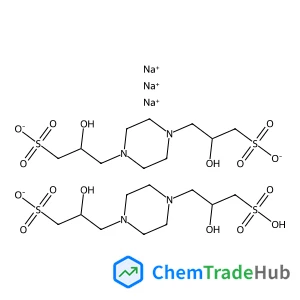
3,3'-(Piperazine-1,4-diyl)bis(2-hydroxypropane-1-sulfonic acid) Sodium Salt
CAS号:
108321-08-0
分子式:
C20H41N4Na3O16S4

推荐供应商





免责声明
本页面提供的学术期刊信息仅供参考和研究使用。我们与任何期刊出版商均无关联,也不处理投稿事宜。如有投稿相关咨询,请直接联系相关期刊出版商。
如发现页面信息有误,请发送邮件至 support@chemtradehub.com 联系我们。我们将及时核实并处理您的问题。