









![2,4-Dichloro-6-isopropyl-5H-pyrrolo[3,4-d]pyrimidin-7(6H)-one structure](https://cnstatic.chemtradehub.com/structs/107/1079649-94-7-ad4a.webp "2,4-Dichloro-6-isopropyl-5H-pyrrolo[3,4-d]pyrimidin-7(6H)-one structure")
Multiplexing cytokine analysis: towards reducing sample volume needs in clinical diagnostics
文献信息
发布日期
2019-04-18
DOI
10.1039/C9AN00297A
影响因子
4.616
作者
Daniel Scott, Smita Joel
查看原文
摘要
The trend for improved more precise diagnostics and management of disease heavily relies on the measurement of panels of biomarkers in physiological samples of patients. Ideally, the ultimate goal would be to detect as many clinically relevant biomarkers as possible in a single drop of blood, achieving quick, sensitive, reproducible, and affordable detection in small volume physiological samples. Bioluminescent (BL) proteins provide many of the desired characteristics required for such labels, including detection at extremely low concentrations, no interference from physiological fluids leading to excellent detection limits, and compatibility with many miniaturized systems. However, to date the use of BL proteins has been restricted by their limited multiplexing capabilities. BL proteins typically exhibit a single emission profile and decay kinetics making the simultaneous detection of multiple analytes difficult. Recent progresses in this area include the use of two different engineered luminescent proteins to achieve resolved signals via one-dimensional time resolution. This approach, however, to date only lead to a dual analyte detection. Herein, we have demonstrated that using a two-dimensional approach that combines both temporal and spatial resolution, we can expand the multiplexing capabilities of bioluminescent proteins. To that end, the photoprotein aequorin (AEQ) has been employed for the simultaneous detection of three separate analytes in a single well, differentiated through the use of three discrete time/wavelength windows. Through a combination of site-specific mutations and synthetic coelenterazines “semi-synthetic” AEQ variants have been developed with altered emission profiles and decay kinetics. In this study, two AEQ mutant proteins were genetically conjugated to three pro-inflammatory cytokines (tumor necrosis factor alpha, interleukins 6 and 8) resulting in AEQ-labeled cytokines. These fusion proteins were combined with synthetic coelenterazines resulting in proteins with differing emission maxima and half-lives to allow for the simultaneous detection of all three cytokines in a single sample. The validity of the assay was demonstrated in serum by employing human physiological samples and comparing our results with commercially available individual tests for each of the three cytokines.
相关文献
Molecular dynamics simulations of alkaline earth metal ions binding to DNA reveal ion size and hydration effects
Makenzie Provorse Long, Serra Alland, Madison E. Martin, Christine M. Isborn
2020-02-20
Paper
DOI: 10.1039/C9CP06844A
On the development of a gold-standard potential energy surface for the OH− + CH3I reaction
Domonkos A. Tasi, Tibor Győri, Gábor Czakó
2020-01-27
Communication
DOI: 10.1039/C9CP07007A
Surface plasmon resonance study of the interaction of N-methyl mesoporphyrin IX with G-quadruplex DNA
M. Perenon, H. Bonnet, T. Lavergne, J. Dejeu, E. Defrancq
2020-02-06
Paper
DOI: 10.1039/C9CP06321H
Pressure-induced non-innocence in bis(1,2-dionedioximato)Pt(ii) complexes: an experimental and theoretical study of their insulator–metal transitions
Helen Benjamin, Jonathan G. Richardson, Stephen A. Moggach, Sergejs Afanasjevs, Lisette Warren, Mark R. Warren, David R. Allan, Carole A. Morrison, Konstantin V. Kamenev, Neil Robertson
2020-03-05
Paper
DOI: 10.1039/C9CP06749C
Co-deposition of gas hydrates by pressurized thermal evaporation
Alexander Ostermann, Tobias M. Gasser, Thomas Loerting, Jörg Petrasch
2020-02-11
Paper
DOI: 10.1039/C9CP04735B
Water plays a dynamical role in a hydrogen-bonded, hexameric supramolecular assembly
Ankita Katiyar, Julia C. Freire Sovierzoski, Paul B. Calio, Anthony A. Vartia, Ward H. Thompson
2020-02-24
Paper
DOI: 10.1039/C9CP06874K
Electronic properties of bare and functionalized two-dimensional (2D) tellurene structures
Daniel Wines, Jaron A. Kropp, Gracie Chaney, Can Ataca
2020-03-09
Paper
DOI: 10.1039/D0CP00357C
您可能还喜欢
化合物问答
(5-氨基吡唑-3-基)乙酸(CAS号:174891-10-2)的物理化学性质是什么?
(5-氨基吡唑-3-基)乙酸是一种无色至白色固体,分子量为174.15 g/mol。它在水中具有较好的溶解性,在有机溶剂中的溶解度较低。该化合物具有较好的反应活...
174891-10-2(3-Amino-1H-pyrazol-...
化合物问答
3-氟-4,5-二氯苯胺(CAS号:35754-38-2)适用哪些法规指南?
3-氟-4,5-二氯苯胺受到多项法规指南的约束,包括但不限于GHS(全球化学品统一分类和标签制度)的危险分类标准、欧盟的REACH法规(注册、评估、授权和限制)...
35754-38-23,4-Dichloro-5-fluor...
化合物问答
什么是(R)-(+)-2,2',6,6'-四甲氧基-4,4'-联(二(3,5-二甲苯基基)膦基)-3,3'-二联吡啶(CAS号:442905-33-1)?
这是一种有机化合物,化学名为(R)-(+)-2,2',6,6'-四甲氧基-4,4'-联(二(3,5-二甲苯基基)膦基)-3,3'-二联吡啶,CAS号为44290...
442905-33-14,4'-Bis[bis(3,5-dim...
化合物问答
1-氨基-2-氰基萘(CAS号:3100-67-2)应用于哪些行业?
1-氨基-2-氰基萘在医药、聚合物、传感器和半导体等行业中有应用。在医药领域,它可用作中间体合成某些药物。在聚合物行业,它可以用于制备具有特定性能的聚合物。此外...
3100-67-21-Amino-2-naphthonit...
化合物问答
如何处理含有1-溴-4-(异丙氧基甲基)苯(CAS号:98446-84-5)的废料?
处理含1-溴-4-(异丙氧基甲基)苯的废料时,首先应确保废液收集在防渗漏的容器中,避免泄露。然后,可以考虑采用化学降解法或物理吸附法进行处理。在特定条件下,可通...
98446-84-51-Bromo-4-(isopropox...
化合物问答
6-Chloro-8-(trifluoromethyl)chroman-4-one(CAS号:1344889-75-3)的主要用途是什么?
6-氯-8-三氟甲基-2,3-二氢-4H-色喃-4-酮主要用于有机合成中的中间体,也可作为研究试剂使用。
1344889-75-36-Chloro-8-(trifluor...
化合物问答
7-乙氧基-2-萘酚(CAS号:57944-44-2)通常如何合成?
7-乙氧基-2-萘酚通常通过N-乙氧基化反应合成,首先将2-萘酚与乙醇钠在乙醇中反应生成7-乙氧基-2-萘酚钠盐,再通过酸化进一步得到7-乙氧基-2-萘酚。该合...
57944-44-27-Ethoxy-2-naphthol
化合物问答
4-(1,1-二氧硫代吗啉)丁醇(CAS号:59801-41-1)适用哪些法规指南?
该化合物需遵循一系列的法规指南,包括但不限于GHS全球统一分类和标签制度,其分类可能包括易燃液体和可能危害水生环境。在欧洲,还需遵循REACH法规,确保物质和混...
59801-41-14-(4-Hydroxybutyl)th...
化合物问答
4-甲氧基苄基叠氮甲酸酯(CAS号:25474-85-5)的物理化学性质是什么?
4-甲氧基苄基叠氮甲酸酯是一种无色液体,具有一定的挥发性。其分子量为198.16,熔点为-69°C,沸点为105°C。该化合物在水中溶解度较低,在有机溶剂如乙醇...
25474-85-54-Methoxybenzyl carb...
化合物问答
如何处理含有4-氯-2-氟嘧啶(CAS号:51422-00-5)的废料?
含有4-氯-2-氟嘧啶的废料应按照危险废物处理。首先,应收集并分类这些废料,避免与其他废物混合。然后,可以采用焚烧处理或者交由专业机构进行处置。在处理过程中,需...
51422-00-54-Chloro-2-fluoropyr...
来源期刊
Analyst

CiteScore:
7.8
自引率:
5.6%
年发文量:
653
Analyst publishes analytical and bioanalytical research that reports premier fundamental discoveries and inventions, and the applications of those discoveries, unconfined by traditional discipline barriers.
推荐化合物
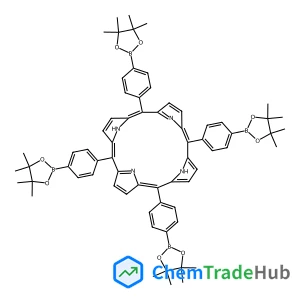
5,10,15,20-tetrakis(4-boronic acid pinacol ester phenyl) porphyrin
CAS号:
1332748-00-1
分子式:
C68H74B4N4O8
![N-{3-[Benzyl(methyl)amino]propyl}-9-chloro-5,6,7,8-tetrahydro-2-acridinecarboxamide structure](https://cnstatic.chemtradehub.com/structs/142/1426944-49-1-1e4c.webp "N-{3-[Benzyl(methyl)amino]propyl}-9-chloro-5,6,7,8-tetrahydro-2-acridinecarboxamide structure")
推荐供应商





免责声明
本页面提供的学术期刊信息仅供参考和研究使用。我们与任何期刊出版商均无关联,也不处理投稿事宜。如有投稿相关咨询,请直接联系相关期刊出版商。
如发现页面信息有误,请发送邮件至 support@chemtradehub.com 联系我们。我们将及时核实并处理您的问题。